Friday, August 23, 2013

The Years-Long Story of Iraqi Kurdistan's Oil Trucked to Iran


August 23, 2013

BEIRUT, Lebanon The dispute between Erbil and Baghdad with reference to the energy riches located in the territory of the Kurdistan Regional Government (the K.R.G.) does not let up. In the last months the quarrel between the two parties has been centered around three main points or at least these were the relevant issues which reached the headlines. In decreasing order of importance these are the three contending points:

A) Negotiating and Signing Energy Deals Within the K.R.G. Territory  Baghdad affirms that it alone has the right to negotiate and sign energy deals for the whole Iraqi territory, the K.R.G. included, while since a couple of years Erbil has been on a deal-signing spree with around 40 international oil companies (I.O.C.s). Considering that within the K.R.G. recent data speak about the presence of 45 billion barrels of oil, i.e., one-third of Iraq's proven reserves (proven reserves are those with a 90 percent certainty of being produced at current prices with current commercial terms and government consent  they are known in the industry also as 1P) which are estimated at 150 billion barrels and that the K.R.G. has 3 to 6 trillion cubic meters of potential gas reserves, it's clear the importance of controlling these resources.

B) The Pipeline Between the K.R.G. and Turkey  Erbil and Ankara are building in three different phases a soon-to-be-completed pipeline system for crude oil (it is due to be ready by the end of this year) that will bypass proper Iraq. This pipeline could be linked up to the existing Kirkuk-Ceyhan Pipeline, which is instead controlled by the Iraqi central government. The first phase connecting the Taqtaq Field to the Khurmala Field is already operational and has an initial capacity of 150,000 bbl/d. The second phase, which is also completed, concerns the conversion to an oil pipeline of a previously planned gas pipeline from Khurmala to Dohuk and has an initial capacity of 300,000 bbl/d. The third and final step will be, it's currently under construction, a pipeline between Dohuk and Fishkabur, which is on the Turkish border. It will have an initial capacity of 300,000 bbl/d.  But Kurdish government sources affirm that by 2015 following the installations of pumping stations the pipeline to Fishkabour will have a capacity of 1 million bbl/d.

C) Trucking the K.R.G. Oil and Condensate to Turkey  According to the latest data,  30,000 to 50,000 bbl/d are trucked from Kurdistan to Turkey. Of course, given the difficulties of trucking hydrocarbons, the concerned quantity is not huge, but with no doubt it starts to have a certain economic impact. In fact, the overall production of the K.R.G. is around 300,000 bbl/d —  it is due to increase to 400,000 bbl/d by the end of 2013  and this means that currently more than 10 percent of this quantity is transported with trucks to Turkey.     

To these issues some industry sources since the end of last July/beginning of August have added a fourth one: 

D) Trucking the K.R.G. Oil to Iran  Also in this case there are some important geopolitical considerations involved in this activity. In fact, in addition to the quarrel between Erbil and Baghdad, trucking hydrocarbons to Iran means turning down and contravening Western countries' sanctions against Tehran. The West passed these sanctions as a response to Iran's attempts at developing a nuclear program.  

It's important to clarify once and for all one thing: This trucking activity between Iraqi Kurdistan and Iran is not new. Smuggling Iraqi Kurdistan's oil to Iran is an activity that has been around for the last years and that only at different intervals normally one time per year has reached the headlines to be immediately after consigned to oblivion for the following months.   


Photo of Ayman Oghanna for The New York Times (2010)

Once again this summer, industry sources affirmed that it seemed that Iraqi Kurdistan was continually (if not continuously) trucking domestic crude oil to a couple of Iranian ports, Bandar Abbas and Bandar Imam Khomeini. The first one is a port city located on the southern coast of Iran very close to the Strait of Hormuz, while the second one is a port city located in the northern part of the Persian Gulf close to the border with Iraq and in front of Kuwait. Then, from this two ports crude oil should be exported to Asia either after one stop in Fujairah (U.A.E.) or one stop at other ports in the Persian Gulf. A possible interpretation for understanding this second hydrocarbons route  the first route trucks hydrocarbons to Turkey  is that Erbil has to find a balance between its two powerful competing neighbors Turkey and Iran. For such small an entity like the K.R.G., at least for now, it's of paramount importance to maintain friendly relations in its neighborhood, especially in light of the strained relations it now has with Baghdad. 


BACCI-K.R.G.-Iran-and-then-Asia-Aug-2013

 
After the industry sources had voiced their comments, a source with the K.R.G Ministry of Natural Resources responded that the Kurdish government was absolutely not involved in these trucking operations to Iran. Moreover, what is exported is not crude oil, but black oil, which is any refined products that have less economic value than crude oil per unit price. In specific, added the source, this black oil going to Iran was a residue of the filtering process happening at the  Baiji refinery, located in proper Iraq. Baiji is a city in northern Iraq, approximately 130 miles north of Baghdad on the main road heading to Mosul. The city in the energy business is well known for its oil refinery, which is the largest in Iraq. In other words, at least according to Erbil, who is doing these trucking activities are only private companies that have previously contracted with Baghdad. Now this business has been going on in this way for years.

In reality, in what is today's Iraqi Kurdistan, the Kurds have been in this trucking business since the 1990s. They began more or less when economic sanctions were imposed upon Iraq following its August 1990 invasion of Kuwait. For this reason, it's very difficult to think that behind this trucking activity there can be only private companies working under a sort of commercial agreement with Baghdad. Over the last years not only has evidence been collected showing that the Kurdish authorities have been well aware of the smuggling, but also it's evident that they have facilitated it (surely the K.R.G. Natural Resource Ministry and the Finance Ministry). Summing up, the profits of the oil smuggling have been split between all the involved actors:

A) the two major parties in the K.R.G.: the Kurdistan Democratic Party (K.D.P.) and the Patriotic Union of Kurdistan (P.U.K.),
B) the energy companies working in the K.R.G. and
C) politicians in Baghdad.     
  
In other words, everyone has had a slice of the economic pie. This is also a good explanation of the low profile that the involved parties have given to this oil smuggling. In fact, at every outbreak of public resentment, the K.R.G. has always repeated the same story, i.e., that private companies were doing this business helped by the fact that Iraqi crude oil was subsidized and might be sold with good profits in neighboring Iran. Last year, Minister of Natural Resources Ashti Hawrami admitted that only fuel oil and byproducts like naphtha were transferred to Iran. This activity was related only to the K.R.G. oil processed at two privately owned refineries that supplied the local market and a power plant. For the minister, the profits of shipping fuel oil and byproducts to Iran were utilized simply to cover the costs incurred by the foreign companies working in the K.R.G. In fact, the Kirkuk-Ceyhan Pipeline, the main export route, was not always open because of the ongoing dispute between Iraqi Kurdistan and Iraq. Last but not least, the minister added that these revenues were separated from the K.R.G. finances and put into a separate account so that in the future they could be reconciled with Baghdad. And of course, the official political speech in the K.R.G. was repeating constantly that Erbil was committed  to stopping this business.  At the same time, in Iraq, the government of Prime Minister Nuri Kamal al-Maliki was menacing of cutting the K.R.G. budget, if this trucking route would not have stopped soon.  

Assessing the trucked quantity to Iran is not easy, the latest data give an amount as large  as 30,000 bbl/d. And it's not clear in what proportions this quantity is split between the two ports. But an initial consideration stands out immediately: Transporting via truck for long distances oil is not very economically viable.  Pipelines in the majority of cases are the only economical transportation means for oil in order to reach sea ports or the final centers of consumption. And this consideration is particularly true for remote oil fields and for land-locked areas. At this regard, last June the Manhattan Institute for Policy Research released a report where it underlined the fact that pipelines are the safest and most cost-efficient way of moving oil and gas and that a person is more likely to be struck by a lightning than to pass away in a pipeline-related accident. From this basic reflection, it's possible to understand that the business we are talking about between Iraqi Kurdistan and Iran is not a huge business, although it's a good business. 

At the moment there are two border gates between the K.R.G. and Iran, the Haji Omaran Border Gate (through the K.R.G. Road 3) and the Bashmeg Border Gate (through the K.R.G. Road 46). Both are located in the Sulaymaniyah Governorate. Reaching with trucks the two above-mentioned Iranian ports from the K.R.G. (let's assume from the Taqtaq oil field, using one of the above-mentioned border gates) and/or Iraq's Baija (if we give full credit to the K.R.G. authorities and we consider the trucking business as only a private activity) is indeed a long road.

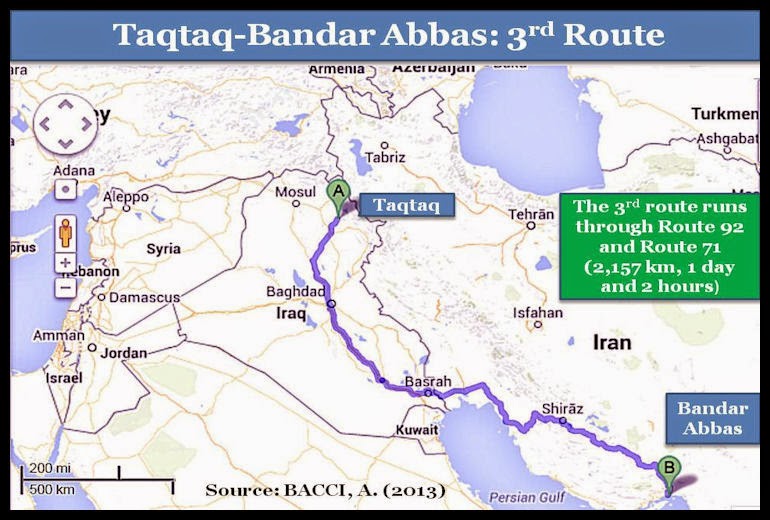
Let's consider the journey from the Kurdish oil fields to Iran's Bandar Abbas passing the frontier with Iran at the Bashmeg Border Gate (using instead of this the Haji Omaran Border Gate would not change consistently the substance). If trucks choose this road they will run Route 71, which after 1,954 kilometers and 21 hours and 48 minutes will take them to their final destination, Bandar Abbas. (For the sake of completeness, it's worth mentioning that there could be an almost identical journey via A-2 and Route 71. Through this second option, trucks would enter Iran at the Khanaquin Border Gate, east of the city of Samarra, in proper Iraq). Instead of crossing at the Bashmeg Border Gate (still not considering to pass through the Haji Omaran Border Gate or to do the journey via A-2 and Route 71) there are two other possible and really different alternatives: running through Route 92 (2,017 kilometers, 1 day and 1 hour) or running through a combination of Route 92 and Route 71 (2,157 kilometers, 1 day and 2 hours). These two alternatives, if almost equivalent in terms of kilometers and required time, involve traveling long distances within Iraq. In specific, the second one makes the trucks enter Iran approximately 250 kilometers south of the Bashmeg Border Gate (point to point). The third traveling option makes the trucks enter Iran even after Basra, in southern Iraq.  


BACCI-Taqtaq-BandarAbbas-1st-and-2nd-Route-Aug-2013


BACCI-Taqtaq-BandarAbbas-3rd-Route-Aug-2013


The involved distances would be more or less the same if trucks departed from Baiji, which is located only 172 kilometers southeast of the Taqtaq area. In fact, from Baiji to Bandar Abbas there are two options: the first one through Route 71 (2,055 kilometers, 22 hours and 26 minutes) entering Iran at the Khanaquin Border Gate (east of the city of Samarra) and the second one through Route 92 (2,024 kilometers, 23 hours and 35 minutes) entering Iran after Basra. It should be noted that according to Google Map navigator from Baiji, going south, the natural entering point to Iran is always the Khanaquin Border Gate. And the same happens if the departing point were Kirkuk  that is on the road leading to the Bashmeg Border Gate (moreover, passing via the Khanaquin Border Gate could also be acceptable if trucks departed from Taqtaq because it would add only 100 kilometers and 1 hour than passing via the Bashmeg Border Gate through Route 71). In other words, following the K.R.G. official declarations (trucking is only related to black oil loaded at the Baiji's refinery) it's quite unusual that trucks completely loaded at the departing point (Baiji) have to travel north to cross into Iran at the Bashmeg Border Gate or even at the Haji Omran Border Gate which is even further north.  

  
BACCI-Border-Gates-from-Taqtaq-and-Baiji-Aug-2013


Anyway, putting aside logistics considerations, thinking of stopping this trucking activity, notwithstanding the sanctions versus Iran, is at least for now simply wishful thinking. According to Joel Wing, a long-time expert of Iraq:

...  there are no incentives for Kurdistan to stop it. First, the profits go directly to the two ruling parties, providing them with an independent source of funds outside of the portion of the budget they receive from Baghdad. The trade is also split up between the two with smuggling to Turkey dominated by the K.D.P., while the P.U.K. handles Iran. In turn, a percentage of the money goes to companies that are producing in Kurdistan.

The only solution for halting smuggling would be for Iraq to finally draft and sign the since-long-time-needed Federal Oil and Gas Law. But relations between Erbil and Baghdad have soured since last March when the Federal Government passed the 2013 Budget Law. Through this law the budget allocation for the K.R.G. was $3 billion short of what Erbil expected. Subsequently, the direct consequence of this federal law was the K.R.G. "Law of identifying and obtaining financial dues to the Kurdistan Region Iraq from federal revenue", a.k.a. the Financial Rights Law of April 2013. The aim of the law is to create a mechanism for establishing the amount Baghdad owes to Erbil and, especially, defining in the framework of the Iraqi Constitution a remedy if the central government does not transfer the established payments to Erbil. This remedy means in practice direct exports of oil and gas produced in Iraqi Kurdistan.

The central point is that considering the great turmoil in the Middle East  and of course in Iraq, a country that risks being fragmented into sub-states the Kurds have started to think of a possible secession from proper Iraq, and of course oil and gas are the tools in order to get to this result. Once Erbil abandons its semi-autonomous status for a possible journey toward independence, it will be very normal that it will develop its own foreign affairs agenda. And consequently that it will try to maintain political and economic relations with Turkey and Iran, two of the candidates as leading countries in the Middle East. In other words, the Kurds have to strike a balance. On the one side, the last 12 months have provided Erbil with leeway and blessing from Ankara in order to develop energy relations between Turkey and the K.R.G. notwithstanding Baghdad's and Washington's opposition  Ankara is strongly looking to diversify its oil and gas sources. On the other side, now Erbil would like to obtain a similar green light from Tehran. But because of the economic sanctions imposed on Iran, the process will be much slower. A final consideration: Smuggling hydrocarbons is only the initial step of a story that if continues in the long run, will unroll pipelines between the K.R.G. and Iran, similarly to what is currently happening between the K.R.G. and Turkey.    


Sunday, July 7, 2013

Video I - Part II - Chevron and Total Continue Investing in the K.R.G.

ALESSANDRO-BACCI-MIDDLE-EAST-Chevron-and-Total-Invest-in-the-KRG's-Energy-Sector-Jun-2013

Dear friends,

I would like to share with you the second part of a video that I have recently recorded. 

This video deals with the increased expansion of the investments carried out in the Kurdistan Regional Government (a.k.a. the K.R.G.) by international oil companies (I.O.C.s). In specific, I have tried to examine the different types of contracts offered by Erbil and Baghdad. In fact, in the K.R.G. there are today production sharing contracts (P.S.C.s), while in Iraq there are technical service contracts (T.S.C.s). The video is divided into two parts: Part I and Part II.

I hope you enjoy it. 

Kind regards,
Alessandro

For additional information about this topic please check my latest article in Alessandro Bacci's Middle East:


Video I - Part I - Chevron and Total Continue Investing in the K.R.G.

ALESSANDRO-BACCI-MIDDLE-EAST-Chevron-and-Total-Invest-in-the-KRG's-Energy-Sector-Jun-2013

Dear friends,

I would like to share with you the first part of a video that I have recently recorded. 

This video deals with the increased expansion of the investments carried out in the Kurdistan Regional Government (a.k.a. the K.R.G.) by international oil companies (I.O.C.s). In specific, I have tried to examine the different types of contracts offered by Erbil and Baghdad. In fact, in the K.R.G. there are today production sharing contracts (P.S.C.s), while in Iraq there are technical service contracts (T.S.C.s). The video is divided into two parts: Part I and Part II.

I hope you enjoy it. 

Kind regards,
Alessandro

For additional information about this topic please check my latest article in Alessandro Bacci's Middle East:


Friday, June 28, 2013

Chevron and Total Continue Investing in the K.R.G. A Brief Analysis of Baghdad's T.S.C.s vs. Erbil's P.S.C.s.


Friday, June 28, 2013

BEIRUT, Lebanon Production sharing contracts (P.S.C.s) between international oil companies (I.O.C.s) and the Kurdistan Regional Government (K.R.G.) continue to be signed notwithstanding the opposition of Iraq's central government, which instead signs only technical service contracts (T.S.C.s). Baghdad affirms that it alone has the right to negotiate and sign energy deals for the whole Iraqi territory, the K.R.G. included. Since U.S. ExxonMobil entered the K.R.G.'s energy sector in October 2011 at that time the company acquired six exploration blocks other major I.O.C.s have been investing in the semi-autonomous Kurdish region. Presently, there are in Iraqi Kurdistan around fifty international energy companies (among them four big names: U.S. ExxonMobil and Chevron, France's Total and Russia's Gazprom), which together have invested more or less $20 billion.


CHEVRON'S AND TOTAL'S RECENT ACTIVITIES IN THE K.R.G.
Approximately ten days ago Chevron and Total respectively announced that they had increased their activities in the K.R.G. In specific, on Monday, June 17, through a statement issued from Erbil, Chevron announced that it had signed an exploration deal  the third with Kurdish authorities in relation to the Qara Dagh field. This block is located in the southern part of the K.R.G. and totals about 860 square kilometers (or 332 square miles). "Chevron will acquire an interest in and operatorship of the Qara Dagh block production sharing contract from the Kurdistan regional government," the company said in the statement. The U.S. company was awarded the exploration deal last January, while, in July  2012, it had already acquired from India's Reliance Industries Ltd. an 80 percent stake in two blocks two (called Rovi and Sarta, with the related operational control) located north of the city of Erbil.


Almost in the same days, Total expanded its presence in the K.R.G. In fact, having purchased an 80 percent stake in the Baranan block (with the K.R.G. owning the remaining 20 percent), south of the city of Suleimaniya, Total now has four assets in the country. This block (a.k.a. K9) had been previously held by the Canadian oil and gas company Talisman Energy until it decided to hand over the acreage last year. In 2012, the French company purchased a 35 percent stake in the Harir and Safen exploration blocks in the Erbil-controlled territory, while at the same time it owns a minority interest in the Taza exploration block in the Kurdish province of Suleimaniya.

In dealing with Baghdad, the position of Chevron and that of Total in are different. In fact, if on the one side, the American company does not have any energy stake in central and southern Iraq, on the other side, the French company owns a stake in the Halfaya oil field in southern Iraq. In this regard, since last year Baghdad has warned Total requesting that it cancel or freeze its contracts with Erbil unless it wants to be forced to relinquish the Iraqi asset. Up to now, the company has continued to operate in the K.R.G. and in Iraq. The only measure implemented by Baghdad has been banning the two companies from future contracts in Iraq. Then, two events have changed the picture. First, last March Total was preselected with six other companies with reference to a call for bids in an oilfield in Nassiriya, in southern Iraq and second, still in March, ExxonMobil  announced its intention of increasing its investment in its West-Qurna-1 oilfield (a $50 billion investment) located in southern Iraq. From this two events, it's possible to understand that Baghdad does not have the upper hand. Indeed, it goes by itself that replacing big companies of the likes of  Total or ExxonMobil it's not an easy task. 

WHY INTERNATIONAL OIL COMPANIES ARE CHOOSING THE K.R.G. INSTEAD OF IRAQ?
In order to understand what is happening in Iraq and the K.R.G. at the level of energy deals, the real question to be answered is: Why are I.O.C.s all flocking to the K.R.G.? 
     
There are three main reasons for the I.O.C.s interest in Iraqi Kurdistan:

A) The presence of abundant energy reserves  Current Kurdish data speak about 45 billion barrels of oil, i.e., one-third of Iraq's proven reserves (proven reserves are those with a 90 percent certainty of being produced at current prices with current commercial terms and government consent, known in the industry also as 1P) which are estimated at 150 billion barrels. In other words, quantitatively (not qualitatively because Erbil has heavier oil) the K.R.G. could be another Libya. In addition to oil, the K.R.G. has from 3 to 6 trillion cubic meters (TCF) of potential gas reserves, as recently underlined in London by the minister of natural resources of the K.R.G., Ashti Hawrami, at the Iraq Petroleum Conference 2013 organized by C.W.C., a company specialized in the dissemination of the energy and infrastructure knowledge.  


The Minister of Natural Resources of the K.R.G., Ashti Hawrami
 
I.O.C.s invest where there are energy resources and especially considering the supermajors  they are accustomed to investing in so-called difficult countries and harsh environments. For instance, Lebanon  a troubled country whose recent history has always been entangled with Syria's (in the latter country there is an ongoing civil war, if not something more because of the external actors, which are involved in the warring operations within and outside the country. Up to know, there have been only sporadic spillovers of Syria's civil war into Lebanon) has recently been able to attract for the prequalification phase of its offshore gas exploration contracts forty-six I.O.C.s.   
    
B) Security and a safe business environment  The K.R.G. with no doubt offers now more security and a safer business environment (for instance: a modern and open investment law and a progressive hydrocarbons (oil and gas) law for the Kurdistan Region) than those present in Iraq. Moreover, during the last years Erbil has been able to implement progressive economic policies and to increase its government transparency. "The K.R.G. also remains committed to the criteria and goals of the Extractive Industries Transparency Initiative (E.I.T.I.) and last year submitted a full report on production and revenues", said Dr. Hawrami still at the Iraq Petroleum Conference 2013.

On the other hand, Iraq is a volatile and unstable country, where the Shia-led government had struggled to restore order until an increase of U.S. troops in late 2007 was able to push insurgents and militia out of the cities and provinces that they were trying to conquer. The row with the K.R.G. about the disputed territory, and in specific about the destiny of the ethnically mixed city of Kirkuk (around 1,000,000 inhabitants, although the figures are disputed, the population should consist of one-third Turkmen, one-third Kurds and one-third Arabs) with its hydrocarbon riches (the city sits on the second largest oil field in Iraq), has continually threatened to derail the peace progress. As a result, insurgents in Iraq continue using violence in order to undermine the government. And according to the United Nations (U.N.), May 2013, when more than 1,000 people were violently killed, has been the deadliest month since the sectarian slaughter of 2006-07.   
  
C) The K.R.G.'s P.S.C.s are more attractive for I.O.C.s than Iraq's T.S.C.s  Let's now examine the two different typologies of energy contracts used respectively in Iraq and the K.R.G. 

C1) Baghdad's T.S.C.s  Since 2008, Iraq's Ministry of Oil has tried to redevelop its energy reserves by bringing in the country top-notch foreign technology. And it has done so through a series of technical service contracts (T.S.C.s) in four bidding rounds (these service contracts have taken also other names like Development and Production Service Contracts or Exploration and Production Service Contracts, but the basic assumptions are quite similar). In practice, with T.S.C.s, I.O.C.s get only a small contribution per barrel while Iraq has full control and ownership of the resources. The companies have no right to lift, market or book reserves, plus they bear all the capital expenditures and financial risks.

Contracts linked to the first three bidding rounds, held in 2009, 2009 and 2010, had for the I.O.C.s an economic return that was not as high as expected and later some of  the companies tried to renegotiate or to cancel the contracts. In fact, the fees per barrel were as low as $1.15 to as high as $7.50. Plus, the fees were additionally reduced by a 25 percent fully carried state participation and by a 35 percent income tax. In the end, the government take in some cases was as high as 99 percent. Moreover, the barrel per fee was reduced by up to 70 percent as the R factor increased from 0.0 to 2.0 (the R factor is a sliding scale that employs a ratio of two numbers to determine a rate. In the oil and gas business the most common R factor is obtained dividing cumulative revenues by cumulative costs). For instance, ExxonMobil from the assigned supergiant West Qurna-1 (which is now producing about 500,000 barrels per day) earns $1.9 per barrel. The profit for the company is substantially fair, but the problem is the produced quantity. In fact, to recoup 30 to 35 percent of its initial investment it should produce 2 million barrels per day, which is not doable now. Plus, as an additional hurdle, the companies that signed these contracts have become entangled with bureaucratic hurdles. 

BACCI - Iraq's Results of the Four O&G Bidding Rounds


Summing up, the first three licensing rounds obtained mixed results for Iraq. According to some commentators, the first one was initially a failure with only the supergiant Rumaila oil field (17 billion barrels) awarded. Only through subsequent negotiations in the following year it was possible to award three fields that initially had not been not awarded: Zubair (4 billion barrels), Maysan (2.5 billion barrels), and West Qurna-1 (8.7 billion barrels). Through these additional negotiations it was redressed a licensing round that at the beginning had raised many questions and doubts. The second and third bidding rounds almost completely awarded their blocks even if bidding was in a certain way feeble. The only really important exception was in the second round the unsuccessful assignment of the East Baghdad oil field (8 billion barrels). But it this regard  and this supports Baghdad's decisions  it should be noted that at least with reference to the first three rounds the fields on offer were all pertaining to discovered areas (some of these were supergiant fields with more than five billion barrels of oil reserves). And this meant that the risk for the companies was very low.
 
The fourth bidding round (oil and gas) was held in 2012 and it was a complete failure. In fact, the dissatisfaction of I.O.C.s with the terms proposed by Iraq was well shown last year when this fourth energy auction ended with very few foreign investors bidding for the blocks. The result was just 3 blocks awarded out of 12 on offer (and 8 blocks did not even receive any bid).  

Why such a negative result? If the previous three licensing rounds had offered rights to immediately start production raising output at large- or medium-sized sites with proven reserves, the fourth round instead involved areas with undetermined levels of hydrocarbons. Besides, in the fourth round there was a new formula to calculate the fee per barrel. In practice, IOCs would have been paid the fee per barrel on the remaining production after having deducted costs (for instance, if total production was 1 million barrels and the contractor had spent $300,000 on a subcontractor, it would later receive payment only for the remaining production, i.e., 700,000 barrels). In the coming months Iraq will organize the fifth licensing round for oil exploration (ten blocks). It appears now that probably Baghdad will ease its contractual terms in order to lure consistently I.O.C.s and avoid another failure. 
  
C2) Erbil's P.S.C.s  In Iraqi Kurdistan the oil and gas contractual terms are quite different. Today's contracts date back to the compromises included in Iraq's Constitution of 2005. In specific, Erbil asserts that the Constitution gives it full authority to sign P.S.C.s with reference to future oil and gas fields (these are fields not yet discovered when the Constitution was signed eight years ago), shared authority  for the existing fields, and the right to export hydrocarbons produced within the K.R.G. borders. On the other side, Baghdad has a completely different view: All fields (existing and future) are supervised at the central level, the government retains the right to approve or reject any future P.S.C. and Baghdad must have full control over oil and gas exports. In order to try to overcome this impasse and given the long-dated incapacity of legislating the much needed Federal Oil and Gas Law, the K.R.G. in 2007 passed the Oil and Gas Law of the Kurdistan Region. Since then the K.R.G. has entered into P.S.C.s with I.O.C.s. Baghdad has immediately considered these contracts completely illegal and has refused to pay the K.R.G. the full value of the oil produced in Iraqi Kurdistan. Baghdad has been paying as a reimbursement only part of the cost oil to the I.O.C.s working in Iraqi Kurdistan. 


Following this move Erbil has not had the economic resources to pay the I.O.C.s  and has retaliated halting production from the K.R.G. It's important to know that based on their share of the Iraqi population, the K.R.G. is supposed to get 17 percent of national revenue. When last March 7, 2013, the federal government passed the 2013 Budget Law the agreed-upon allocation for the K.R.G. was $3 billion short of what Erbil expected. And the direct consequence of this federal law was the K.R.G. "Law of identifying and obtaining financial dues to the Kurdistan Region Iraq from federal revenue", a.k.a. the Financial Rights Law of April 2013. The aim of the law was to create a mechanism for the assessment of the amount Baghdad owed to Erbil and, especially, and for the definition, within the framework of Iraq's Constitution, of a remedy if the central government did not pay. This remedy meant direct exports of oil and gas produced in Iraqi Kurdistan. Currently, the K.R.G. Ministry of Finance affirms Baghdad's debt is as high as $20 billion of which $4 billion belongs to the I.O.C.s operating in the K.R.G.      
   
With P.S.C.s a contractor in general carries out all the investments and performs management implementing all the technical and operating services under the control of a state agency (many times a national oil company (N.O.C.)). Here the big difference with service agreements is that a contractor receives a share of production to recover its costs (cost oil). Subsequently, the I.O.C. will split the remaining production (profit oil) with the government to get its profits. Summing up, in a P.S.C.  the overall economic rent consists in general of five components:

1) Bonus (government share),
2) Royalty (government share),
3) Government's Profit Oil (government share),
4) Taxes (government share) and
5) Contractor's Profit Oil (contractor share)           

If it's true that the majority of the economic rent goes to the hosting government, it's also true that the contractor has the possibility of recovering all its costs (Exploration Costs, Development Costs and Operating Costs). In fact, Article 25.3 of the K.R.G. P.S.C.s format says that:

Subject to the provisions of this Contract, from the First Production in the Contract Area, the CONTRACTOR shall at all times be entitled to recover all Petroleum Costs incurred under this Contract, of up to [ ] percent ([ ]%) of Available Crude Oil ...

Plus, at the same time, in addition to recovering its costs, the contractor is entitled to obtain profit Oil. In fact, Article 26.2 of KRG's PSC says that:

From First Production and as and when Petroleum is being produced, the CONTRACTOR shall be entitled to take a percentage share of Profit Crude Oil and/or Profit Natural Gas, in consideration for its investment in the Petroleum Operations, which percentage share shall be determined in accordance with Article 26.5.

Why the K.R.G. is proposing P.S.C.s. is another good point to be raised. The reason is both based on economic and political assumptions. Erbil believes that economically speaking it has to develop its own economic agenda. Being linked to Baghdad means proceeding with a very slow pace and with unreliable economic gains postponed to future times. Iraq does remain now in dire conditions with huge security problems associated to a sectarian civil war that continues up to today and does not seem to abase. With reference to the energy sector, a national hydrocarbons law to date has not been passed and Iraq's bidding rounds, based on T.S.C.s, have been quite a failure. Moreover, Turkey is very interested into Erbil's energy riches and could be the customer permitting the K.R.G. to export its oil and gas. In other words, P.S.C.s with a more balanced revenue sharing mechanism, could be the right tool for developing in a fast manner a sector that until a few years ago (2006) had been practically nonexistent.  I.O.C.s have flocked to the K.R.G. without many doubts. If improved economic conditions will permit Erbil to create an independent state is another thing. But surely in Erbil many officials do not have positive ideas about Iraq's future. "Iraq is going to hell. If we cannot live together we must talk about something else. We Kurds are not part of the conflict between Shia and Sunnis. But if there is a fire in the house next door, it will burn you too in the end. And there is no fireman" said in an interview Fuad Hussein, an adviser to the president of the K.R.G., Massoud Barzani.         

CONCLUSION
To conclude our analysis of these two types of oil and gas contracts it should be underlined that there is no energy ontract that can really fit all the working possibilities. In fact, every contract suits different economic conditions, and it's important to strike a fair balance between I.O.C.s and the hosting state. A T.S.C. could be an acceptable contract when companies have to work in an environment where there are proved reserves and/or where the real activity is just related to a previously exploited field (for instance, a redevelopment activity). In this regard, Iraq's first three licensing rounds (and also the contracts related to fields not awarded with the first licensing round, which only later were awarded through private negotiations  see for instance West Qurna-1) have very tight conditions, but with the right amount of produced barrels (permitting a company to recoup its incurred costs) could well be profitable for the involved I.O.C.s. Things of course change if we consider areas with unproved reserves. In such a case, it's clear that contractual terms have to change if a government wants to avoid a bidding failure as Iraq's fourth oil and gas licensing round.