Monday, May 5, 2014

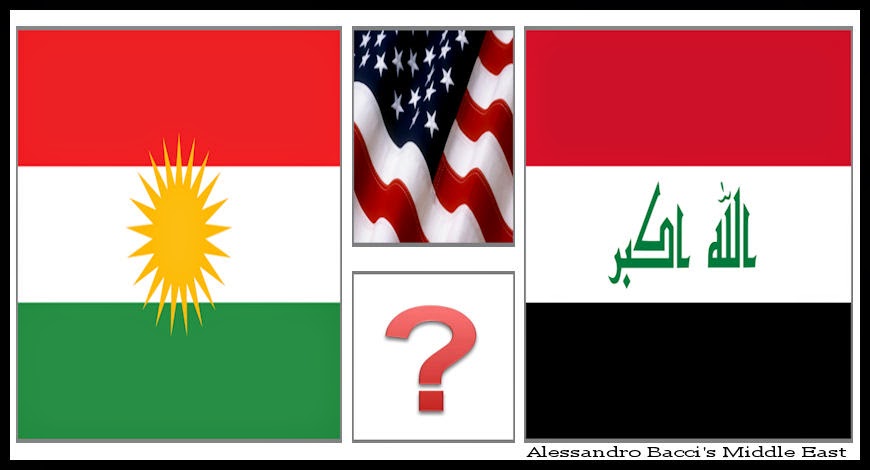
Confidential Memorandum (Fictional) — What Should the U.S. Position Be with Reference to the Current Tense Relations Between the K.R.G. and Iraq?

BACCI-Confidential-Memorandum-The-U.S.-Position-with-Reference-to-the-Dispute-between-the-K.R.G.-and-Iraq-May-2014


May 5, 2014


To:           The U.S. Department of State

From:     Alessandro Bacci, Energy Analyst (Middle East)  

Date:       May 5, 2014

Subject: What Should the U.S. Position Be with Reference to the Current Tense Relations between the K.R.G. and Iraq? 

BEIRUT, Lebanon — It is quite probable that independently of the results of Iraq's April 30, 2014, parliamentary elections and the subsequent political process of government formation, the road for political stability will not be easy for Iraq. Whatever will be the winning coalition — Prime Minister Nuri al-Maliki and his State of Law (SOL) coalition are likely to obtain a good result — it will be difficult to stabilize Iraq especially in a short- and medium-term horizon. With reference to the Iraqi Kurdish-Iraqi tense relations, which have worsened because Erbil intends to export its energy riches independently of Baghdad's authority, it is not easy to find a possible compromise. In addition, given this current standoff between Erbil and Baghdad, the former started to voice more loudly that energy revenues could permit the K.R.G. to secede from proper Iraq.

The U.S., for the time being, should continue not to favor any of the two involved actors. In fact, at the international level, the U.S. has always favored and prioritized political stability, from which it benefits greatly. The U.S. classic approach in a secessionist crisis consists of supporting "initially" the central states, which face a possible secession, and of shifting "only in a second time" the American support toward those secessionist movements that are able to guarantee the country's stability in the long run. This approach could work for Iraq as well. Instead, favoring Erbil or Baghdad could have unintended consequences, which are difficult to predict, at least for now. At this time, any U.S. direct involvement would be premature, especially in light of the fact that the K.R.G. is an autonomous region within Iraq and that as of yet it has not implemented any real secessionist activities. In practice, not choosing now one of the two sides could permit more leverage in the future.         

MAIN ACTORS IN THE DISPUTE BETWEEN THE K.R.G. AND IRAQ  

In addition to the two main actors, which are of course the K.R.G. and Iraq, there are four additional players with stakes in the dispute. They are: the United States, Turkey, Iran and Saudi Arabia. 

  • The K.R.G. wants at least more economic resources from Baghdad. Erbil is entitled to receive 17 percent of Iraq's national budget, but according to some Kurdish officials, in the past Baghdad paid only a little over 10 percent. Probably, the paid percentage should be around 14 percent, meaning approximately $15 billion. Political independence/the right of self-determination for the K.R.G. could be the step that follows an economic independence, which could be obtained through the direct export of Kurdish oil and gas reserves—with no ingerence from the federal government. Summing up, the failure of a democratic and unified Iraq, relevant export revenues through the northern export corridor and significant water resources could really push Erbil towards declaring secession.

  • Iraq needs to use all its efforts to maintain the control of the hydrocarbons present within the Iraqi territory, Iraqi Kurdistan included. Losing the control of the oil and gas reserves located in the K.R.G. would have relevant economic consequences for a country whose oil industry traditionally accounts for 95 percent of the government's revenues. Moreover, a possible secession of the K.R.G. could start a process of complete fragmentation of Iraq — which is already a country divided along sectarian lines: in the north the Kurds, in the south the Shiites and in the central western Iraq the Sunnis — where Baghdad could become a city-state. 

  • After the December 2011 withdrawal, the U.S. has seen its influence in Iraq partially reduced, but the U.S. is still the main trading partner of Iraq (25 percent of total exports and 6 percent of total imports). U.S. major oil companies play a relevant role in Iraq (ExxonMobil, Occidental Petroleum) as well as in the K.R.G. (ExxonMobil and Chevron). Political stability is America's main goal in the Middle East, which de facto is the cauldron of the rivalry between Shiites and Sunnis. With Syria on the path to being a broken state, the U.S. cannot accept the collapse of Iraq and the possible resurgence of Islamic fundamentalism across the Middle East.      

  • In the last years, Turkey has gained political authority in the Middle Eastern chessboard. The country has become an economic regional powerhouse and in consideration of its ballooning $60 billion energy bill (presently, it imports 92 percent of its oil and 98 percent of its gas) it is deeply interested in the K.R.G.'s energy riches. Erbil could also be a way to diversify from Russia and Iran. The Kurds have completed their own independent pipeline (the existing capacity is 300,000 barrels per day) from the Taq Taq oil field to Fishkhabur, close to the Turkish border. From there oil enters the Kirkuk–Ceyhan Pipeline and continues to Ceyhan. Ankara would like to avoid endangering its relations with Baghdad, but it is already a major investment and trading partner of the K.R.G.

  • Iran is the most influential foreign actor involved in the internal politics of Iraq. Tehran wants to preserve and expand the influence that it has gained after the fall of Saddam Hussein in all Iraq and to avoid any new sectarian Sunni-Shiite war. While Iran is boosting its economic relations and ties (pipelines) with the K.R.G., at the same time it fears a possible independence of the K.R.G. Such independence could provoke a messy fragmentation of Iraq where southern Iraq (and its oil reserves) will lean toward Iran, but while at the same time central western Iraq will become a stronghold of Sunni extremism — indeed, an outcome that Tehran wants to avoid.       

  • Since the 2003 regime change in Iraq, Saudi Arabia has opposed the Shia-dominated government in Baghdad and Mr. al-Maliki, in particular, whom Saudi Arabia sees as a sectarian leader. Riyadh fears that if the Kurds become independent, Iraq will be divided into three parts, of which southern Iraq, which is Shia-dominated and owns important oil riches, will end up under the Iranian sphere of influence. And later, southern Iraq could incite Shia people in Saudi Arabia and other Gulf countries against their rulers. Moreover, Saudi Arabia has no interest in seeing either the K.R.G. to develop as an energy hub or Iraq to become a swing producer menacing Saudi Arabia's role within OPEC. However, would an independent K.R.G. be part of OPEC?   

THE DRIVING FORCES 

The driving forces that have an impact on the dispute are three: the K.R.G.'s energy riches, Prime Minister Nuri al-Maliki of Iraq and the conflict in Syria. 

  • The K.R.G.'s energy riches are the tool that could permit Erbil to declare independence. Current data speak about 45 billion barrels of oil, i.e., one-third of Iraq's proven reserves, which are estimated at 143 billion barrels. In addition to oil, the K.R.G. has from 3 trillion cubic meters to 6 trillion cubic meters of potential gas reserves. The relations between Erbil and Baghdad have worsened since U.S. oil super major, ExxonMobil decided to start negotiating drilling contracts directly with the K.R.G. in 2011. On the one side, Baghdad affirms that it alone has the right to negotiate and sign energy deals for the whole territory of Iraq, the K.R.G. included. On the other side, Erbil insists that Iraq's constitution allows it to agree to contracts and, as a result, to ship oil independently of the central government. The legal framework is not clear while it is open to divergent interpretations. Once the K.R.G. production overpasses 500,000 barrels per day (right now its production hovers around 255,000 barrels per day) Erbil would be better off selling autonomously its oil than waiting for the 17 percent (or 14 percent) of Iraq's national budget.  

  • Notwithstanding the fact that, incumbent Prime Minister Nuri al-Maliki with his coalition will probably emerge as the largest winner in the election and that he will probably win a third term as prime minister, Mr. al-Maliki is a controversial figure. His re-election in 2010, as well as the refusal to call for a vote of no-confidence against him in 2012, was linked to strong Iranian support. However, at the same time, considering al-Maliki responsible, in light of his authoritarian methods, for the worsening of the ethnic tensions in Iraq, Iran would probably like to have an alternative — not available now — to Mr. al-Maliki, who defines himself more of a nationalist than just a Shia Muslim, and who is definitely not a puppet in Iranian hands. If re-elected he should transform his leadership from a divisive one into an inclusive one.

  • Syria, which since March 2011 has been experiencing an armed conflict between forces loyal to President al-Assad and anti-government groups that want to oust him, is indeed a destabilizing driving force in the region (especially in Lebanon and Iraq, the K.R.G. included). The relations between Baghdad and Damascus have recently improved in light of the growing danger of the Islamic fundamentalism in both countries. On the one side, a long-lasting civil war in Syria with the possibility of the fragmentation of Syria into three states along sectarian lines (Sunni, Shia and Alawite) could set the precedent for Iraq, which would follow suit. On the other side, for the time being, internal Kurdish rivalries have prevented Iraqi Kurds from adopting a common policy to help Syrian Kurds. In specific, the president of the K.R.G., Massoud Barzani cannot send fighters to the Syrian theater to help Syrian Kurds against the al-Assad regime because such a move would engender some problems with Iran.  
     
Robin-Wrights-Remapped-Middle-East
Source — The New York Times (September 2013)

THE TWO MOST CRITICAL UNCERTAINTIES 

BACCI-The-Two-Most-Critical-Uncertainties-May-2014

The two most critical uncertainties are:

  • 1) Whether the K.R.G. becomes independent or it continues to be a semi-autonomous region of Iraq. Economically speaking, in a short to medium time-frame the K.R.G. will be able to produce and export approximately 500,000 barrels per day, which are the barrels required to match the national budget quota Erbil receives from the federal government. In other words, the call for independence is getting stronger in Erbil — the K.R.G. is de facto autonomous. What is difficult to imagine is how the K.R.G. may be independent without creating a domino effect, which could bring about the fragmentation of Iraq and an epochal transformation of the Middle Eastern borders.  An Iraq formed by only southern Iraq (Shia), central and western Iraq (Sunni) and Baghdad as a city-state has very few chances to exist. As further proof of this difficult and precarious Iraqi political equilibrium, the 2010 elections are a good memento. In fact, in that occasion Mr. al-Maliki came in second to candidate Ayad Allawi and his Iraqiya list and only with the suport of the Kurds, Iran and the U.S. Mr. al-Maliki was able to form a government.              

  • 2) Whether the new Iraqi government is able to implement a political action aimed at unifying the country and not at dividing Iraq along sectarian lines? The winner of the 2014 elections will have to find a formula to implement a cross-sectarian policy. In other words, he will have to move from Mr. al-Maliki's current exclusionary practices to practices involving reconciliation and inclusiveness between the different ethnic groups. Is such a task doable? It is very difficult. Firstly, because it seems that Mr. al-Maliki will be the winner of the 2014 general elections. Moreover, Mr. al-Maliki since the American departure in December 2011 has implemented a policy of strong confrontation against the Sunny community and against the Kurds. Secondly, because it is not clear yet how many seats SOL will obtain — the majority to form a government is 167 seats. If SOL gets 60-90 seats, it's expected a long period of government formation — also in this case SOL's goal will be to obtain the post of prime minister — during which Mr. al-Maliki will act as caretaker prime minister. Instead, if SOL gets 90 seats or more, the process of government formation will be faster. In addition, this second scenario does not guarantee a reduction of Mr. al-Maliki's current political radicalization. In fact, an important victory could be understood as a mandate to crush the Sunni opposition with the result of increasing the onset of a new civil war.   
              
BACCI-The-Four-Scenarios-May-2014
         
FINAL RECOMMENDATION

Indeed, the U.S. is able either to favor the independence of the K.R.G. or to maintain the current status quo with the integrity of Iraq's territory. Nevertheless, it is not in the interest of the U.S. to take either decision given the current state of the affairs. The involved risks are too high. It is true that some American oil companies are operating in Iraq and/or the K.R.G., but these are I.O.C.s and not N.O.C.s so the U.S. government does not have the authority to direct their investments when they operate in foreign countries. Moreover, the U.S., which has historically imported from the Middle East no more than 15 percent of its oil supply (today 9 percent of its oil supplies) should perceive the importance of the stability of Iraq not for the oil supplies directed to the U.S., but for the overall stability of the Middle East. In fact, notwithstanding an American presence in Iraq from March 2003 to December 2011, Iraq is still on the verge of fragmentation. The U.S. has the power to sponsor the K.R.G.'s independence or Iraq's unity, but it does not have the power to stabilize a region where too many unintended consequences might soon emerge. If America's goal is the stability of the Middle East, it suits America a wait-and-see approach with reference to the quarrel between the K.R.G. and Iraq. 


Saturday, April 5, 2014

Alessandro Bacci’s Interview About Renewable Energy in the MENA Region With Al Mayadeen’s Economic Bulletin

Renewable Energy MENA Middle East ME Energy Al Mayadeen Economics  Alessandro Bacci’s Middle East


April 5, 2014 
Dear friends,

I would like to share with you my interview with Al Mayadeen's Economic Bulletin (الإقتصادية) on Saturday, April 5, 2014. The topic of the program was "renewable energy" in the MENA region.

I hope you enjoy it.

Best regards,

Alessandro  


Renewable Energy MENA Middle East ME Energy Al Mayadeen Economics  Alessandro Bacci’s Middle East

Renewable Energy MENA Middle East ME Energy Al Mayadeen Economics  Alessandro Bacci’s Middle East

Renewable Energy MENA Middle East ME Energy Al Mayadeen Economics  Alessandro Bacci’s Middle East

Alessandro Bacci’s Interview about Renewable Energy in the MENA Region with Al Mayadeen’s Economic Bulletin

Renewable Energy MENA Middle East ME Energy Al Mayadeen Economics  Alessandro Bacci’s Middle East

Renewable Energy MENA Middle East ME Energy Al Mayadeen Economics  Alessandro Bacci’s Middle East


Monday, March 31, 2014

Saudi Arabia's Crude Oil Exports to Asia Might Be Affected by the 2014 Crimean Crisis


March 31, 2014

BEIRUT, Lebanon  —  "Ever since the continents started interacting politically, some five hundred years ago, Eurasia has been the center of world power" said Polish-American political scientist Zbigniew Brzezinski in 1997 in his famous book The Grand Chessboard. Eurasia is the combined continental landmass of Europe and Asia. It's the earth's supercontinent. In fact, physical geography does not differentiate between Europe and Asia, even though the concepts of Europe and Asia as distinct continents have been around since antiquity. Eurasia covers an area around 36.2 percent of the earth's total land area, while it hosts 4.6 billion people, i.e., 72.5 percent of the world's human population. In The Grand Chessboard Brzezinski continued saying that the last decade of the twentieth century had witnessed an important shift in global affairs because "[f]or the first time ever, a non-Eurasian power ha[d] emerged non only as the key arbiter of Eurasian power relations but also as the world's paramount power". Since the end of the Cold War the United States has experienced the power of pre-eminence in Eurasia, which is the chessboard where the struggle for global primacy continues to be played. Now following recent events in Crimea and the possible sanctions that the West would like to impose on Russia, the geopolitical panorama in Eurasia might change ushering in an intensification of the political and economic (energy) relations between Russia and China (as well as other Asian countries). This adjustment could in turn partially create some modifications to the pattern of oil shipments from the Persian Gulf to China and other Asian energy-hungry countries. Also natural gas trade could similarly be affected, but this paper covers only the geopolitical issues linked to crude oil.

Casus Belli
The casus belli for these possible relevant changes in the geopolitical energy trends in Eurasia is linked to the 2014 Crimean crisis between Russia and Ukraine. The Crimean peninsula, which is the principal flashpoint in the 2014 Ukraine revolution, is a pro-Russia part of Ukraine, and it also hosts Russia's Black Sea Fleet. This peninsula has always gravitated in the orbit of Russia. It was absorbed into the Russian empire, together with the majority of the ethnic Ukrainian territory, by Catherine the Great in the 18th century. In 1954 the Crimea peninsula was transferred to the Ukrainian Socialist Soviet Republic within the Soviet Union (S.S.S.R.), and then in 1991 it became part of the independent Ukraine. The Crimean crisis unfolded in late February 2014 as a consequence of the Ukrainian revolution, which had culminated with the ousting of the then-President of Ukraine, Victor Yanukovych and the creation of an interim government. On February 26, pro-Russian forces started a process to took control of the Crimean peninsula. Subsequently, on March 11, the Supreme Council of Crimea and the City Council of the Sevastopol passed a joint resolution through which they expressed their intention that Crimea be independent from Ukraine and join the Russian Federation. On March 16, a referendum about this issue was held in Crimea. The result showed that 96 percent of the votes were in favor of independence — although this percentage was quite debated by those who opposed the referendum. The Ukrainian Parliament opposed this result, while the United States (U.S.) and the European Union (E.U.) declared the vote illegal. On March 18, basing his request on the international law principle of self-determination, Russian President Vladimir Putin claimed that Crimea was a part of the Russian Federation.

Sanctions Against Russia
China abstained from the United Nations Security Council (S.C.) resolution that declared the Crimean succession referendum illegal and Russia vetoed it. Instead, as a response to the crisis in Crimea, both the U.S. and the E.U. have imposed sanctions against persons who played a role in relation to the violation of Ukraine's sovereignty. Moreover, the U.S. has targeted Russia's Bank Rossiya, which the U.S. believes to have been used by Mr. Putin's inner circle. In addition to the sanctions ad personam the G-7 communiqué issued on Monday, March 24, 2014 called for Russia's suspension from the G-8 but not for its expulsion. On the European side an extension of the sanctions may be very complicated for two main points:

  • Some European countries strongly rely on Russia for their energy supplies (both oil and gas).
  • Some European countries have important overall trading relationships with Russia.


On the side of China, it's evident that Beijing is not inclined to pass sanctions against Russia in reason of at least three important points:

  • China always refrains from intervening (non-interference) in the internal affairs of other countries, lest it be questioned about its sovereignty.
  • Historically, Russia and China within the Security Council of the U.N. have always tried to develop a sort of mutual support notwithstanding the fact that many times they have seen issues through different perspectives*.
  • China imports energy from Russia, and, given its huge demand for energy, it would like to broaden consistently this trade relationship.

(*This Sino-Russian alignment is a way to counterbalancing the alignment between the three Western members of the S.C.: the U.S., France and the United Kingdom (U.K.).)

Also Japan and South Korea have taken a soft line versus Russia. Both countries need to maintain and probably to expand their energy relations with Russia. Indeed, they have now a strong interest in importing more liquefied natural gas (L.N.G.) — given the very high prices of L.N.G. in Asia.

It's out of the scope of this analysis to discuss about the legitimacy of Russia's actions in Crimea or about the legal grounds for the imposition of sanctions against Russia. Instead, the following paragraphs will cover China's third point, which was mentioned above, i.e., China's interest in expanding its energy relation with Russia In specific, attention will be given to the possible outcomes of the expansion of Sino-Russian energy relation for the Middle East.

Yet, concerning the sanctions one consideration stands out: Probably the only real sanction that could have an impact on Russia would be lifting the ban on the export of U.S. crude oil (Meghan L. O'Sullivan, A Better Energy Weapon to Stop Putin, Bloomberg, March 2014). Russia is vulnerable with reference to the price of oil. In fact, Russia's revenues from gas sales constitute only 8 percent to 9 percent of the national budget, while oil revenues accounts for 37 percent to 38 percent.  
  
The Importance of the Power of Alternatives in International Affairs and Especially With Reference to Energy Relations.
The game of chess has a certain resemblance to the moves and countermoves that the countries implement at the international level. When playing chess the objective of the game is to checkmate the opponent — although of course at the international level a win-win solution would be advisable.


Checkmate is a game position in chess in which a player's king is in check (threatened with capture) and there is no way to remove the threat. Checkmating the opponent wins the game. (Wikipedia)

Using the idea of the game of chess, it's interesting to note that possible sanctions against Russia would not corner Russia in check because Moscow would still have the power of alternatives, which in this case would have relevant implications for Asia's energy future. These alternatives pass through an improved energy relation with China. That Russia now needs an improved energy coordination with China and the other energy-hungry countries of East Asia and South Asia is the natural evolution of the incredible development that those two Asian areas have been witnessing in the last four decades. Russia is in a geographical position through which it could well serve with its precious commodities, oil and gas, both the left side (Europe) and the right side (East Asia and South Asia) of the Eurasian continent. Russia needs to diversify away from an excessive reliance on slow-growing and complicated European energy markets (oil and gas). This is a must for Russia, whose economic growth is primarily driven by energy exports. Utilizing the business concept of the Five Competitive Forces, which were elaborated by Harvard Business School's Professor Michael Porter, we could affirm that Russia has to increase its bargaining power as supplier.

Russia (Exporter) — Russia's Oil Exports Needs Diversification
According to P.F.C. Energy, a consultancy, in 2012 Russian oil and gas revenues accounted for 52 percent of the federal budget revenues and for over 70 percent of total exports. Russia is the world's third-largest producer of oil after Saudi Arabia and the U.S.. In 2012 its crude oil production averaged 10.5 million barrels per day (bbl/d). According to the U.S. Energy Information Administration (E.I.A.), in 2012 Russia exported about 7.4 million bbl/d of total liquid fuels (5 million bbl/d of crude oil and 2.4 million bbl/d of petroleum products).


Russia's main production areas are: western Siberia, which has an output of 6.4 million bbl/d, nearly two-thirds of Russia's total oil production, and Urals-Volga, which accounts for 22.4 percent of Russia's total output, i.e., 2.3 million bbl/d. The other Russian producing areas across the country have an output of 1.5 bbl/d equal to 15.3 percent of the country's output. In specific, the producing areas located in eastern Russia are the fields in eastern Siberia (which will have an important role in the future) and those in Sakhalin Island, which is off Russia's eastern shore. Still at an initial stage of development, the area Yamal Peninsula/Arctic Circle, which straddles western Siberia, is new to crude oil but if it solves some infrastructural problems it could serve both the European and the Asian markets — the latter could be served thanks to the already built Purpe-Samotlor Pipeline and to the planned Zapolyarye-Purpe Pipeline.    


As a consequence of the location of Russia's main production areas, still in 2012, the greater part (79 percent) of the crude oil exports was directed to European countries (including Eastern Europe), in specific to Germany, the Netherlands and Poland. Instead, approximately, 18 percent of crude oil went to Asia. 


More than 80 percent of Russian oil is exported via the Transneft pipeline system (88 percent of crude oil and 27 percent of oil products), while the remainder is shipped via rail or on vessels loading at independently owned terminals. Transneft is a Russian state-controlled company that has an extensive domestic distribution and export pipeline (the length of the main Transneft oil pipeline is about 43,495 miles). Of the main Russian pipelines only the Tengiz-Novorossiysk Pipeline is not controlled by Transneft. Among the controlled pipelines there is the Druzhba Pipeline, which is the world's longest oil pipeline (2,400 miles and a capacity of 2 million bbl/d) and has been servicing Europe for decades.


Of the nine Russian pipelines (one pipeline has only been proposed) showed in the table only three play a direct or indirect role as for Asia. They are:

  • Eastern Siberia-Pacific Ocean (ESPO) Pipeline (o.6 million bbl/d, direct export)
  • Purpe-Samotlor Pipeline (0.5 million bbl/d, indirect export)
  • Zapolyarye-Purpe Pipeline (proposed, capacity 0.9 million bbl/d, indirect export). 


Information about ESPO will be provided below in the following paragraph. Rail exports cover a very small portion of Russian oil exports. Oil is transported through rail along the coastline. Russia exports crude oil and petroleum products to Estonia and Latvia in the West and crude oil to Harbin, China, and to central China via Mongolia in the East.
 
Moreover, Russia has at least 18 ports from where it exports its oil to the rest of the world. Among them, eight ports stand out for their relevant their role. And among these eight ports, three are located in eastern Russia. They are:

  • Kozmino Bay in the far eastern Primorsky Province. Crude oil loaded at Kozmino Bay is previously transported via the ESPO pipeline and rail to the terminal. The port's initial capacity of 300,000 bbl/d will eventually be expanded to 1 million bbl/d.
  • De-Kastri in Russia's Far East, southwest of the Tatar Strait that separates Sakhalin Island from the Russian mainland. Its export capacity is 250,000 bbl/d. The harbor can accommodate Aframax tankers.
  • Prigorodnoye on Sakhalin Island on the Aniva Bay. The harbor is capable of loading 100 Aframax and 160 L.N.G. vessels each year.


Data are quite clear: Russia crude oil exports are leaning toward Europe much more than toward Asia, and this could be a dangerous condition for Russia in times when Europe has a reduced interest for Russia's energy sources — Europe's stance is guided by several factors: politics, environmental targets and the necessity of diversifying its energy supplies — if we use the same business jargon of Michael Porter's Five Competitive Forces we could say that Europe has to increase its bargaining power as buyer.   

China (Importer) — China Needs Oil
Currently, China is the world's second-largest oil consumer after the U.S. and in 2010 it became the largest energy consumer on a global scale. These results are quite astonishing because until the early 1990s China was still a net oil exporter. Oil in China is the second-largest source of energy (after coal) accounting for 18 percent of the country's total energy consumption. According to recent statistics by the Oil and Gas Journal (O.G.J.), the country holds 24.4 billion of barrels of proven reserves, which are the highest in the Asia-Pacific region. Over the last twenty years China has increased its oil and liquid production by approximately 54 percent, but, notwithstanding this production growth, the country has not been able to keep pace with the booming demand growth.

In 2013, China produced domestically an estimated 4.5 million bbl/d of total oil liquids (93 percent was crude oil), while in recent years the country's national oil companies have been in a spending spree linked to assets located abroad so as to secure additional oil supplies. In the last decade, China's national oil companies (N.O.C.s) have been active in the Middle East, North America, Latin America, Africa and Asia. "China's oil production from its overseas equity shares and acquisitions has grown significantly over the past decade from 140,000 bbl/d to an estimated 2 million bbl/d in 2012" has recently reported in its latest report on China the E.I.A.     


In 2013, the country consumed an estimated 10.7 million bbl/d (record highs). It's manifest that there is a considerable gap between the domestic and the overseas oil production on the one side, and the country's overall oil consumption on the other side. In 2013, on average China imported 5.6 million bbl/d — in practice oil imports now made up over 50 percent of total oil consumption. These barrels of imported oil come from different location, but the Middle East with 2.9 million bbl/d covers the lion's share of China's oil imports. Then, respectively follow Africa with 1.3 million bbl/d, the Americas 562,000 bbl/d, the Asia-Pacific region 129,000 bbl/d and 736,000 bbl/d from other countries. The following pie chart for year 2011 by the E.I.A. shows that out of a total of 2,525 bbl/d from the Middle East (Saudi Arabia, Iran, Oman, Iraq, Kuwait and the U.A.E.) in 2011 Saudi Arabia covered 40 percent of China's Middle Eastern oil imports. Recently, China has replaced the share of oil lost from Iran (international sanctions) Sudan and South Sudan (political conflicts between the two African countries) and Libya (domestic turmoil) with oil from other locations like the Middle East, Angola, Venezuela and Russia. Data from 2011 show that Russia shipped to China approximately 8 percent of China's overall crude oil imports.  


China has built three international oil pipelines connections with its neighboring countries so as to diversify its oil supply sources. They are:

  • The Kazakhstan–China Oil Pipeline — In 2006,  Beijing inaugurated its first transnational oil pipeline, which shipped Kazakh and Russian oil through a 1,384-mile-long pipeline (with a capacity of 240,000 bbl/d) from western  Kazakhstan (Atyrau) to Chinese Xinjiang (Alashankou). Currently, this pipeline is undergoing some expansion plans aiming at almost doubling the capacity by the end of 2014. Under consideration there is the possibility of another pipeline from Kazakhstan to China — this project should supply crude from Kazakhstan's oilfields in the Caspian Sea region. 


  • The Eastern Siberia-Pacific Ocean Pipeline (ESPO) — The 3,018-mile-long pipeline was constructed by Russia's Transneft, and it's a system to export Russian crude oil  from the oil fields in eastern Siberia to the Asia-Pacific markets (China, Japan and Korea). The pipeline runs from the Russian city of Taishet to the Pacific Coast. It was built in two stages. The first one consisted of a pipeline with a capacity of 600,000 bbl/d from Taishet to Skovorodino (Russia). From there, the China National Petroleum Corporation (C.N.P.C.) built a 597-mile-long pipeline to China's Daqing oilfield. This Skovorodino-Daqing pipeline became operational in January 2011 and now delivers up to 300,000 bbl/d of Russian oil to China (20-year supply contract). The construction of the second stage from Skovorodino to the Russian Pacific port of Kozmino, near Nakhodka, started after the launching of the first stage. Through the port of Kozmino Russia may export additional oil to China. Russia would like to expand the capacity of the Taishet-Skovorodino pipeline to 1.6 million bbl/d by 2018 and, consequently, to supply more oil to energy-hungry China. Until the ESPO spur to China is brought to full capacity, Russia's oil company Rosneft will ship to 140,000 bbl/d  of western Siberian oil to China through the Kazakhstan-China pipeline.  

   
  • The Sino-Burma Oil Pipeline — In march 2009 China and Burma signed an agreement for the construction of an oil pipeline between the two countries. This 479-mile-long pipeline will be of paramount importance for the Middle East's oil shipments to China. In fact, Persian Gulf's oil will be shipped to Burma (via sea tankers) and then to China (via pipeline) bypassing the choke point of the Strait of Malacca (until now 80 percent of China's oil imports has passed through this strait). The maximum capacity of this pipeline will be 440,000 bbl/d when it comes online later in 2014.   

 
The Eastern Siberia-Pacific Ocean Pipeline (ESPO) — Source: The Economic Research Institute for Northeast Asia (Erina)


What Could Heavy Sanctions against Russia Mean for Saudi Arabia and the Middle East?   
Increasing its oil shipments to Asian customers for Russia is an important alternative and, at the same time, the natural and in a certain way long-awaited evolution of its oil-exporting economy. Of course, Russia and its Asian customers will have to strike a fair balance with reference to the agreed oil prices of their exporter/importer relation. It's true that for Russia it won't be easy to reduce its energy exports to Europe and the U.S. This is due to a consistent lack of infrastructures. But Moscow has already implemented steps aimed at developing an increased cooperation with China and all the others energy-hungry Asian countries. What is also clear is that Russia will compete in this Asian market with Middle Eastern suppliers, which are presently targeting Asian buyers in light of the fact that the U.S. covers a rising portion of its oil and gas requirements with its domestic production. Asia is the market to service for both oil and gas.

Let's now consider Saudi Arabia's oil exports. In 2012, Saudi Arabia exported an estimated 7.5 bbl/d of crude oil. Of this crude oil an estimated 54 percent went to East Asia. In addition to crude oil, the majority of Saudi Arabia's refined petroleum product and natural gas liquids (N.G.L.) went to East Asia as well. In specific, in 2012 Saudi Arabia exported to Japan, China, South Korea and India respectively 1.1 million bbl/d, 1.1 million bbl/d, 0.8 million bbl/d and 0.7 million bbl/d. These numbers say that for Saudi Arabia the Asian market is of paramount importance especially when Saudi Arabia and the Persian Gulf's other exporting countries need to maintain a high price of oil as a consequence of growing domestic budgetary obligations.

Together Russia and Saudi Arabia have a production of 22.1 million bbl/p in 2012 (respectively 10.5 bbl/p and 11.6 bbl/p), which equal more or less a quarter of the globe's crude oil production. But, Russia, which is not part of the OPEC cartel, and which is not aligned with OPEC's policies, is completely free to produce as much oil as it wants and to export it — of course provided that it has the required expertise and technology.

In particular, the ESPO pipeline has changed the oil game in Asia. In practice this pipeline has given Russia the possibility of selling crude oil in a market that before it could not reach. Before that, Russia's oil probably existed, but it was out of the market, while now it competes with Persian Gulf's oil in the same Asian market — this crude oil is a real alternative for Asian buyers. To get an edge in the competition with Russia and to maintain their quota in Asia, OPEC countries should reduce global oil prices, but given their budget problem it's almost an impossible task. Moreover, ESPO crude oil is of better quality — closer to the Libyan crude — than most Saudi crude, which not all refiners are able to treat.

It will be quite interesting to monitor future oil trends and the energy relations between Russia, China (and the other energy-hungry countries of East Asia) and Saudi Arabia (and the other OPEC producing countries, especially those located in the Persian Gulf). In fact, now it appears evident that Russia in the medium term could gain crude oil market quota in East Asia to the detriment of Saudi Arabia. The reason of this is linked to the way OPEC works.  

The real power that Saudi Arabia and the other OPEC members (within OPEC's 12 members 6 members are located in the Persian Gulf: Saudi Arabia, Kuwait, the U.A,E., Qatar, Iraq and Iran), which together are sitting on top of three-quarters of the world's conventional oil reserves, is the capacity to reduce/increase oil production. Of course, to adopt such policies these countries have to agree upon their oil policies — and this is not always sure 100 percent. On October 19, 1973 "a reduction of supply in the face of the same level of demand was guaranteed to drive prices up globally —for everyone — not just to those countries targeted by the embargo" affirmed Gal Luft and Ann Korin in their article The Myth of U.S. Energy Dependence (Foreign Affairs, October 2015). Rising and decreasing the price of oil is the power of OPEC. In practice, what the U.S. imports from the Persian Gulf is the price of oil. In fact, the U.S. has never been fully dependent upon Middle East's supply of oil — as a matter of fact today only 9 percent of U.S. oil supply comes from the Middle East and this percentage historically never rose to more than 15 percent.    

In practice with the same level of oil demand and no additional supplies OPEC:

  • may reduce its production and contextually may increase the price of oil (Rule I)
  • may increase its production and contextually may reduce the price of oil (Rule II)           


But with additional quantities of available crude oil, it is not so straightforward that the cartel may easily implement the two roles it has implemented for a long time — not mention that Libya, Iran and Iraq are all experiencing some exporting problems and their supplies are already partially out of the market. Of course this is a preliminary way to look at the arrival of Russian crude in East Asia. In fact, in addition to the concepts of supply and demand — which are the foundations of Rule I and Rule II — many other complex variables of course should be factored in. Among them it's worth mentioning:

  • The impact of distance on deciding between pipelines and sea tankers
  • Crude oil extraction prices according to different locations
  • Crude oil quality: light/heavy and sweet/sour
  • Reliability of the oil supplier (Saudi Arabia is extremely reliable)  
  • Pure politics — which many times does not follow pure economic paths          


Conclusion
The basic idea of this analysis is to reflect on how a political crisis happening in Crimea could have in the medium term a geopolitical impact with reference to crude oil exports toward East Asia. The paper examines this geopolitical shift only for crude oil and it does not consider natural gas. The decision to focus the analysis only on crude oil is due to the fact that crude oil is the real money-making tool for Russia (37- to 38 percent of the national budget of Russia). Russia will have to continue developing its oil industry very carefully and in the medium- to long-term horizon it's natural that it will increase its attention to Eastern Asian markets. In this analysis China is the representatives of the countries of East Asia and Saudi Arabia the representative of the countries of the Persian Gulf. The decision to choose these two countries was simple: China has the world's second-largest economy in terms of nominal G.D.P., while Saudi Arabia is the world's most important oil producing country and the most important OPEC member (as well as the world's swing producer). Indeed, this game between Russia and Saudi Arabia to conquer the Asian oil markets could bring about an energy geopolitical shift with, thus far, very unclear outcomes.       


Friday, February 28, 2014

Only Political Stability May Provide Lebanon With the Long-Awaited Energy Sector


February 28, 2014

BEIRUT, Lebanon — A country without political stability and consequently without good governance is a country with no encouraging future. And Lebanon exactly epitomizes a  condition of chronic political instability now exacerbated by the possible spillover of the civil war ravaging neighboring Syria. In addition to this, in Lebanon there are more than one million of Syrian refugees, whom the already well-strained Lebanese economy is unable to accommodate. Following recent years' discoveries of relevant quantities of oil and gas — current estimates speak of 1.7 billion barrels of oil and 123.6 trillion cubic feet of gas — in the Levant Basin, in the eastern Mediterranean, Lebanon is now trying to develop its oil and gas sector, which could spur that much needed economic growth and reduce the country's public debt standing in 2013 at 145.9 percent of G.D.P. The problem is that under the current political instability, internal as well as external, such an endeavor is almost an impossible target. Not to mention the security of Lebanon where Al-Qaeda-linked explosions now occur almost on a weekly basis.       

Proof of Lebanon's difficulties is the fact that of the countries touched by the Levant Basin — Syria, Lebanon, Israel, Gaza and Cyprus — in the oil and gas business Lebanon is consistently behind schedule, notwithstanding that it could probably have the largest reserves. For instance, it's quite impressive that after two and a half years of war, Syria, as recently as last December, signed a deal with Soyuzneftegaz, a Russian state-controlled energy group, with reference to the rights to develop and to produce oil and gas off Syria's coast. Similarly, Cyprus is implementing its gas licensing rounds and wants to build an L.N.G. export terminal, while Israel already carried out its first gas delivery on March 31, 2013, and recently signed a deal with two Jordanian firms to sell $500 million of gas — first agreement of this type outside of Israel. In Gaza, after years of embittered relations between Israel and Gaza over territorial waters, the Palestinian Authority and Russia are in talks to sign an agreement permitting Russia to develop Gaza's offshore gas fields.

In Lebanon, 2D and 3D seismic surveys offered positive results and brought the previous minister of energy and water, Gebran Bassil — he is now foreign minister — to affirm that the country could have, under a 50 percent probability, 95.9 trillion cubic feet (TCF) of gas and 865 million barrels (MMBL) of oil. Last year, forty-six companies prequalified to bid for the Lebanese offshore gas riches, which had been split among 10 sea blocks. Last November, the government should have held the auction for these blocks, but since then this auction has been postponed three times and its official deadline is now April 10, 2014. This postponement is linked to the government's inability to approve two decrees that deal with the demarcation of the sea blocks and the clarification of the financial features of the energy contracts. Despite possible interesting reserves, oil and gas companies with difficulty could be lured into investing without plain details.  
  
Minister of Foreign Affairs Gibran Bassil (previously minister of energy and water)
    
Will this auction be postponed one more time? It's probable. But here one consideration stands out immediately. The real problem for Lebanon is not what to include in the two fundamental decrees. Lebanon is not the first country nor the last that will have to strike a balance between its economic interests and those of the energy companies. In the oil and gas sector — where there are always important sunk costs — there is constantly a balance between the involved parties. And similarly, developing reserves in deep waters, like for instance those of Lebanon, is not anymore an impossible task for international oil and gas companies. It could cost more, but again we go back to striking a fair balance between the hosting state, on the one side, and the companies, on the other side. So what is stopping Lebanon from developing its energy sector? The answer is simple: its political instability, which now is increasing thanks to the Syrian civil war.

In fact, also during normal times, politics in Lebanon is difficult because it's based on sectarian divisions. According to the country's Constitution, the president of the republic has to be a Christian Maronite, the prime minister a Sunni and the speaker of the Parliament a Shia. Furthermore, the seats in the Parliament are divided on a sectarian basis as well. After the resignation of Prime Minister Najib Mikati in March 2013, a caretaker government was in charge for almost one year. Only on February 15, 2014, a new government was formed with Mr. Tammam Salam as prime minister. At present, the new government is drafting its policy statement, which later the Parliament will have to approve. Drafting this document is not easy because there is the controversial issue of how to define the presence in Lebanon of the armed resistance embodied by Hezbollah. At the same time, this new government is perceived as temporary because it should be in charge until May's presidential elections, unless the political factions are not able to reach an agreement on the new president. Moreover, to an already complicated domestic political environment, the Syrian crisis has added further complexities: The Lebanese politicians are now divided between those who support Syria's government forces and those who rather favor the opposition to Bashar al-Assad. 
    
Lebanon's First Offshore Licensing Round

Besides, the Sunni-Shia conflict is well evident in relation to the energy issue. Indeed, on the one side, the two still-to-be-signed energy decrees have found strong opposition from the March 14 Alliance (a Sunni and Christian alliance whose main party is the Future Movement, a Sunni party), which is close to Saudi Arabia, a country that does not see with great favor the establishment of an upstream oil and gas sector in Lebanon. On the other side, the pro-Iran March 8 Alliance (a Christian and Shia alliance, whose main parties are the Free Patriotic Movement, a Christian party, and Hezbollah, a Shia party) supports the development of the energy sector. It's still premature to know whether the newly appointed Minister of Energy and Water Arthur Nazarian, an Armenian, will speed up the development of the energy sector. But one consideration stands out immediately: Considering that this winter in Lebanon has been almost completely without rainfalls, it's probable that Mr. Nazarian's first concern will be the availability of water for the agriculture sector and for a population that with the Syrian refugees has increased by 25 percent — from 4 million to 5 million at least. 

Summing up, it's very difficult that the political agenda of the next months may include a real advancement of the energy dossier in Lebanon. It's a sort of irony that during last year's political debates many local politicians discussed how to invest the future energy profits so as to avoid the so-called resource curse, although with Lebanon's proposed contracts (production sharing agreements) profits are postponed to the beginning of production. And in Lebanon if we started to develop the energy sector tomorrow, it would take at least six to seven years before we could get oil or gas. But again, without political stability and  good governance it's quite difficult that Lebanon will establish its oil and gas sector.  


For more information about the development of an energy sector in Lebanon please see: