Wednesday, June 28, 2017

Lebanon Launches Its Offshore Oil and Gas Sector

BACCI-Lebanon-Launches-Its-Offshore-Oil-and-Gas-Sector-June-2017-Cover


The article “Lebanon Launches Its Offshore Oil and Gas Sector” has been initially published by Oilpro, a professional network for the oil and gas professionals

June 28, 2017

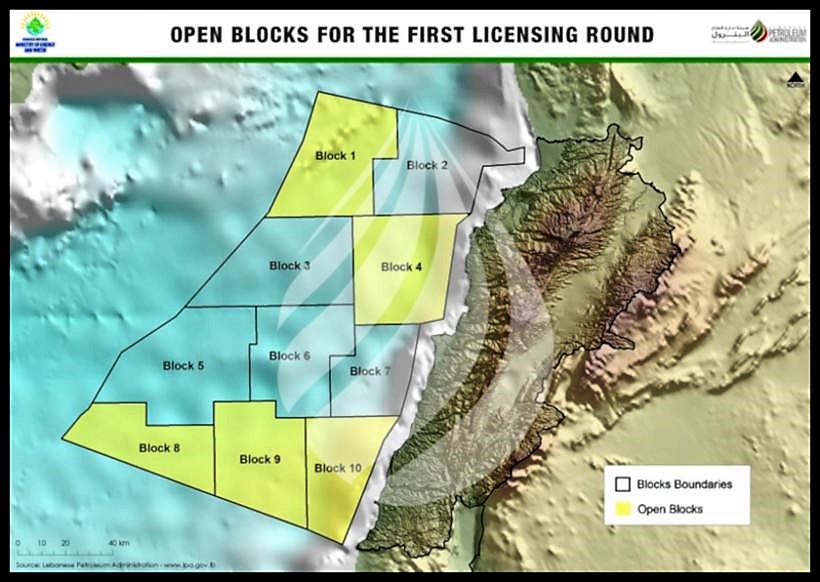
LONDON — I want to start this analysis concerning Lebanon by saying that I wish Lebanon, a beautiful country where I lived for three full years between 2012 and 2015, all the best possible luck in regard to its petroleum (oil and gas) sector development. In fact, after years of postponements, Lebanon is finally kickstarting its offshore oil and gas (O&G) industry. On January 4, 2017, the government approved two decrees, which were necessary to go ahead with the licensing procedure. Decree No. 42 defines the geographical parameters of the blocks in which Lebanon’s economic exclusive zone (E.E.Z., 22,700 sq. kilometers) is divided; Decree No. 43 sets out the tender protocol (T.P.) and the model exploration and production agreement (E.P.A.) to be entered with the bidding companies. A few weeks later, on January 26, 2017, Minister of Energy and Water Cesar Abi Khalil declared that blocks 1, 4, 8, 9, and 10, out of 10 overall blocks, would be open for bidding during the first offshore licensing round.     

Then a pre-qualification round, a second pre-qualification round to be more precise, was held between February 2, 20117 and March 31, 2017; according to this second pre-qualification round, 8 new companies qualified: 1 operator (India’s O.N.G.C. Videsh Limited) and 7 non-operators. Previously, in 2013, 46 companies had qualified via the first pre-qualification round—in specific, 12 of them qualified as operators (among them U.S. Chevron and Exxon Mobil, U.K. Shell, and France’s Total). But then, at that time, the tender process stopped abruptly. In fact, the government had never passed the decrees necessary to have a licensing round until January 2017.

In sum, because not all the 46 companies that pre-qualified in 2013 will be part of the licensing round, there are now 51 companies that have pre-qualified and should be willing to take part in the tender submitting bids in relation to the open blocks on September 15, 2017. After that day, the Lebanese Petroleum Administration (L.P.A.) will assess the received applications and send a report to the cabinet, which will decide by November 15 which companies will win the tender.

BACCI-Lebanon-Launches-Its-Offshore-Oil-and-Gas-Sector-June-2017-1
Attracting Exploration Investment by Ensuring Progressive Fiscal Regime — Source: Wissam Zahabi
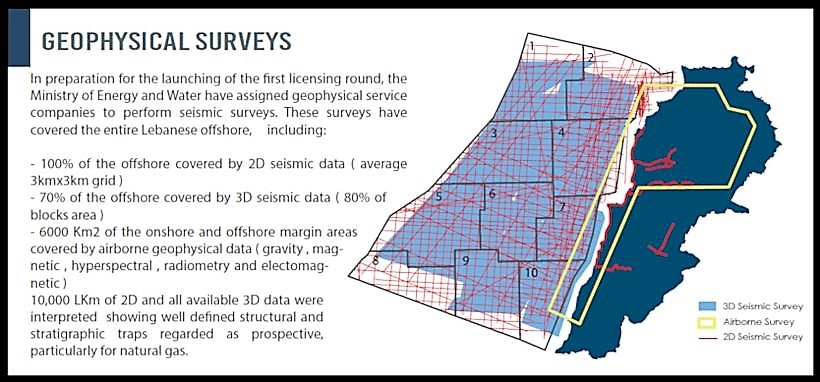
Initial estimates tell that buried under the Lebanese seabed there could be 30 trillion cubic feet (around 850 billion cubic meters) of natural gas and 660 million barrels of oil. Of course, until the companies that will sign a production sharing contract (P.S.C.) with the Lebanese government start their exploration phase, it’s impossible to confirm whether these initial estimates are correct. In preparation for the launching of the first licensing round, some years ago, the Ministry of Energy and Water had assigned geophysical service companies to perform seismic activities. These surveys covered the entirety of Lebanon’s offshore territory. In particular, 100 percent of the offshore was covered by 2D seismic data and 70 percent of the offshore was covered by 3D seismic data. Thanks to this activity, data related to 10,000 kilometers of 2D surveys and all the available 3D data, once interpreted, showed well defined structural and stratigraphic traps regarded as prospective, especially for natural gas.  
BACCI-Lebanon-Launches-Its-Offshore-Oil-and-Gas-Sector-June-2017-2
Geophysical Surveys — Source: Lebanese Petroleum Administration
In other words, until companies start drilling, there is no certainty of Lebanese O&G reserves, but 2D and 3D mapping and the recent natural gas discoveries in the E.E.Z.s of Cyprus, Egypt, and Israel give the Lebanese government hope that also Lebanon’s E.E.Z. could be rich in O&G—in 2010, the United States Geological Survey estimated that there could be up to an additional 122 trillion cubic feet of undiscovered natural gas in the Levant Basin, with also 1.7 billion barrels of recoverable oil. This means that for an international oil company (I.O.C.), when evaluating whether to invest in Lebanon, the risk doesn’t lie too much in geological problems but in geopolitical problems. In fact, because we’re talking of offshore operations, if on the one hand it’s true that finding and development (F&D) costs won’t be low, on the other hand they should not be too different from other offshore operations across the globe. For sure, if the price of a barrel of oil went down to $20 a barrel—a possibility that cannot be completely ruled out—there would be great difficulties in achieving breakeven.

So, the real problem for an investor is the geopolitical risk, which in Lebanon may be split into two main components: Lebanon’s very complex and dysfunctional internal politics and Lebanon’s difficult relationships with its neighbors.

With reference to the first component, it’s difficult to look to Lebanese politics with trust and hope. In fact, Lebanon’s politics is based on religious divisions (a confessionalism including 18 recognized religious sects). In practice, the highest offices are reserved to representatives from certain religious communities. For example, the president of the republic must be a Christian Maronite, the prime minister a Sunni, and the speaker of the Parliament a Shia. Similarly, seats in the Parliament are confessionally distributed but elected by universal suffrage. Each religious community has an allotted number of seats in Parliament, although all candidates in a particular constituency must receive a plurality of the total vote, which includes followers of all confessions. Indeed, it’s a complicated system, but, it’s the system that was introduced with the National Pact of 1943 (slightly changed in 1990 after the end of the Lebanese Civil War). The logic of this system is that it should be able to reduce the possibility of armed violence between the different components of Lebanon’s society, but at the same time its result is a big drag on the speed and meritocracy of Lebanon’s politics. Also, the members of the L.P.A. have been selected according to sectarian lines.  

Doing politics in Lebanon is quite difficult. Among the main political problems that Lebanon has recently experienced in the last years five years—and I just go by memory—there are the following issues

  • Absence of the president of the republic for more than two years (29 months)

  • Absence of a continuous supply of electricity

  • Acts of violence across the country, Beirut included

  • A high level of corruption at all levels of Lebanon’s society

  • A high public debt at 146 percent of the country's G.D.P. in 2016

  • Garbage crisis and related environmental issues

  • More than 1 million of Syrian refugees, but the number could be close to 2 million

  • Parliamentary elections, to be held in 2013, postponed until at least mid-2018

  • Poverty with around 28 percent of the population living under the poverty line

  • Savage privatization of public land across the country

With reference to the second component, Lebanon and its southern neighbor, Israel, are still technically at war. Moreover, to add an additional layer of complexity, there is an 854-square-kilometer wedge of sea between the two countries claimed by both Beirut and Tel Aviv. In the last years, the U.S. has tried to figure out a solution, or at least to avoid that this dispute could escalate into something more dangerous. In this regard, the U.S. has discouraged Israel and Lebanon from conducting O&G operations in the disputed wedge of water.

BACCI-Lebanon-Launches-Its-Offshore-Oil-and-Gas-Sector-June-2017-3
The Disputed Wedge of Water — Source: Menas Associates
In Israel, Noble Energy, a U.S. energy company quite active in Israel, and Israel’s Delek Group held the license for block Alon D, which stretches into the disputed area. This license expired in March 2016. Several reports have explained that the Israeli government has prevented drilling in the license area Alon D. Another controversy with Israel was linked to the discovery of the Tanin and Karish gas fields by Noble Energy in 2012 and 2013. These fields are located in Israeli-licensed areas Alon A and Alon C. And Alon C is only 4 kilometers away from Lebanon’s block 8 and 9 kilometers from block 9. Tension between Israel and Lebanon when Noble started drilling in the Karish field, which according to Noble Energy is 10.6 kilometers from Lebanon’s block 9, while according to Lebanon is just 4 kilometers away from the block. As a consequence, Lebanon’s government immediately voiced its concern regarding Karish field operations because these could affect the Lebanese gas reserves, either by drilling in a contiguous gas resource, or through horizontal drilling—Nabih Berri, the speaker of the Lebanese Parliament strongly voiced its concerns regarding the disputed offshore territory. Today, after a series of business transactions, the license to the Karish and Tanin fields is held by the Greek company Energean Oil & Gas.

BACCI-Lebanon-Launches-Its-Offshore-Oil-and-Gas-Sector-June-2017-4
Israel's Offshore Fields — Source: Offshore Energy Today
But now, Lebanon’s first offshore licensing round might create trouble. In fact, 3 blocks (block 8, 9, and 10) out of 5 of the blocks to be licensed cover the length of the offshore border between Israel and Lebanon, i.e., they include the disputed wedge. Why that? In March, at Eastern Mediterranean Gas Conference (E.M.G.C.) 2017 in Cyprus, Mr. Wissam Chbat, chairman and head of geology and geophysics of L.P.A. explained that

  • Block 1 has high-to-moderate hydrocarbon potential, with gas, possible condensate, and oil expected to be discovered

  • Block 4 has moderate potential for gas, oil, and possible condensate

  • Block 8 has high potential for gas and some condensate

  • Block 9 has very high potential for gas, condensate, and oil

  • Block 10 has very high potential for oil, condensate, and some gas             
BACCI-Lebanon-Launches-Its-Offshore-Oil-and-Gas-Sector-June-2017-5
Open Blocks for the First Licensing Round — Source: Lebanese Petroleum Administration
The government justification for the green light to proceed with block 8,9, and 10 is that they have a high potential. And in order to lure I.O.C.s’ interest in Lebanon’s offshore, it’s better to offer immediately the most promising areas, especially in the present environment of low oil prices. The idea is that it’s always better to start with the right foot.

In addition, as mentioned above, with reference to the three southern blocks, in the past, several times Lebanese politicians raised the issue that Israel, which is quite ahead of Lebanon in its offshore operations, via infrastructure located in its own E.E.Z. could extract natural gas located in Lebanon’s E.E.Z. These fears could be considered another justification to immediately put under a license those three blocks. Moreover, it’s worth mentioning that Lebanon and Syria didn’t complete the demarcation of their land and maritime borders either—Lebanon’s E.E.Z.’s northern border and Syria’s E.E.Z.’s southern border. And now demarcating maritime borders with Syria will probably be impossible until the end of the conflict in Syria. 

One initial consideration is that Lebanon should have already begun the development of its petroleum sector. Indeed, if the licensing phase had been completed in 2013, it would have been better for the coffers of Lebanon’s Treasury. In 2013, Brent crude prices averaged more than $100 a barrel. It’s true that petroleum operations, if successful, could span at least three decades, which means that an I.O.C. will always experience over the course of a specific project high oil prices as well as low oil prices, but it’s also true that when a government organizes a commodity licensing round, it’s much better if the price of the concerned commodity is quite high. The only real advantage that Lebanon could have right now is the low costs of oil services. Timing is not so good for Lebanon as it was four years ago. Instead, in the eastern Mediterranean region both Cyprus, Egypt and Israel are quite ahead with their projects.

BACCI-Lebanon-Launches-Its-Offshore-Oil-and-Gas-Sector-June-2017-6
Geographical Location of the Main Recent Gas Discoveries in Offshore Eastern Mediterranean — Source: European Parliament, Energy: A Shaping Factor for Regional Stability in the Eastern Mediterranean?, June 2017
In 2009, Noble Energy announced the discovery of the Tamar field (280 billion cubic meters of natural gas) in the Israeli E.E.Z. Then, still Noble Energy announced in 2010 the discovery of the Leviathan field (620 billion cubic meters) in the Israeli E.E.Z. and in 2011 of the Aphrodite field (140 billion cubic meters) in the Cypriot E.E.Z. Last but not least, in 2015, Italy’s E.N.I. announced the discovery of the giant Zohr field (850 billion cubic meters) in the Egyptian E.E.Z. These three countries are much ahead in their projects than Lebanon is. In fact, 

  • In Israel, natural gas is already extracted. The Tamar field was quickly developed and early 2013 it became operational supplying Israel with 7.5 Bcm per year; the Leviathan field’s Phase 1A will produce 12 Bcm per year starting in 2019.

  • In Cyprus, thanks to three licensing rounds (in 2007, 2012, and 2016) block 12 (Noble Energy, Delek, and Shell), 2 (E.N.I. and Korea’s Kogas), 3 (E.N.I. and Kogas), 9 (E.N.I. and Kogas), 11 (Total and E.N.I.), 6 (Total and E.N.I.), 8 (E.N.I.), and 10 (Exxon Mobil/Qatar Petroleum) have been awarded.

  • In Egypt, E.N.I. will start producing from Zohr in the 4th quarter of 2017—E.N.I. is the operator while British Petroleum has a 10-percent stake and Russia’s Rosneft a 30-percent stake. It’s possible that Zohr will be the first of a series of discoveries in the area. BP is proceeding with its development of West Nile Delta project, which could produce 12 Bcm, per year starting in 2017.     

All this said, despite a not-so-perfect timing and despite internal and external problems, Lebanon has probably to try to develop its offshore resources. When I.O.C.s and a country sign a petroleum contract, let’s say a P.S.C., they could arrive at the signature starting from distinct positions, but when they sign, they have, hopefully, found an agreement satisfying both parties. There is a caveat: under the current low oil prices, I.O.C.s may find several different investment opportunities; if a company doesn’t see an investment opportunity as sufficiently profitable, it can easily switch to drilling in other localities. Instead, a country doesn’t have the same privilege. Oil and gas deposits are fixed in a specific place. In brief, a country has to do with what it has.

Indeed, a country has to maximize its profits, but it has also to do a reality check. And, in the case of Lebanon, this reality check may be done with an eye to the amount of dollars that every year Lebanon must use to satisfy its energy requirements. In 2013, a year with high oil prices, Lebanon imported oil and derivatives for an amount of $5.11 billion, i.e., 11.4 percent of its G.D.P. Moving to 2016, a year of low oil prices, there was an 8.20 percent yearly rise in value of oil imports to $3.72 billion, which is equal to 98.21 percent of mineral products’ import value. These numbers would probably be a sufficient reason for Lebanon to try to develop its hydrocarbons sector. In fact, in addition to spending less money, by developing its own offshore natural gas deposits, Lebanon could start using natural gas rather than oil to produce electricity with many environmental benefits, give its citizens and industrial sector a continuous supply of electricity, permit its industrial sector to gain competitiveness in pricing and exports, and increase its energy security. On top of these improvements, Lebanese politicians, who are always overoptimistic, already envisage the possibility of creating new industries like petrochemicals—this idea is very premature.   

Until now, citizens and large-scale manufacturers have relied on their own electricity generators to ensure uninterrupted electricity supply—in some parts of the country there is no electricity for 18 hours a day, while at the same time current expenditures for Electricité du Liban, the public body controlling 90 percent of the activities of production, transportation and distribution of electricity in the country, are still the third most important point in the budget after debt service and public wages. Losses from intermittent energy supply and the utilization of private generators have translated into a considerable loss of competitiveness of Lebanese products on global markets. According to the Association of Lebanese Industrialists, the average energy factor cost is 5.7 percent of the companies’ selling price, but this cost is as high as 35 percent of the selling cost for energy intensive industries like manufacturing.

By developing its offshore natural resources, Lebanon could increase its overall energy security in order not to repeat the problem Lebanon is currently facing with its two natural gas power plants. In fact, presently Lebanon has already two combined cycle gas turbines (C.C.G.T.s), Zahrani (460 MW) and Deir Ammar (460 MW), in operation but they are not working properly because they use fuel oil and not natural gas, which, in light of external political and economic circumstances, is not currently exported to Lebanon. 

Corruption is a huge problem. Transparency International, a global civil society organization, in its corruption perceptions index ranked Lebanon 136 out of 176 countries in 2016. And the idea of getting rid of corruption is probably just wishful thinking. Think of Angola, which is a good case in point. From 2002 to 2015, this country’s exports totaled almost $600 billion, nearly all of it from oil. According to the Catholic University of Angola’s Center for Studies and Scientific Research, oil revenue brought the government coffers $315 billion. At the same time $28 billion from government budgets remained unaccounted for and up to 35 percent of the money spent on road construction vanished. And in relation to Lebanon, it’s important to underline that immediately after the first pre-qualification phase, already in 2013, serious transparency problems had emerged concerning two of the three qualified Lebanese companies.

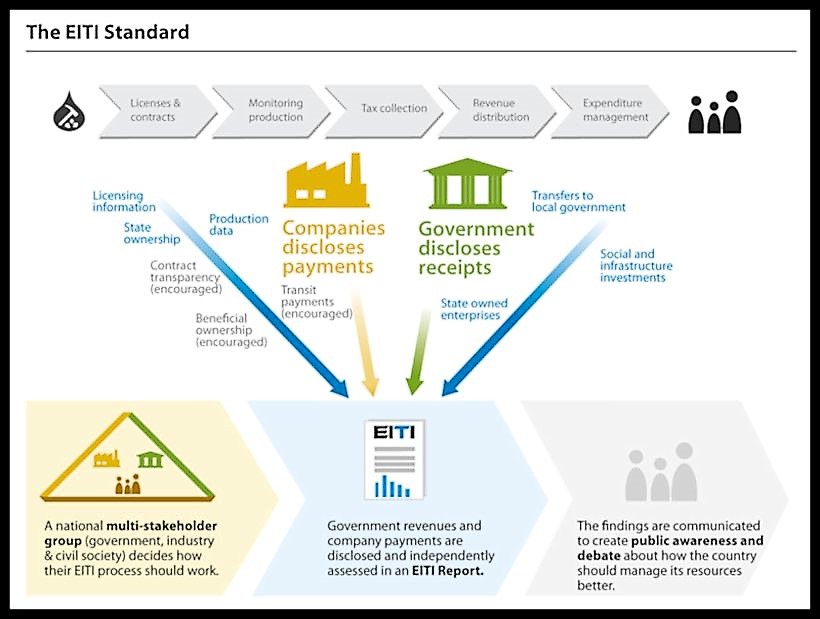
One positive, but limited, note for the possible investors is that Lebanon has announced its intention to join the Extractive Industries Transparency Initiative (E.I.T.I), which is a voluntary initiative through which the government of Lebanon will commit to publishing reports on how the government manages the oil, gas, and mining resources. In practice, the participation in the E.I.T.I. will promote transparency in the hydrocarbons sector. It would be quite important that Parliament approved a draft law, which was prepared in the last two years, regarding transparency in the O&G sector before November.       
BACCI-Lebanon-Launches-Its-Offshore-Oil-and-Gas-Sector-June-2017-7
The E.I.T.I. Standard — Source: E.I.T.I.
There is a final question: What companies could really be interested in investing in Lebanon? It’s difficult to have an answer. U.S. Exxon Mobil, Chevron, and Anadarko, Brazil’s Petrobras, Italy’s E.N.I., Denmark’s Maersk Spain’s Repsol, U.K. Shell, Norway’s Statoil, France’s Total, Japan’s Inpex, Malaysia’s Petronas, and O.N.G.C Videsh Limited all pre-qualified as operators—12 in 2013 and 1 in 2017. Indeed, these companies are among the best I.O.C.s at world level. But it’s quite probable that the interest they had in 2013 is not present any longer in light of all the considerations developed above.

Recently, a few days ago, Foreign Minister Gibran Bassil while meeting with his Chinese counterpart, Wang Yi, encouraged China to invest in Lebanon’s oil and gas sector. Normally, this type of exhortation would be perfectly in line with the meeting. But when you are the foreign minister of a country that is currently carrying out its first licensing round to which no Chinese company will participate, such a behavior raises the doubt that the pre-qualified companies haven’t until now shown excessive interest in the licensing round and that Lebanon has to develop a plan B. Of course, this could easily be just a simple conjecture because companies will submit their tenders only on Sept. 15, 2017.     

In particular, in view of the considerations developed in this analysis, it could be difficult for an I.O.C. to develop a good business case and decide to invest in one of the three blocks comprising the disputed wedge of water. Moreover, Lebanon does not have the naval capabilities to protect militarily its future O&G installations, while Israel has powerful naval means.

But there is something more. The sectarian divisions of Lebanese society, which are mirrored in the country’s political institutions, until now have consistently and only slowed the development of an O&G sector in Lebanon. What if instead the energy sector with its consistent revenue stream became a new lever capable of kindling another time Lebanon’s society internal conflicts?             

                   
For More Information Please See


Tuesday, May 30, 2017

The U.S. Vision of Iraq's Oil Production

BACCI-US-Vision-Iraq-Oil-Production-May-2017-Cover

The article “The U.S. Vision of Iraq's Oil Production” has been initially published by Oilpro, a professional network for the oil and gas professionals
May 30, 2017
LONDON — Last week, I attended Iraq Petroleum 2017, a conference organized every year by The C.W.C. Group, which is the world-leading events and training producer for the oil, gas and infrastructure industries — still with reference to Iraq/K.R.G., The C.W.C. Group is currently organizing in Beirut, Lebanon, Basra Oil, Gas & Infrastructure Conference (planned for Oct. 2017) and in London, U.K., Kurdistan-Iraq Oil & Gas (planned for Dec. 2017).
This year’s edition of Iraq Petroleum (the eleventh edition) gathered over 200 senior industry professionals and government representatives with the main goal of discussing new strategies for Iraq’s energy sector. In specific, this edition focused on the focus was on Iraq's oil and gas #infrastructure development projects and on the global trends in #crude oil #trading in light of Iraq's increased #exports.Iraq's oil and gas infrastructure development projects and on the global trends in crude oil trading in light of Iraq’s increased crude oil exports.
BACCI-US-Vision-Iraq-Oil-Production-May-2017-1
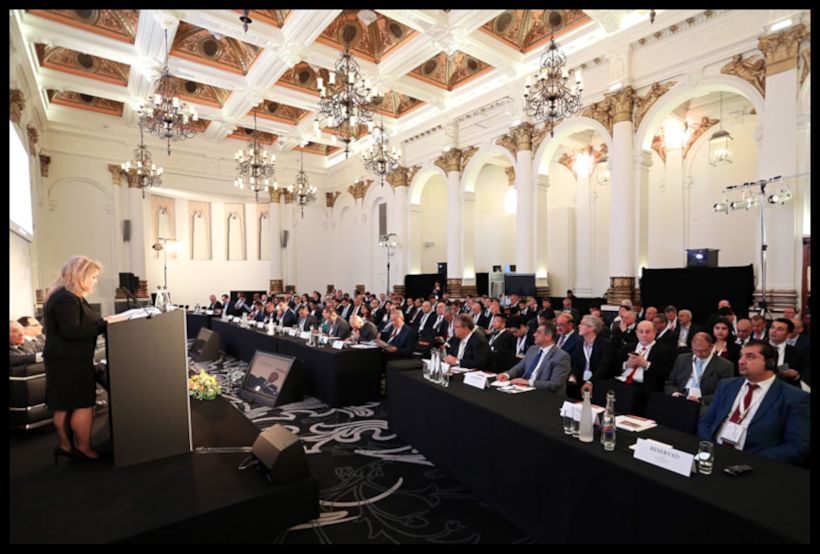
The Conference — Source: The C.W.C. Group Press Service
Very interesting, and in a certain way quite direct and frank, was the speech of Mr. Alan Eyre, director of the Office of Middle East and Asia of the Bureau of Energy Affairs with the State Department. Mr. Eyre clearly defined what the U.S. vision of the new energy landscape is. He was part of the panel called “Iraq a Major Oil & Gas Power: Strategies for the New Energy Landscape.”  
BACCI-US-Vision-Iraq-Oil-Production-May-2017-2
The Panel "Iraq a Major Oil & Gas Power: Strategies for the New Energy Landscape" — Source: The C.W.C. Group Press Service
The State Department’s position — and consequently the position of the U.S. government — supports the U.S. shale oil and gas producers to push ahead as much as they can with their shale operations on the American soil, no matter what an increased U.S. shale oil production might mean to the oil price internationally. Technological advances in the past few years have made U.S. shale oil production now profitable at $40 to $50 per barrel.
In other words, the U.S. government calls for an oil price based on a pure free market approach. If U.S. shale oil producers make a profit, they stay in the market, if they don’t, they have to exit the market. It’s a simple but very clear approach. This vision does not make room any longer for cartel restrictions, such as those that OPEC has always tried to implement over the course of its existence.
In specific, with reference to the last two years and a half, since the end of November 2014 OPEC has been playing a commercial battle with the U.S. shale producers with the final goal of pushing them out of the market. In fact, despite plunging oil prices, in November 2014, OPEC members decided not to cut output. At that time, cutting output was a move required to support oil prices, but strategically OPEC members preferred to maintain (if not to enlarge, this, at least, was their initial idea) their market share. As a consequence of their decision, oil prices bottomed out in January 2016 when Brent was less than $30 per barrel. Then, in November 2016, with the Brent price partially higher at around $45 a barrel, OPEC ministers secured a cut in OPEC’s oil production from 33.8 million barrels a day (b/d) to 32.5 million b/d for the first six months of 2017 to prop up prices. Then, just a few days ago, at its May 2017 meeting, OPEC decided to extend its production cut by nine months. At the time of this writing, Brent is around $52 a barrel. Currently inventories haven’t stopped rising and supply continues to outstrip demand — this explains why the price of oil is not really rising. In addition, shale production is increasing at the same rate as it was before 2014. To counter its lost political power, OPEC might try to expand its base and access to producers.
The U.S. vision of the new energy landscape is well in line with the new U.S. administration’s concept of “America First” (implemented at the energy level as well) and with the present inherent value of fossil fuels. With reference to the first point, the White House has clearly affirmed that it wants to maximize the use of American resources, freeing the U.S. from dependence on foreign oil. Here, putting politics aside, this economic target makes sense: If U.S. shale oil producers are able to generate profits, they will be on the market and this will be beneficial to the U.S. economy overall. The second point, the present inherent value of fossil fuels, needs to be consistently enlarged.
Time after time, Arab countries have always released statements where it was written that the correct price of oil was a certain amount of dollars per barrel (for instance $70, $90 and so on). And they have always closed their statements affirming that the stated price per barrel could guarantee a sort of win-win agreement between producing/exporting countries and importing/consuming countries.
The reality is that we don’t know what the correct price of a barrel of oil should be, especially on a medium- to long-term basis. According to a free market logic, the price of an item, oil as well, should be based on the balance between supply and demand. In other words, the price of oil is a moving thing. Of course, when talking about oil there are also political and security considerations that enter the picture. But, in times of oil abundance in the U.S., these political and security considerations can be played down. See at this regard, President Donald Trump's proposal to sell half of the U.S. strategic oil reserve. This proposal well highlights a reduction in the U.S. reliance on imports — and a weaning off OPEC crude — exactly when the domestic U.S. production soars.
Another layer of complexity for those who invest in oil, but this is also true for natural gas and minerals, is the long lead time of the projects, i.e., the time between the initial stage of a project and first commercially viable production. In other words, from the final investment decision (F.I.D.), but, in reality, an investor has already used important economic resources at this stage, to the moment when the first barrel of oil will be commercially produced, there could easily be 7 years, 10 years, if not longer times. And this means that the profitability envisaged at the F.I.D. time could no longer be present when you have the first barrel of oil. This is a real problem for commodities — instead, a manufacturer who produces for example t-shirts has very a short lead time between the ideational phase and the production phase thanks to reduced entry barriers. 
But let’s put aside political considerations, security considerations, and long lead times, and let’s focus our attention on the concept of the price oil deriving from the balance of supply and demand. Persian Gulf’s oil producers artificially would like a high oil price, which on the basis of the number of oil producers across the world and the pace of the world economy in 2017 is not achievable right now. If in the coming months there were a war in a major oil-producing country, a complete reduction of the inventory levels of crude oil, or difficulties maintaining the present level of oil production because of the reduced oil investments of the last two years, things could be very different and the oil price could spike again also consistently. Indeed, the decline in upstream investment in 2015 and 2016 ($450 billion and less than $400 billion respectively from around $650 billion in 2014) could materialize in a severe shortage in the medium-term.
Business theory tells us that with a successful differentiation strategy, a company is able to offer products or services perceived to be distinctively more valuable to customers than are competitive offerings, while maintaining more or less the same cost structure used by competitors. But with commodities this is not possible. With commodities, and crude oil is a commodity, a producer (especially if it works only upstream) cannot differentiate its product in order to present it as more attractive to buyers. It’s true that crude oils are different according to different A.P.I. grades and sulfur content, but it’s also true that the final products deriving from crude oil are exactly the same (for instance at the pump station when you fill your tank it doesn’t matter what gasoline brand you use) and that we can consider the A.P.I. grades and sulfur differences as just initial cost differences and not as a real final differentiation of the product. For more information about the concept of competition please see the extensive research done on the topic by Professor Michael Porter of Harvard University.
So, logic wants that with commodities in a competitive market low-cost producers are the winners. With reference to crude oil this means that if there is a place in the world where crude oil should ideally be produced, it’s exactly in the Middle East and in particular, in Iran, Iraq, and Saudi Arabia as a consequence of their finding and development (F&D) costs, which are probably less than $10.
In a perfect world, these three countries should be the hard-core oil producers at world level. In addition, although they would not be able to satisfy all the world’s oil demand (they would not be monopolists), they would still gain a lot from being price takers. In fact, all their low-cost oil production would be sold at the price asked to cover the production cost of the highest-cost producer necessary to satisfy the last barrel of oil required by world demand.     
Arab countries want high oil prices because their economies are almost exclusively based on the export of oil and gas. But, under the current circumstances, for Arab countries, obtaining, let’s say, $100 per barrel of oil in order to balance their fiscal budget is impossible. In this regard, at the conference resounded quite loudly the idea of diversifying Iraq’s economy. Personally, I think the expression “diversifying the economy” in relation to Persian Gulf’s producers is not correct. I believe it would be more correct to say “partially reducing the dependence on O&G exports.”
In fact, for a commodity producer, and especially for one located in the Middle East, reaching economic diversification and maintaining it, is never an easy task. In confirmation of this point think of Norway, which has always been considered the poster-boy of how an O&G producer should develop its petroleum sector. As oil prices started to fall in 2013, it became apparent that the Norwegian economy had become incredibly unbalanced. "The oil and gas industry became too strong in our economy, especially during the last four or five years” said Prime Minister Erna Solberg in an interview with the BBC News website in 2016. And then she added that the Norwegian economy had to diversify. Norway has the same problem as the Arab countries. In fact, Norway’s Johan Sverdrup field (expected resources of  1.9 to 3.0 billion barrels of oil equivalents), a huge field that will start production in 2019, now could probably reach breakeven at $20 to $30 per barrel, but the government requires $70 per barrel oil to balance its fiscal budget. Also Norway is a one-path economy, mostly dependent on oil and gas exports (around 60 percent of exports).
The two pictures below show Norway's unbalanced export sector and the U.S. much more balanced export sector.
BACCI-US-Vision-Iraq-Oil-Production-May-2017-3
What Did Norway Export in 2014? — Source: The Atlas of Complexity, Harvard University
BACCI-US-Vision-Iraq-Oil-Production-May-2017-4
What Did the U.S. Export in 2014? — Source: The Atlas of Complexity, Harvard University
In practice, at the conference the State Department’s suggestion to Iraq was to produce more oil, i.e., to develop a real economy of scale in the petroleum sector. The idea was to try to make up for the decreased government revenues of the last years with more millions of oil exported on a daily basis. But the implementation is not easy. Indeed, infrastructural problems are among the most important hurdles. In fact, in the last years Iraq has already lowered its ambitious oil production targets. When the technical service contracts (T.S.C.s.) were signed, the federal government and the IOCs had set an initial production target of more than 12 million b/d by 2017 from a dozen oil fields. Later, after renegotiating the signed contracts, the federal government and the companies planned to reach 9.0 million b/d by 2020. It’s now probable that Iraq will lower the target down to 6.0 if oil prices stay low. In fact, in addition to infrastructural problems, Iraq has been forced to revise its expansion plans because under the current T.S.C.s low oil prices have a particularly damaging effect on the government’s income.
The State Department’s suggestion to Iraq echoed David Ricardo’s theory of comparative advantages. For the most part, countries all try to do what they are relatively best at and trade for everything else. A country has an absolute advantage in relation to those products in which it has a productivity edge over the other countries. This means that it takes this country fewer resources to produce a certain product. A country has a comparative advantage when a good can be produced at a lower cost in terms of other goods. Countries that specialize based on comparative advantage gain from trade. A country has an absolute advantage in producing a good over another country if it uses fewer resources to produce that specific good. Absolute advantage can be the result of a country’s natural endowment — and this is the case of Iraq with oil.
The concept of comparative advantages doesn’t want to deny the idea of the importance of economic diversification in order to reduce economic risks (this principle is absolutely valid for personal investment portfolios, for companies’ operations, and for countries’ G.D.P. composition). But when considering Middle Eastern oil producers, if on the one hand economic diversification is important, on the other hand it has to be taken cum grano salis. The reason is that for these countries diversifying their economy will be extremely difficult. So, oil and gas will continue to be for these countries the main pillar of their economies. And, if this weren’t the case, these countries would fall into chaos more than they are now. Consequently, a more realistic approach is needed otherwise we risk falling into pure wishful thinking. One thing is what we want to do, another thing is what we are able to do.
In addition, the State Department’s invitation to Iraq seems to underline one point: Oil producers have to export oil now that it has a value. Maybe it doesn’t have the per-barrel value that Arab countries would desire, but it has a value. In twenty or thirty years many things could change. It’s true that according to many forecasts there will be an increase in energy (and petroleum) consumption globally, but forecasts on a long-term basis are never easy and could contain a higher probability of fallacy.
BACCI-US-Vision-Iraq-Oil-Production-May-2017-5
Marcus Antonini, Shell Iraq's Vice President & Country Chairman (right), and Alessandro Bacci (left) — Source: The C.W.C. Group Press Service


Friday, April 7, 2017

A Neutral Stance Doesn’t Help Energy Companies in Iraq

BACCI-A-Neutral-Stance-Does-Not-Help-Energy-Companies-in-Iraq-Cover-April-2017


The article “A Neutral Stance Doesn't Help Energy Companies in Iraq” has been initially published by Oilpro, a professional network for the oil and gas professionals

April 7, 2017
FLORENCE, Italy — One aspect of corporate foreign policy that is not any longer so basic a tenet as it was during the latter part of the 20th century is the necessity of being or at least appearing neutral. Neutrality may be defined as the state of not supporting or helping (physically and ideologically) either side in a conflict or disagreement. Exactly because for a multinational company, corporate foreign policy, which subsumes in its definition corporate diplomacy and geopolitical due diligence, is becoming central to winning internationally, a basic neutral approach is too limited to guarantee in every instance positive results. 
Starting in the mid-1980s, international companies have presented themselves as a sort of apolitical players, which, among their core goals, have an interest in the advancement of the societal environment of the countries where they invest. Indeed, this attitude is a complete sea change from the corporate foreign policy of the 1950s and 1960s when companies often carried out a neocolonialist strategy, which strongly influenced the internal politics of many weak states.
A good example of the neocolonialist behavior was the complicity of United Fruit Company, an American corporation that traded in tropical fruit, with the U.S. government in the 1954 coup in Guatemala. A coup that ousted the democratically elected leader of Guatemala, President Jacobo Arbenz, and resulted in more than three decades of military strongmen at the helm of the country. 
Since the mid-1980s international companies have shunned any political involvement, while at the same time they have tried to implement a good corporate social responsibility (C.S.R.), to protect and improve their brand perception and reputational risk management, to cultivate stakeholder management, and to adopt better public relations with N.G.O.s.
With hindsight, these promotional tools have never given the international companies a real edge with reference to high-impact geopolitical events such as coups, regional and civil wars, internal power struggles, changes in the political status of key local partners, and changes in the public sentiment toward the company. In other words, only through their neutral approach and the tools developed after the mid-1980s, the international companies cannot really protect themselves and thrive in the much more unstable world that emerged at the end of the Cold War.
A clear illustration of the problems deriving from maintaining a neutral approach concerns the energy investments in Iraq proper and Iraqi Kurdistan. The latter is also known as the Kurdistan Regional Government (the K.R.G.) and is a semi-autonomous region within Iraq. Without entering into too much detail, it’s important to understand that after World War I, for all the 20th century, the relations between the Kurdish population based in what is today’s K.R.G. and those who exerted their rule over that area had been very tense and experienced several episodes of violent conflicts. 
The relations between Erbil and Baghdad worsened again at the end of 2007 when the K.R.G. started signing production sharing contracts (P.S.C.) with small- and medium-sized companies without prior authorization from the federal government — in addition, the latter has never signed P.S.C.s but only technical service contracts (T.S.C.s). Baghdad has always said that it alone has the right to negotiate and sign energy deals for the whole Iraqi territory, the K.R.G. included. Instead, Erbil insists that Iraq's Constitution allows it to agree to contracts, and as a result to ship oil independently of the central government. 
In October 2011, tensions rose to a higher level when the U.S. supermajor Exxon Mobil, a company that was already the operator of West Qurna 1, a giant oilfield in southern Iraq, signed an oil deal related to the development of six exploration blocks in the K.R.G. — in December 2016 Exxon Mobil pulled out of three of these six blocks, but this move was not due to Baghdad’s pressure.
Exxon Mobil was the first supermajor to sign oil deals with Iraqi Kurdistan, and the federal government was literally scared that Exxon Mobil could act as a sort of trailblazer opening Iraqi Kurdistan to Big Oil investments. In fact, for Baghdad, one thing was to confront a K.R.G. receiving its economic legitimacy from small- and medium-size oil companies, one completely different thing was to confront a K.R.G. receiving its economic legitimacy from the supermajors.
The federal government wanted to appear resolute against Exxon Mobil — as it had done until then with the small- and medium-sized companies that had invested in the K.R.G until then. So, Baghdad immediately menaced to push Exxon Mobil out of Iraq proper stripping the company of its West Qurna 1 contract — the U.S. company had a 60 percent share in that oil field — if it hadn’t relinquished its Kurdish investments. Today, after almost 6 years, Exxon Mobil is still an investor in both the K.R.G. (with three blocks) and in Iraq proper (in West Qurna 1, where it’s still the operator, although with a 25 percent share). 
In Iraq (Iraq proper and the K.R.G.), there is a sort of dichotomy regarding the energy investment strategies on the part of the international oil companies (I.O.C.s). In practice, some companies have decided to invest only in the K.R.G. (among them, U.S. Chevron, Korea National Oil Company, China’s Addax Petroleum/Sinopec, and Norway’s D.N.O. ), while others have decided to invest only in Iraq proper (among them, British Petroleum, Anglo-Dutch Shell, Japan Petroleum Exploration Company, Russia’s Lukoil and Rosneft, and China’s Cnooc and C.N.P.C). The only energy companies that escape this dichotomy and consequently have investments in both Iraq proper and the K.R.G. are Exxon Mobil, Russia’s Gazprom, and France’s Total.  
A neutral approach may be useful when in a country there are completely unstable political conditions (for instance, military clashes/open war), and when it seems probable that in the short term there could be a clear and definitive political solution. But, when the quarrelling parties are not physically fighting between themselves, and when it appears highly improbable that there will be a final arrangement any time soon, a neutral approach may represent for a company only a lost economic opportunity. In the case of the K.R.G. and Iraq proper, neutrality is probably not useful.
Both the K.R.G. and Iraq proper have oil and gas reserves located in areas that can be easily protected from the Islamic State — Kirkuk oil fields may be more exposed, but let’s focus our attention only on the fields within the K.R.G. and on those in southern Iraq. Moreover, it seems evident that the tensions between Erbil and Baghdad won’t be gone soon — these tensions date back several decades. In fact, if the emergence of the Islamic State and its destruction of the Iraqi side of the Kirkuk-Ceyhan pipeline has forced the K.R.G. to build its system of export pipelines, which could be seen as a first step toward a K.R.G. economic independence, it also true that low oil prices, a complicated geopolitical environment, and oil reserves not as large as initially thought — a better assessment is needed — could induce the K.R.G. to continue with its tense cohabitation with Iraq proper.   
In the end, can international companies wait for a real improvement in the relations between the K.R.G. and Iraq proper before doing business in the area? In other words, can they wait for a political improvement that might occur one year, three years, five years, or ten years from now? The answer is no, because as usual uncertainty is business’s worst enemy. In Iraq, neutrality is a way to lose economic opportunities. Instead, if companies want to succeed, they have to decide where they want to invest and then they have to act consequently.
India’s Reliance Industries sold its two blocks in the K.R.G. to Chevron because it wanted to pursue other economic ventures in Iraq proper from which it could have been barred if it had continued with its K.R.G. investments. Exxon Mobil, Total, and Gazprom had a different leverage over the federal government when they invested in the K.R.G — respectively in October 2011, July 2012, and August 2012. In fact, at that time, they had already signed service contracts related to the development of three of Iraq’s largest fields
  • ExxonMobil for West Qurna 1 (Iraq's first licensing round in 2009)
  • Total for Halfaya (Iraq's second licensing round in 2009)
  • Gazprom for Badra (Iraq's second licensing round in 2009)
In other words, for Baghdad it was very difficult, because economically unappealing, to strip these three companies of the contracts signed in the previous two or three years — contracts of paramount importance for relaunching and expanding the Iraqi oil sector.    
But, it’s Shell’s approach that confirms how a corporate foreign policy based on a neutral approach could have been a very risky option in Iraq. In fact, if, on the one side, Shell was part to the initial negotiations that Exxon Mobil developed with the K.R.G. in 2011, on the other side, it was already deeply involved in Iraq proper with relevant investments.
In fact, Shell was Exxon Mobil’s junior partner (15 percent share) in the West Qurna 1 field (8.7 billion of recoverable barrels of oil) and the operator (45 percent share) in the Majnoon field in southern Iraq (13 billion of recoverable barrels of oil). But, at that time, Shell was also in the final stages of the talks that would end in November 2011 with the signature of a $17.2 billion’s worth deal with the federal government for collecting and processing all the natural gas from three of Iraq's giant southern oilfields, i.e., Rumaila, West Qurna 1, and Zubair.
In the end, Shell’s real interest in Iraq weights the balance in favor of investing in Iraq proper only. If Shell had signed a deal with the K.R.G., the federal government might have scuttled the gas deal, which was the weak link for Shell — for the same reasons explained above in relation to Exxon Mobil and its investment in West Qurna 1, it would have been quite difficult to strip Shell of the Majnoon contract. Moreover, what is sure is that for Shell a neutral approach would have meant not investing in Iraq proper nor in the K.R.G. with all the economic lost opportunities that this action would have encompassed.

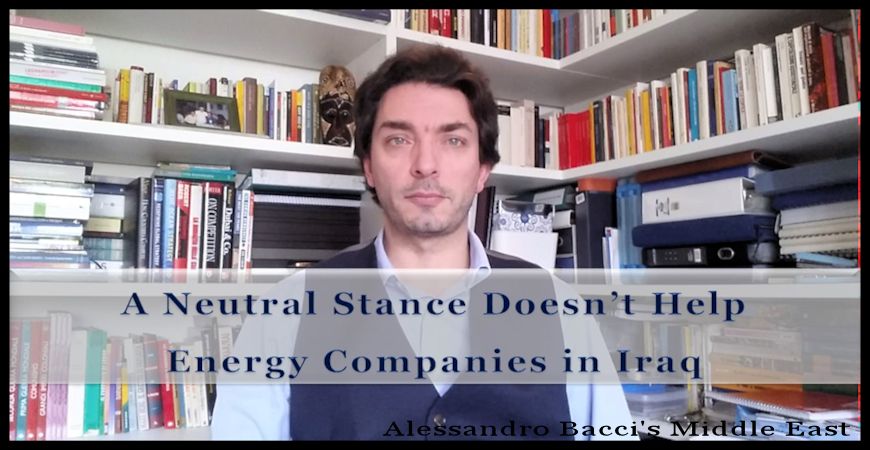
This article covers the topic of the video “A Neutral Stance Doesn’t Help Energy Companies in Iraq,” which was released on April 4, 2017, on Alessandro Bacci’s Middle East. 


Tuesday, April 4, 2017

A Neutral Stance Doesn’t Help Energy Companies in Iraq

BACCI-A-Neutral-Stance-Does-Not-Help-Energy-Companies-in-Iraq-April-2017


April 4, 2017
FLORENCE, Italy

Dear friends,

I would like to share with you my video “A Neutral Stance Doesn’t Help Energy Companies in Iraq.”

One aspect of corporate foreign policy that is not any longer so basic a tenet as it was during the latter part of the 20th century is the necessity of being or at least appearing neutral.

In fact, in the post-Cold War world, a neutral approach does not provide international companies with a real edge with reference to high-impact geopolitical events.

A clear illustration of the problems deriving from maintaining a neutral approach is apparent in the energy investments (oil and gas) in Iraq proper and Iraqi Kurdistan (a.k.a. the Kurdistan Regional Government — K.R.G.).

Thank you

Kind regards,

Alessandro


Wednesday, March 22, 2017

Protecting Iraq’s Oil-Producing Areas

BACCI-Protecting-Iraq-Oil-Producing-Areas-Cover-March-2017


The article “Protecting Iraq’s Oil-Producing Areas” has been initially published by Oilpro, a professional network for the oil and gas professionals

March 22, 2017

FLORENCE, Italy — The Islamic State (a.k.a. ISIS or ISIL) is in retreat in Iraq and Syria. It has lost approximately half the territory straddling between western Iraq and eastern Syria that it controlled after its 2014 expansion when it caught off guard the federal government in Baghdad. This outcome was not difficult to predict already in the summer of 2014, because the Islamic State was a poor and dysfunctional state in relation to the vast conquered territory and the administered population. Add to this that already in August 2014 the U.S. and some allies (Bahrain, Jordan, Qatar, Saudi Arabia and the United Arab Emirates) started launching surgical airstrikes against ISIS positions in Syria, precisely around the city of Raqqa and along the Syrian-Iraqi border. In practice, it was evident that, especially in Iraq, defusing the Islamic State military power was primarily a matter of time and of better organization.  

Last October Iraqi forces and the U.S.-led coalition started an offensive whose goal was the liberation of the city of Mosul, which is the capital of the Islamic State in Iraq. Mosul is the largest city under Islamic State control, with two million residents. At the time of this writing the Iraqi forces have retaken the eastern part of Mosul and around 30 percent of the western part of the city. On March 14, 2017, Prime Minister Hayder al-Abadi declared that the battle was in the final stages and that the cornered Islamic State fighters had to surrender if they didn’t want to be killed. Indeed, recapturing the whole Mosul won’t be easy — with a high probability of civilian casualties in the narrow streets of Mosul’s Old City — but a positive outcome for the Iraqi forces seems already taken for granted.

The Islamic State is losing ground in Syria as well. The Syrian Kurdish People’s Protection Units (Y.P.G.), which is the armed wing of Syria’s Democratic Union Party (P.Y.D., a left-wing Kurdish political party established in 2003 by Kurdish activists in Syria) recently revealed that the Kurdish-dominated Syrian Democratic Forces (S.D.F.) have plans to launch at the beginning of April 2017 the final offensive to retake Raqqa, the Islamic State’s capital in Syria. Last November, the Syrian Democratic Forces launched Euphrates Rage, an operation whose final goal in the long run was to free Raqqa. Also in this case, recapturing Raqqa won’t be immediate, because the city is likely fortified with a network of trenches, booby traps, and car bombs. But, in theory, with the right amount of forces and good military equipment (provided by the U.S.) retaking Raqqa should be only a matter of time.

BACCI-Protecting-Iraq-Oil-Producing-Areas-1-March-2017
Areas Under the Islamic State Control as of March 5, 2017 — Source: Wikipedia

Apparently, the present conditions in relation to Mosul and Raqqa seem similar, but the events may take a different fold. Turkey has long complained about Iran’s increasing influence in Iraq and Syria, and consequently it intends to expand its participation in the two offensives against the Islamic State, the one in Iraq and the one in Syria. But while in Iraq the war against the Islamic State to retake Mosul is by now up and running and sees at the forefront Iraq’s government forces (Iraq’s official army) and the K.R.G. forces (the forces belonging to Iraqi Kurdistan, which is a semi-autonomous region recognized by Iraq’s Constitution) in Syria the present conditions are much more complicated and in flux. This means that Turkey has right now probably more room for maneuver in Syria. In specific, in Syria in the war against the Islamic State Ankara would like to consistently increase the role of the Free Syrian Army (F.S.A.), whose main target is to bring down the government of President Bashar al-Assad, and instead to reduce the role of Y.P.G./P.Y.D., which it considers a terrorist group linked to the Kurdistan’s Workers’ Party (P.K.K., a Kurdish left-wing organization based in Turkey). This Turkish desire of playing a major role in reconquering Raqqa has until now clashed with the U.S. and Russian targets in Syria. In fact, the U.S. has reduced its support to the F.S.A. and it now favors actions led by the Kurdish-dominated S.D.F. While Russia, since the beginning of the conflict, has backed the government of President Bashar al-Assad politically, with military aid, and since September 2015 through a direct military involvement as well.

In light of the above considerations, it’s evident that if the Syrian Civil War is far from being solved, the Islamic State, once expelled from its main strongholds in Iraq and Syria, will return to being what it was before, i.e., a guerrilla movement. And with the Islamic State transforming again into an insurgency movement, in Syria the civil war will continue, and the Islamic State fighters will blend with the host populations and join other more or less radicalized warring factions across the country (for instance Al Qaeda and the Jabhat Fateh al-Sham — the latter was previously known as the Nusra Front). In Iraq, the Islamic State fighters will retrench along the Syria-Iraq border, blend with the host populations, and continue a guerrilla fight against primarily the federal government. On top of this, it’s quite probable that the Islamic State might gradually increase its actions outside the Syrian-Iraqi theater.

Especially in Iraq, once the Islamic State has transformed again into a guerrilla group fighting against the central government, Iraqi civilians will be the primary targets. Suicide bombings and direct attacks against mosques, public squares, markets, festivals, political rallies, and infrastructure will increase. Now that the Islamic State is losing ground, this strategy is by now quite evident. The most striking example of this strategy has been the coordinated bomb attack of July 3, 2016, in Baghdad killing more than 300 people and injuring hundreds more. A few minutes after midnight local time a suicide truck targeted the mainly Shia district of Karrada, busy with late night shoppers for Ramadan. A second roadside bomb was detonated in the suburb of Sha'ab, killing at least five. 

Putting aside the complex relations between Iraq proper and the K.R.G. (this topic is only lightly considered in this article), if the Iraqi government intends to really first pacify and then consistently develop the country, it has to reach out to the Sunni disenfranchised communities, which have provided fertile ground to many radical extremists. It’s important not to repeat the same script that started in 2007, when after the U.S. troop surge, the jihadis moved into the remote frontier lands along the borders of Iraq, Syria, Lebanon, Jordan, and Turkey. There the movement rebuilt itself, and seven years later it attacked again in Syria and Iraq.

BACCI-Protecting-Iraq-Oil-Producing-Areas-2-March-2017


Winning the war against the Islamic State on the field is one thing, pacifying Iraq is a completely different and complicated thing. And since the fall of Saddam Hussein, the Iraqi authorities have not been capable of finding a way to implement a real power sharing among all the sects and ethnicities present in Iraq—be it clear that it’s a very difficult task. So, it appears that a military victory over the Islamic State won’t represent a definitive stabilization of Iraq. Large swaths of Iraq, especially Anbar Governorate (Ramadi), Nineveh Governorate (Mosul) and Saladin Governorate (Tikrit) will not be safe areas because of the Islamic State guerrilla.

BACCI-Protecting-Iraq-Oil-Producing-Areas-3-March-2017
Governorates of Iraq — Source: Wikipedia

Let’s now focus our attention on Iraq, which, with a production of almost 4.6 million bbl/d (600,000 bbl/d from Kurdish fields), is one of the world’s main oil producers. Earlier this month, at the CERAWeek 2017, Oil Minister Jabbar Al-Luaibi affirmed that Iraq would ramp up production capacity to 5 million bbl/d by 2017. This declaration is quite interesting because it shows that Iraq intends to increase its oil production despite this new target might clash with OPEC’s oil cuts.  

Iraq’s economy is almost completely dependent on oil revenues. In 2014, the revenue from crude oil export accounted for 93 percent of the country’s total government revenues and 80 percent of foreign exchange earnings. These numbers explain that a worsening oil sector in Iraq could easily translate into the event triggering the demise of the Iraqi state as we have known it until today. For the Iraqi coffers oil is everything. In 2015, because of the declining oil prices and despite a relevant increase in export volumes, Iraq proper (excluding the K.R.G.) through crude oil exports earned only slightly more than $49 billion, which was $35 billion less than in 2014. If, on the one hand, oil prices are a variable that Iraq cannot control, on the other hand, it might improve the security deficit present across Iraq so that the Iraqi oil industry (Iraq proper and the K.R.G.), could continue its oil production guaranteeing at least part of the revenue the country desperately needs.

Iraq’s oil industry relies on three main producing areas
  1. the southern fields in Basra Governorate (government control)
  2. the Kurdish fields in the K.R.G. (K.R.G. control)
  3. the Kirkuk fields (part under government control and part under K.R.G. control)

The first two areas are completely independent one from the other, while part of the Kirkuk fields oil production is exported through the Kurdish pipeline system, which is used by the Kurdish fields.

Increasing Iraq’s oil production implies having these three areas completely insulated from possible episodes of violence and sabotage. Protecting the southern fields should not be an impossible task. These fields are located in a Shia-dominated area and have been quite safe in the last years. Similarly, the K.R.G. has emerged as the safest territory within Iraq. Only sporadic episodes of violence have occurred in the last years within the K.R.G. And at the same time, despite fighting came close to the fields Khurmala Dome and Shaikan. the Kurdish forces have demonstrated to be capable of well shouldering the attacks of the Islamic State.

Instead, more complicated is the future of the Kirkuk fields. In fact, the oil-rich city of Kirkuk is claimed by both Iraq’s central government and the K.R.G. Erbil is seeking to integrate Kirkuk Province into the K.R.G. claiming it to be historically a Kurdish city, but Baghdad fiercely opposes this Kurdish design. The population is a mix of Kurds, Arabs, Christians and Turkmen. Kirkuk has seen a rise in ethnic tensions after the Islamic State group’s offensive across northern and western Iraq in 2014. Iraqi security forces largely withdrew from Kirkuk, and Kurdish Peshmerga forces took control of the city. Since then, Shiite militia fighters have also massed around the city.

Recently 120,000 bbl/d from Kirkuk oil fields under the control of the central government’s North Oil Company (N.O.C.) have been exported using the same pipeline that the Kurds use to independently export their oil to the port city of Ceyhan, Turkey. This Kurdish pipeline (nameplate capacity of 700,000 bbl/d) bypasses the Iraqi section of the Kirkuk-Ceyhan pipeline and merges into the latter in Fishkhabur at the border between the K.R.G. and Turkey. In the future, thinking of repairing also the Iraqi section of the Kirkuk-Ceyhan pipeline, which was heavily sabotaged in March 2014, seems not viable. First, miles of the pipeline have to be substituted, and second, it would still run through a territory—Saladin Governorate and Nineveh Governorate—that also in the future could be exposed to other acts of sabotage. 

Still with reference to Kirkuk oil fields, last February, Iraq and Iran signed a memorandum of understanding to evaluate the construction of a pipeline to export Kirkuk’s crude oil via Iran. This pipeline could help Iraq proper diversify the export routes of crude oil produced in Kirkuk and reduce Baghdad’s reliance on shipping this oil through the K.R.G. territory. Erbil doesn’t like this project because it could lose the leverage it currently has as for the export of N.O.C.’s oil via the Kurdish pipeline. Apart from the political games supporting this project, it’s important to underline that this pipeline from Kirkuk will go east through much safer zones. 


Thursday, November 24, 2016

Modeling the Libra Oil Field

BACCI-Modeling-the-Libra-Oil-Field-Nov-2016-Cover

November 24, 2016,
CALGARY, Canada
Dear readers,
Below you may read my paper "Modeling the Libra Oil Field." This paper is a follow-up to my collaboration with OpenOil in developing Brazil's Libra oil field financial model. OpenOil is a consultancy, publishing house and training provider, specialized on open data products and services around natural resources.          
Thank you
Kind regards,
Alessandro

Saturday, November 12, 2016

OPENOIL — Interview With Alessandro Bacci


November 12, 2016,
CALGARY, Canada
Dear readers,
Below you may watch my interview with OpenOil, a consultancy, publishing house and training provider, specialized on open data products and services around natural resources. The video was filmed at the end of October in Berlin, Germany, where I participated in OpenOil's Open Financial Modeling Sprint, a workshop (Oct. 24-28) centered on financial modeling in the extractive industries. In specific, my participation was related to the development of Brazil's Libra oil field financial model, which OpenOil and I have recently produced.               
Thank you
Kind regards,
Alessandro