Sunday, June 24, 2012

Fujairah: A Slumbering City May Become A Major Gas Terminal


July 24, 2012
 
The Emirate of Fujairah is one of the seven emirates that make up the United Arab Emirates (U.A.E.) and it's the only one that abuts the Gulf of Oman (Indian Ocean) rather than being located within the Persian Gulf.

The city of Fujairah does not have the appeal of the two main cities of the U.A.E.: Abu Dhabi and Dubai. And as a matter of fact, already many Fujairah's residents travel to the western emirates for entertainment and shopping ends. Part of this Fujairah's slumbering attitude is due to pitiable land transport infrastructure, which only recently has been improved thanks to the Dubai-Fujairah motorway.

The real importance of this slumbering city is its port facing the Indian Ocean. In fact, Fujairah's main businesses are shipping and ship-related services. Geographically the city is perfectly located  Chinese and Indian merchants sailed regularly from and to Fujairah more than 2,000 years ago and as a consequence ships trading from the Persian Gulf anchor here for provisions, bunkering, repair and technical support before starting their long voyages. Its port along with Singapore's and Rotterdam's ranks as one of the top three bunkering ports in the world.

Now, two relevant events have the potential to additionally boost and strongly diversify the economic development of the Emirate of Fujairah. The first one is the recent inauguration of the Abu Dhabi Crude Oil Pipeline (Adcop), which permits the U.A.E. oil to bypass the Strait of Hormuz and to be exported directly from the Indian Ocean. The second one is the plan by Mubadala and International Petroleum Investment Company (IPIC) of building a major floating L.N.G. import and regasification unit in Fujairah. This option would eliminate the need for gas vessels to enter the Strait of Hormuz.

Let's now focus our attention on the second event, which is related to the construction of the gas terminal. In relation to the first event for more detailed information please refer to: BACCi, A., U.A.E.s Alternative Oil Exporting Route Bypassing the Strait of Hormuz, July 2012.

The basic idea behind the construction of this gas terminal (it will be the second regasification terminal in the U.A.E. after the one in Dubai)  the project feasibility study was completed last year and the terminal should be ready by 2014 is to provide gas tankers with the possibility of delivering their cargoes to the U.A.E. directly in Fujairah in this way cargoes would avoid to pass through the Strait of Hormuz. In other words, we are talking about energy security. Headlines normally point out the importance of the strait for oil trade, but with reference to L.N.G. the position is probably worse. For, currently there are no available alternatives for gas to the route through the Hormuz waterway. And, given the relevance of Qatar in the L.N.G. market, this means that almost a third of all world's L.N.G. shipments pass through the strait. The construction of the floating storage and regasification unit (FSRU) is another Emirati step aimed at mitigating its exposure to Iran's possible destructive actions within the Persian Gulf. During the last months in response to U.S. and E.U.'s economic sanctions Iran has menaced to close the Strait of Hormuz raising again the tension in the area. And surely, memories of the 1980s with its Tanker War (1984-88) are still very vivid and present in the U.A.E.

For completing the FSRU, the two wholly owned investment vehicles of the Government of Abu Dhabi, Mubadala Development Company (The gas project is run by its subsidiary Mubadala Oil & Gas) and IPIC have established the joint venture Emirates L.N.G. The gas unit will be built in two phases and in the end it will have an import capacity of 1.2 billion standard cubic feet of gas per day.

For decades the U.A.E. had been a gas exporter, but since 2007 it has been requiring more gas that it has been producing. Increasing natural gas production in the U.A.E. is not an easy task because of the subsidized prices. Now, the majority of the country's electricity is generated by plants that burn natural gas. With energy-hungry industries (for instance: steel production, aluminum and petrochemicals) and households consuming more and more energy, the U.A.E. (the Emirate of Dubai in 2010) and previously Kuwait (in 2009) have been forced (especially during the summer season) to import gas notwithstanding the fact that Middle East owns 40 percent of the world's known natural gas reserves. In specific, Abu Dhabi owns 3 percent of the world's total. It's quite probable that Bahrain and Oman will soon start importing L.N.G. as well. According to the Oxford Institute for Energy Studies, it seems that together the G.C.C. countries have a gas shortage summing up to 46 billion cubic meters a year. In general, forecasts state that between 2010 and 2030 Middle East annual gas consumption will double from 315 billion cubic meters to 550 billion cubic meters.

Mubadala is already a partner (with a 51 percent stake) in the Dolphin Project, a pipeline, whose full capacity is up to 3.2 billion cubic feet a day. This pipeline carries natural gas from Qatar to the U.A.E. (both Abu Dhabi and Dubai are served) and to Oman at very discounted prices ($1.3 to $1.5 per million British thermal units). The problem here is that the pipeline is operating at less than two-thirds (around 1.859 billion cubic feet a day adding together the gas for the U.A.E. with the gas for Oman)of its full capacity. Currently, the U.A.E. imports from Qatar an average of 1.659 billion cubic feet a day (929 million cubic feet a day of gas for Abu Dhabi and 730 million cubic feet a day for Dubai), while Oman receives only 200 million cubic feet a day. And for sure, Qatar with its immense reserves of natural gas ideally would be the best candidate for providing gas to the other G.C.C. countries. But power politics among the six G.C.C. countries and Qatar's desire to maximize its revenues (which is absolutely not unfounded) have always impeded progress in relation to a pan-G.C.C. gas network. Qatar prefers to sell its L.N.G. outside the Persian Gulf at much more remunerative prices. And it makes sense.

Plus, until at least 2015 Qatar is set to maintain a moratorium on gas export projects and this well precludes for both the U.A.E. and Oman the possibility of purchasing supplementary gas to be transported through the Dolphin pipeline. Given the current confrontation between Qatar and the potential G.C.C. customers, some G.C.C. countries are necessarily trying to develop some extreme gas projects like Saudi Arabia in the Empty Quarter or the U.A.E. with the Shah ultra-sour gas field in the Emirate of Abu Dhabi (the latter is a joint venture between the Abu Dhabi National Oil Company (Adnoc) and U.S. Occidental Petroleum and it's due to come on stream in late 2014). Still in the U.A.E., Adnoc has signed an agreement with Germany's Wintershall and with Austria's O.M.V. in order to develop a difficult (sulfur) gas field located in the desert of Al Gharbia. In any case, it should be understood that removing sulfur from domestic gas is expensive (gas price up to $6 per MMBtu) and forces the governments to raise the price to final customers as it's now happening with the utility bills in Dubai.

Surely, all that glisters with the newly built pipeline and the still-to-be-built gas terminal is not gold. And new problems may easily arise. For instance, one is piracy. Last February, a container vessel came under attack very close to Fujairah's coast. In the area shipping routes are already menaced by piracy and increasing the number of vessels may further decrease safe shipping routes.

But the real problem is: Where does the L.N.G. to be treated in Fujairah come from? L.N.G. is expensive for a country accustomed to pegging gas prices to around $1 per MMBtu and this well explains why Qatar prefers to sell its gas to the energy-hungry Asian countries, which  given a tight market are right now paying around $16 per MMBtu. Emirates L.N.G. suggested that it could get 1 million tons per annum of gas from Abu Dhabi's Adgas L.N.G. once an existing agreement with Japan's Tepco to supply an additional cargo a month expires in 2013-2014. Moreover, once the 25-year agreement delivering an average of 4.9 million tons per annum by Adgas L.N.G. to Japan expires in 2019, it's highly probable that it won't be renovated, but that this gas will be used domestically. Given these circumstance, supplies may come from far places like Russia, Australia, Mozambique (some commentators think also of the United States as a gas provider for the U.A.E.) but the problem is always the final price.

In the previous months, international oil traders have already built rows of massive oil storage tanks along Fujairah's coast in anticipation of the new pipeline (Sinopec, the Vitol Group and Royal Vopak N.V. are just some of these companies). Summing up, many oil and gas companies are setting up their bases in Fujairah. Estimates envisaged Fujairah's storing capacity (both for crude oil and refined products) to rise from 6.8 million cubic meters in 2012 to 13.3 million cubic meters in 2015.

For the moment the real winner of all this frantic activity along the Indian Ocean is the Emirate of Fujairah that  while maintaining its long-dated shipping and ship-related services could really become U.A.E.'s energy security hub both with reference to oil and gas with the two commodities well suited to being clustered in the same area. At this regard, the gas terminal may well supply energy to IPIC's still-in-construction 200,000-bbl/d crude oil refinery in Fujairah, which will be operational in 2016.


Tuesday, June 19, 2012

The U.A.E. Alternative Oil Exporting Route Bypassing the Strait of Hormuz


July 19, 2012
 
On July 15, 2012 Abu Dhabi started to export crude oil through the Abu Dhabi Crude Oil Pipeline (Adcop) bypassing the Strait of Hormuz. The initial shipment consisted of 500,000 barrels. The 403-kilometer pipeline runs from Habshan, which is a collection point for Abu Dhabi's onshore oil fields (Habshan is an area in the southwestern part of the emirate of Abu Dhabi), to the emirate of Fujairah, which is on the Gulf of Oman (Indian Ocean) past the Strait of Hormuz. From Fujairah,  the crude oil continues its trip to Pakistan in order to be unloaded at the Pak Arab Refinery Ltd., which is a joint venture between the International Petroleum Investment Company (IPIC) and the government of Pakistan. In specific, IPIC owns a 40 percent stake of this refinery, which on a regular basis utilizes 40,000 barrels a day (bbl/d) of Abu Dhabi's crude oil out of a daily consumption amounting to 100,000 bbl/d. The pipeline is operated by the Abu Dhabi Company for Onshore Operations (ADCO), which is the main oil producer of Abu Dhabi's onshore fields.

The pipeline was paid for (the link was completed as recently as last March) by IPIC, which is an investment company established  pursuant an Emir's decree of 1984 by the government of the Emirate of Abu Dhabi (which owns it). The mandate of the investment company is to invest in energy and energy-related fields across the globe. During the inauguration ceremony, Khadem al-Qubaisi, IPIC's managing director said that the final cost of the pipeline was $4.2 billion. In the end, the project was 27 percent more expensive than the $3.3 billion contract that had been awarded in 2008 to China Petroleum Engineering & Construction Corporation. Part of the additional costs was due to the a more-than-one-year delay in completing the project because of some technical problems.

According to the released information, the pipeline is able at full capacity to transport at least 1.5 million bbl/d of Murban crude, which is the oil loaded within the Gulf but at periodic intervals the pipeline could pump as much as 1.8 million bbl/d, officials stated recently. This capacity is quite interesting considering that, according to data related to last month,  the U.A.E. is the fifth largest OPEP oil producer with 2.61 million bbl/d. Were the pipeline operating at 1.5 million bbl/d of crude oil, 57.4 percent of the UAE's crude oil production (Abu Dhabi holds 90 percent of U.A.E.'s oil) would bypass the Strait of Hormuz. During the next months, ADCO will gradually increase oil capacity and by December the pipeline should be ready to operate at full capacity. The system at Fujairah is planned to load tankers at three offshore mooring buoys. Currently, only one of these three buoys is already working.

Strategic reasons are behind the decision of building the pipeline. In fact, up to now U.A.E.'s oil export route has passed through the Strait of Hormuz, which is located between Iran and Oman and is wide at its narrowest point 21 nautical miles (39 kilometers). The problem is that the width of the shipping line is in either directions only two miles separated by a two-mile buffer zone. The Strait of Hormuz is mainly considered for its importance in relations to crude oil. Around 20 percent of the world's oil (including all of Abu Dhabi's crude oil) or 35 percent of seaborne traded oil, passes through the strait. Thanks to the new pipeline the U.A.E. wants to have an alternative route for exporting its oil. This is of paramount importance, if Iran blocks the strait. After, at the beginning of the year, the U.S. and the E.U. approved sanction measures in response to Iran's suspected nuclear-weapons program, Iran later carried out some naval exercises in the area near the waterway. And it explicitly affirmed that it would implement a blockade of the Strait of Hormuz if the sanctions undermined its oil-exporting activity. The current possibility of Iran blocking Hormuz is no doubt very difficult, but in any case it cannot be completely ruled out. In fact, it's quite probable that Iran would never use the Strait of Hormuz option unless Iran was forced to a-last- resort action in order to maintain power or to countermand an imminent invasion.

Currently, were the Strait of Hormuz blocked, Bahrain, Kuwait and Qatar would be completely unable to export oil (and obviously all of Qatar's liquefied natural gas exports would be similarly blocked). Only Saudi Arabia is partially able to bypass Hormuz thanks to the 5 million-bbl/d East-West Crude Oil Pipeline (Petroline) which is used to transport oil from the Abqaiq refineries in the Eastern Province to the Red Sea terminals (Yanbu). In addition to Petroline, Saudi Arabia recently has reopened an old pipeline called the Iraqi Pipeline in Saudi Arabia (IPSA, with a capacity of 1.65 million-bbl/d), which was built in Saudi Arabia by Iraq in the 1980s with the aim of bypassing the Strait of Hormuz. In fact, during the eight-year Iraq-Iraq War, oil tankers in the Persian Gulf were possible targets for the two contending countries so, Saddam Hussein's regime decided to build IPSA, which was useful for carrying oil from the Persian Gulf to the Red Sea (Mu'ajjiz). This pipeline was laid across Saudi Arabia by Iraq, but it has not been carrying Iraqi oil since the Iraqi invasion of Kuwait in 1990. The pipeline was then confiscated in 2001 by Saudi Arabia as a compensation for Iraqi debts and was used for transporting gas from east of the country to the power plants located in the western part of Saudi Arabia. In order to carry crude oil Saudi Arabia had to recondition the pipeline. In practice, reconditioning IPSA is Saudi Arabia's move to secure an additional alternative route to export its oil.

The big problem for Riyadh is that Petroline and IPSA are able to move oil towards the Red Sea, which is not the best location in times of rising oil demand from Asia and declining demand in Europe. For many customers Yanbu's exports are economically unattractive in comparison to Ras Tanura's exports (Ras Tanura is Saudi Arabia's main oil port in the Persian Gulf). In practice, for shipping to Asia departing from Yanbu and passing through Bab al-Mandab adds up to five days than departing from Ras Tanura.

Summing up, Petroline and IPSA for Saudi Arabia and Adcop for the U.A.E. are the insurance tools permitting the two countries to maintain a good percentage of their oil revenues in the event of an Iranian blockade of the Strait of Hormuz. Surely, given current market trends where the main buyers of Persian Gulf oil are Asian countries, Adcop, having access to the Indian Ocean and not to the Red Sea, has a better location for serving Asian customers.

Putting aside strategic considerations, commercially the pipeline will be a useful transporting means if the U.A.E. is able to maintain the same price for the oil to be loaded at Fujairah and for the oil loaded from inside the Gulf, stated Robin Mills, the head of Manar Energy Consulting. In practice, had this pipeline been of paramount importance on pure commercial terms, the U.A.E. would have built it some years ago. According to some internal sources, the initial crude oil to be shipped is priced as Murban crude oil. It's possible that in the next months Abu Dhabi may identify a different pricing formula also accounting for the cost of using the link.

The day of the inauguration, on the other side of the Persian Gulf, an Iranian M.P. Mohammad-Hassan Asferi affirmed that, given the limited capacity of the pipeline, it would be impossible to consistently reduce the oil that has to pass through the Strait of Hormuz. He then continued stating that this link is "propaganda and political maneuvering guided by Western countries, especially the United States which aims to reduce the strategic importance of the Strait of Hormuz".

There are three other useful considerations. First, in Fujairah it's possible to operate with very large crude carriers (V.L.C.C.s), i.e., any oil tanker with 200,000 deadweight or more. Second, loading in the Gulf of Oman will reduce the shipping traffic through Hormuz. Third, there will be additional economic development for Fujairah. At this regard, it has to be underlined that IPIC plans to build there a refinery with a capacity of 250,000 bbl/d. This refinery will be set in order to produce oil derivatives for both local sale and export. The refinery  whose cost is esteemed at $3.5 billion  could increase the importance of Fujairah's port transforming it into a relevant hub for processing, storage and shipment of fuels. 


Friday, May 4, 2012

Kuwait Moves From Seasonal to Year-Round Imports of L.N.G.


May 4, 2012
 
It seems an irony but it's quite probable that by 2013 Kuwait will start year-round imports of liquefied natural gas (L.N.G.). The irony is based upon the fact that Kuwait owns at least 1 percent of the world's natural gas reserves, i.e., 1.8 trillion cubic meters (TCM)  the majority of which is associated gas. Given these numbers the country should be in the position of avoiding gas imports.

Instead, in Kuwait in the first decades of the country's hydrocarbon era, natural gas being mainly associated gas was considered a big problem for the oil sector, a trouble when extracting crude. In practice, in the past, associated natural gas ended up being flared or burnt when extracting oil. The initial idea of utilizing gas for energy purposes started to be discussed in Parliament only in 1969. After a couple of years, when on October 28, 1971, the Kuwaiti Parliament reconvened after the summer break, gas nationalization was the moment's hot topic. Then, by order of the Parliament the gas industry was de facto nationalized. The result of the nationalization was a relevant increase in the utilization of gas. Recent years have brought important economic growth, which raised the country's gas requirements. The next-to-last step was for Kuwait in 2009 starting to import seasonally (from April to October) L.N.G. in order to satisfy summer's skyrocketing electricity demand. So, gas cargoes from Australia, Russia and Trinidad arrive now to a $150-million floating terminal in the Persian Gulf waters. The final step seems to be in 2013 year-round imports.

Natural gas is used as a feedstock in the petrochemicals industry and for electricity generation. Subsidized prices very common within the G.C.C. countries do not attract investments (especially foreign investments) and at the same time do not curb energy waste. According to the Oxford Institute for Energy Studies, for several years Kuwait's power stations burnt gas at subsidized prices ranging between $0.5 to $2.5 per million British thermal units (B.T.U.). Recently, the Ministry of Oil increased domestic prices, but they are still very low in comparison with Asia's natural gas rates, which averaged in April 2012 more than $16 per B.T.U. In practice, in Kuwait, final prices are not able to cover the costs of investment, production, transmission and distribution. Moreover, intraregional early gas deals like those bringing gas through the Dolphin Pipeline from Qatar to the U.A.E. and then to Oman at current rates would be literally underpriced. For instance, the U.A.E. paid $1.25 (in Abu Dhabi) to $1.50 (in Dubai) per B.T.U. while the Omani price was $1.44. Things are already changing. In fact, when some years after the initial Dolphin deal the U.A.E. requested an additional deal with favorable prices, Qatar replied asking for the payment of the international price (around $11 per B.T.U.).

What is interesting to understand is the real changeover in dealing with gas in Kuwait. In fact, now natural gas is not considered anymore a disgrace when pumping out of the ground crude oil. Kuwait has recently initiated a spending spree worth $90 billion aimed at expanding both crude oil upstream and downstream sectors. This spending spree should increase oil production capacity to 4 million barrels per day (bbl/d) by 2020 from the current 2.5 million bbl/d in 2010. But, given the presence of associated gas in crude oil fields, increasing oil production means in Kuwait increasing also the output of gas. Continuing to rely only on associated gas will not be sufficient, so Kuwaiti authorities are propping up the exploration for additional gas reserves in order to satisfy the country's ever-increasing natural gas needs. "We hope we'll discover more gas so we'll have less dependence on imports" told last April to reporters the C.E.O. of state-owned Kuwait Petroleum Corporation (K.P.C.) Farouk al-Zanki. He then added that the main goal for the Emirate is "to use gas for power generation so we can maximize oil exports". In fact, burning oil for power generation could sensibly reduce the Kuwaiti Treasury income. With reference to gas the final goal is to increase gas output from the current value around 1.13 billion cubic feet per day (bcf/d) to 4 bcf/d by 2030. This gas increase would reduce Kuwait's dependency on imports.

Summing up, in order to develop Kuwait's still embryonic natural gas industry and consequently tackling the ever-more-occurring gas shortages, today's strategy is based upon two pillars:

A)Exploring and then developing domestic non-associated natural gas fields (medium- to long-term implementation)
B)Importing natural gas with different means of transportation (short-term implementation).

Statistics specify that during summer the consumption rate between oil and gas is 60 percent the former and 40 percent the latter, which means a total of 250,000 barrels of oil equivalent per day (BOE/d) of both fuels. Last April, Kuwait imported about 400 million cubic feet per day (MMCF/d) of L.N.G. and the Mina Al Ahmadi gas port receives five L.N.G. cargoes every month according to a source with the K.P.C. Data show that gas shortages became crystal clear in 2009 and now the only available short-term solution for avoiding blackouts is to bring in L.N.G. cargoes all year-round.

In the long run, the first option for increasing the production of non-associated gas could be to develop gas fields from North Kuwait. Another possibility could be exploring offshore, but Kuwait's fiscal and political situation do not proactively work toward this target. In the northern part of Kuwait in 2006 was discovered the Jurassic non-associated gas field possessing an estimated 35 trillion cubic feet (TCF) of reserves. Preliminary studies completed by Schlumberger and Shell suggest considering the field as one of the most challenging fields in the world in light of two factors: the geological composition and the technical complexities. Shell is developing the Jurassic Gas Field through its February 2010's five-year enhanced technical service agreement (E.T.S.A.) valued at $700 million. The production targets were grandiose (i.e., 17 million cubic meters a day (MMCM/d) of gas by the end of 2013, and 30 MMCM/d by 2016), but current output is still low.

In the long run, another possible solution for increasing Kuwait's quantity of non-associated gas is the Dorra Gas Field, which is located offshore in the Partitioned Neutral Zone (P.N.Z.), which is the neutral zone between Kuwait and Saudi Arabia. Three countries are sharing this gas field: Kuwait, Saudi Arabia and Iran (the latter calls the field Arash). Kuwait and Saudi Arabia announced plans to start production by 2017 when they would be able to produce a quantity of gas between 500 MMCF/d to 800 MMCF/d. Iran for the moment only said that it would develop by itself its own side of the field. As to the current political tensions between Arab countries on the one side, and Iran on the other side, it's highly presumable that the development of this gas field won't be void of disputes between the three neighboring countries.

An additional step could be to implement a common G.C.C. gas strategy and the development of a regional gas grid. In fact, currently only Qatar, out of the six G.C.C. countries is not short of gas. Bahrain, Kuwait, Oman and Saudi Arabia have all a negative gas balance. "We need to cooperate to see if we can come up with a gas network. We have to optimize our resources" remarked last month Mr. Zanki.


Monday, April 30, 2012

Egypt and Israel: Just Rising Gas Tensions or Something More?


 April 30, 2012

On April 22, 2012, the state-owned Egyptian Natural Gas Holding Company (EGAS) announced that it had scrapped its gas deal with Israel. The reason for canceling the deal was linked to complaints that EGAS had not received the gas payments due (related to a four-month period) by the Israeli-Egyptian firm that currently purchases natural gas in Egypt and then resells it to Israel. The involved gas deal supplies Israel with around 40 percent of its gas needs (or one-third of its overall fuel) at below-the-market gas prices.

The twenty-year gas deal between the two countries was signed in 2005 under the Hosni Mubarak presidency, which strongly supported this contract also as a means for expanding the relationship between Egypt and Israel. The two countries signed a peace treaty in 1979. Since the resignation of President Mubarak the gas deal has come under legal scrutiny and criminal investigations have accused Mr. Mubarak and his close associates of selling gas to Israel at a much discounted price and subsequently of reducing Egypt's state revenues.

The parameters of the deal were never disclosed publicly, but according to some Egyptian sources, gas was sold to the East Mediterranean Gas Company (E.M.G.), which was the company operating the cross-border gas pipeline at around $1.25 per British thermal unit (Btu). This price augmented to $4 per Btu in 2008. Both prices are indeed very convenient. In fact, similar deals involving Greece, Italy or Turkey have shown prices ranging from $7 to $10 per Btu. In addition to this, the gas pipeline since February 2011 has been attacked at least 14 times and consequently, supplies have been reduced. The target of these attacks was to disrupt the flow of gas to Israel.

According to the Ampal-American Israel Corporation  — a stakeholder within E.M.G. — in 2011, gas deliveries to Israel did not occur for more that 200 days, while in 2012 until the end of March gas delivery did not occur for more than 60 days. As a consequence, a strong debate emerged again within Israel with reference to energy independence for the Israeli state. Apart from this political debate, the immediate consequence in Israel has been the increase in electricity prices and the warning that next summer there could be blackouts. Immediately after the announcement from EGAS, E.M.G. stated that it was considering possible legal remedies in order to revert the shut-off. It should be noted that the Ampal-American Israel Corporation already started utilizing international arbitration with the aim of getting compensation for the shortages it has undergone since the beginning of the Egyptian uprisings last year.

The real and important question is now to understand whether this deal cancellation is just a commercial dispute or something more is boiling between Egypt and Israel. Both countries are for the moment trying to define the deal scrapping as only a business dispute. "I think that to turn a business dispute into a diplomatic dispute would be a mistake. Israel is interested into maintaining the peace treaty and we think this is also a supreme interest of Egypt" affirmed Foreign Minister Avigdor Lieberman of Israel lowering the tone after some initial scaremongering declarations. And "We don't see this cut-off of the gas as something that is born out of political developments" added similarly Israel's prime minister Benjamin Netanyahu. On the Egyptian side, Amr Moussa, former Arab League secretary-general and now presidential candidate, welcomed the deal scrapping on the grounds that the deal was stained with corruption. Other Egyptian commentators underlined that Egypt needed the gas in order to face its internal gas shortages. According to Egyptian Planning and International Cooperation Minister, Fayza Aboulnaga, Egypt is willing to negotiate a new agreement under modified terms, i.e., new conditions and new prices.

It's regretful  although in a certain way understandable why the Egyptian military chose not to intervene in order to defend the gas deal. In fact, with Egypt's presidential elections scheduled in just one month and a rising anti-Israeli tide, it would have been extremely complicate to assert immediately the call for an improved and partially revised gas deal, if not the integral legal validity of the gas deal, without compromising the power held by the military. Already this April, the military have disqualified several candidates to the presidency and an intervention in favor of the gas deal would have been very difficult to digest for the Egyptian public opinion. Anyway, it should be noted that the main presidential candidates are all basically only requesting to renegotiate the gas deal according to fairer commercial terms.

The real game changer for gas supply will be for Israel the development of the Tamar Field located in waters deep 5,600 feet in the Mediterranean Sea, roughly 50 miles off the coast of Haifa. Estimates talk of probable 250 billion cubic meters of gas capable of covering Israel's needs for the next 20 to 25 years. Production is supposed to start in 2013. Moreover, in 2004 when the gas deal with Egypt was impending it would have been very advisable also to develop a small gas field off the Gaza shore under the control of the Palestinian Authority. The latter gas field would have easily serviced the Gaza Strip's gas needs.

Depending on a single provider, in this case Egypt, for around 40 percent of the required gas demand is too big a risk (Egypt also supplies 80 percent of Jordan's natural gas demand). In fact, apart from possible political reasons, Egypt has already quite a lot of problems with its natural gas production, which is declining while domestic demand is rising. Every year the quantity of gas available for export is diminishing. Given the current situation, the Israel Electric Corporation (I.E.C.) is feverishly looking for a new gas provider and it plans to buy $850 million's worth of natural gas during the remaining months of 2012.

Notwithstanding these authoritative statements, like Lieberman's and Netanyahu's, in Israel there is a clear interest to understand what the future of the 1979 peace treaty with Egypt will be. In fact, since Tahrir's Square events the relations between Egypt and Israel have worsened consistently for several reasons. Among them:

  • First, last August some militants crossed the border and attacked an Israeli bus killing eight people, while Israeli forces pursuing these militants killed five Egyptian soldiers.
  • Second, in September, thousands of mobsters assaulted Israel's embassy in Cairo and, consequently, the ambassador was forced to leave the country.
  • Third, as mentioned above, the gas pipeline connecting Egypt to Israel has been blown up at least 14 times since February 2011.
  • Fourth, on April 18, 2012, the visit of the Gran Mufti of Egypt, Ali Gomaa to the Al Aqsa Mosque in Jerusalem sparked a lot of criticism in Egypt.
  •  Fifth, the deal cancellation as it has been explained above.

There is fear that the Islamist parties, which have a majority in the Egyptian Parliament, will implement actions aimed at abrogating the 1979 peace treaty, which at least guaranteed a cold peace between the two countries.

In other words, given Israel's domestic eventual gas supplies, Egypt's' deal cancellation is only the straw that broke the camel's back after several months of already strained relations. There is hope in Israel that all the political discussions about scrapping the gas deal in Egypt are just the consequence of the presidential campaign — a bashing-Israel policy brings in votes and that once a new president will be sworn in the relations between Egypt and Israel will again move back to the normal cold peace. Many Israeli officials privately admit that if it weren't for the elections, Egypt's behavior would be different. For Rob Malley, program director for the Middle East and North Africa at the International Crisis Group, the relations between Egypt and Israel are not going to change for the worse soon because good relations are of critical importance for both countries. The problem is that the MENA region is experiencing a profound transformation with changes also in Egypt, which could implement a shift in its foreign policy. "But deep down, neither Israel nor the Egyptian military, nor even the Egyptian Muslim Brotherhood has an interest in undermining relations with Israel, relations with the United States because all prefer stability" added Mr. Malley in an interview with National Public Radio (NPR) last week.  


Friday, March 23, 2012

Qatar and India: A Gas Relation Due to Continue


March 23, 2012
 
In the Pacific Basin around 40 percent of gas demand is met by L.N.G. imports from outside the region, mainly from the Persian Gulf (Qatar and Oman, although, given an increase in domestic consumption, the latter is experiencing declining L.N.G. exports) and from Russia. Gas demand is strong in Asia and, in 2010, Japan, South Korea and Taiwan accounted for more than 50 percent of the world's L.N.G. imports. The relentless economic growth of China and India now requires shipments of L.N.G., and according to the International Energy Agency (I.E.A.) gas demand may grow annually as fast as 7.7 percent in China and 6.5 percent in India. In the last five years the two Asian giants have become net importers of natural gas. Both countries have invested heavily, and will continue investing in regasification infrastructure. India's peculiarity is that the country may import gas only as L.N.G. Although the country is in talks with Turkmenistan, Myanmar, Oman and Iran in order to finalized pipeline projects, up to now India has not had any pipeline connection with another country.

According to the Energy Information Administration (E.I.A.), in 2010, India produced approximately 1.8 trillion cubic feet (TCF) of natural gas while consumption attained the level of 2.3 TCF. In practice, India is onow bliged to import around 0.5 TCF of gas per year. And India's natural gas consumption is expected to increase substantially. This is largely driven by the demand in the power sector. Data confirm that 75 percent of gas consumption in the country is related to power generation and fertilizers. But, it goes by itself, that natural gas is expected to increase its share of the energy consumption market as a consequence of India's intention to obtain improved energy diversification, energy security and energy cleanliness.


The rise of Indian imports is also linked to the decline of the domestic production at the Krishna Godavari D6 Block off India's east coast in the Bay of Bengal. In fact, at the beginning of last December, Reliance Industries  this company has a 60 percent interest in the block, then follows U.K. BP Plc with a 30 percent interest and Canada's Niko Resources which owns the remaining 10 percent saw its gas output drop to an all-time low level of 39.80 million cubic meters (MMCM) per day. And, just in March 2010, the K.G.-D6 production was as high as 61 MMCM per day. This reduction was due to a drop in wells pressure and excessive water and/or sand ingress, which limit gas output. According to the 2006 master plan, K.G.-D6 was supposed to be able to produce 70.39 MMCM per day by the end of 2011. Then, in February 2012 government sources said that by the following April K.G.-D6 block could release an output 66 percent lower than previously estimated. Now, it seems that gas output will decline to 27 MMCM per day. According to the master plan, the block was supposed to be able to produce by April 2012 80 MMCM per day of natural gas. Following this decline, India will be forced to resort to additional imports of L.N.G., said recently government sources.


The majority of India's natural gas production up to now has derived from the western offshore regions, especially from the Mumbai High complex, although the mentioned and much-advertised Krishna-Godavari gas field is located offshore the Bay of Bengal (India's east coast) and exactly there is shifting the center of gravity of the Indian natural gas production. Despite the steady increase in India's natural gas production, since 2004 gas demand has surpassed supply and the country has become a net importer of gas. As explained in table 1 above, India has an interesting geographical position because five out of the seven world's top countries in terms of confirmed gas reserves are close to India. But bringing gas from these countries to India is absolutely a complex task with the exception of Qatar. In specific, the two most interesting possibilities would be linked to Iran and Turkmenistan. But in this regard, it's necessary to underline that building pipelines from Iran (Iran-Pakistan-India pipeline, I.P.I.) and/or Turkmenistan (Turkmenistan-Afghanistan-Pakistan-India pipeline, TAPI) is really complicated because of the very tense political relations between the involved countries. India is also planning to develop unconventional gas, but it's still at an infancy level. Summing up, the only viable short-term solution in order to avoid gas shortages is importing L.N.G.

The problem with L.N.G. in India is that in fiscal years 2010 and 2011 Qatar supplied 90 percent of India's imported L.N.G. This percentage will remain equal in 2012 while it will probably drop to 60 percent in 2013 and to below 50 percent only in 2015 according to CARE Research and Industries. As stated by Eni's Oil and Gas Review 2011, in 2009 New Delhi imported from Qatar 10.29 million tons per annum (MTPA) and in 2010 10.53 MTPA. The remaining 10 percent of gas imports originated instead from other countries, like Algeria, Australia, Egypt, Nigeria, Oman, Russia and United Arab Emirates. Until recently this dependence on Qatari gas has not had a big impact on India's gas imports. But now L.N.G. accounts for 19 percent of India's natural gas, and projections by the Indian Planning Commission indicate that in four years L.N.G. imports will overpass 28.8 percent of the overall Indian gas demand (In India gas accounts for  only 10 percent of the country's primary energy basket versus a world's average of 24 percent, so there is room to grow consistently).


Energy security is a concept widely utilized by both the media and the academic world, but it's quite evident that a crystal clear definition does not exist. The European Commission (E.C.) Green Paper Towards a European Strategy for the Security of Energy Supply (2000) stated that energy has to be considered according to four parameters: availability, affordability, adequacy and sustainability. In the case of India, relying on Qatar for 90 percent of its L.N.G. imports is indeed a risky option in relation to the parameter of availability. The risk resides not in Qatar itself Qatar is considered a stable and reliable country but within Qatar's regional security complex, i.e., the Middle East Regional Security Complex (See table 2 above). And here the main risk is linked to transportation. Qatari L.N.G. has to pass through the Strait of Hormuz, the world's most important energy choke point. The Strait of Hormuz, which is located between Iran and Oman, is wide at its narrowest point 21 nautical miles (39 km), but the width of the shipping line is in either directions only two miles, separated by a two-mile buffer zone. The Strait of Hormuz is mainly considered for its importance in relations to crude oil and in fact around 20 percent of the world's oil or 35 percent of seaborne traded oil, passes through the strait (15.5 million barrels per day in 2009). All this said, if some difficult-to-be-built alternatives to the transit through the strait may still be envisaged for oil, gas is much more vulnerable. Qatar currently ships 25 percent of the world's L.N.G. through Hormuz and there is no alternative and present outlet. Shutting off the Strait of Hormuz would mean blocking L.N.G. exports from the Gulf. Similarly, a war in the Gulf area or just simple military skirmishes could endanger the normal trade flow. In this regard, it's important to underline that during the Tanker War of 1984-88  between Iraq and Iran, 546 vessels were damaged in the Persian Gulf and the U.S. was forced to implement a naval response. And in these initial months of 2012, Qatar has been drawing up a contingency plan to maintenance shut down all of its 14 liquefaction plants in case of a blockade of the Strait of Hormuz.


The Strait of Hormuz  Source: WIKIPEDIA

The current possibility of Iran blocking Hormuz is very difficult, but it cannot be completely ruled out (the Iranian military apparently has played a series of large-scale war games during the last several months). In fact, it's quite probable that Iran would never use the Strait of Hormuz option, unless Iran was forced to a last resort action in order to maintain power or countermand an imminent invasion. Going back to India, were to happen such a blockade of the Strait of Hormuz, India won't be receiving 90 percent of its long-term L.N.G. supplies when, as explained above, India's domestic production is declining and conversely gas demand is spiking. Such a position entails too big a risk for the Indian energy security.

India is fully aware about this risky Qatari L.N.G. dependence and since 2008 it has started signing L.N.G. importing contracts with countries other than Qatar. Among them it's worth mentioning Australia, France, Russia and the U.S. Before 2008 India had received L.N.G. only from Qatar. The reason for this linkage with Qatar was principally based on the subscribed prices. In fact, India has very regulated domestic gas prices and consequently importers are in huge difficulties when they have to pay L.N.G. according to high oil-indexed prices. Until now Qatar has been able to propose to the Indian counterparts contracts that have been only loosely linked to the price of oil. The gas market is currently transitioning toward high prices in India following the development of gas fields in offshore deep waters, which require high investments.


LNG Projects in India — Source: Interfaxenergy

This tight relation between India and Qatar has been perfectly evident since 2004 when Petronet (a consortium of state-owned Indian companies and international investors), opened the 5 MTPA capacity Dahej terminal in the Gujarat State after having signed a 25-year contract with Qatar's Ras Gas. This gas shipped by Ras Gas uses the whole capacity of this terminal. The following year, India’s second terminal, the Total-Royal Shell Hazira L.N.G. regasification terminal, started operations. This facility has a 3.6 MTPA capacity and Total provides for 26 percent of the imports, while the remaining free capacity is used on the basis of short-term contracts and L.N.G. purchases on the spot market. And last year this terminal started receiving cargoes from the Qatargas-Shell joint venture. New terminals at Kochi (the Kerala State) and Dabhol (The Maharashtra State) are scheduled to come online in 2012 (the latter should be ready by the end of March or as early as April 2012 with a planned capacity of 5 MTPA), and they could partially help reduce Qatar's share in the overall supply of L.N.G. to India.

Given the current impossibility of Indian natural gas production to satisfy India's demand, L.N.G. is currently the only viable means to increase supply. Domestic gas, selling at discounted prices than those of imported L.N.G., still does complicate the picture because it augments the reduced appeal of the international spot market and could slow the negotiations for long-term supply contracts although it seems that India is now more willing (or it would probably much correct to say "is now forced") to pay higher prices for L.N.G. supplies. The global L.N.G. market will remain tight until at least 2014 because Japanese demand for gas will stay high in light of  the Japanese nuclear plants shutdowns, and because Asian countries require more natural gas. Australia is expanding its liquefaction capacity. It is developing new offshore gas fields and could well supply the Asia-Pacific Region, but its new liquefaction plants (among them the Gorgon and the Queensland Curtis plants) won't be ready before 2014 with no significant contribution to global L.N.G. production before 2015. In other words, in the short-term Qatar is the only reliable L.N.G. provider to Asia. And Doha is seeking to sign now additional contracts to sell L.N.G. to Asian countries. These contracts in general envisage a duration of as many as 20 years. The plan of Qatar is to lock in some customers before other competitors like Australia, the U.S. and Russia, may offer better prices on the Asian market. More players will mean reduced prices and probably a challenge to the until now dominant oil-linked formula for L.N.G. in Asia. So, for Qatar it is important to lock in gas-receiving countries now with long-term agreements. Plus, Qatar originally allocated as much as one-third of its gas supplies to North America before diverting some gas to Asia following America's "natural gas Renaissance".

Notwithstanding its already high dependency on Qatar's gas, since last year India has been requesting additional supplies of L.N.G. from Qatar to meet its growing energy demands and possible disruption of supply from sanctions-hit Iran. In October 2011, India sought an additional three to four MTPA of L.N.G. on long-term deals (20 to 25 years starting in 2013), but negotiations were delayed by price discussions that derived also from the fact that Exxon Mobil was getting favorable L.N.G. prices in Australia in a long term contract. Qatar was looking for a price around $16 per million British thermal unit (Btu). In fact, Qatar sought with India a price of 15 to 16 percent of the Japanese Crude Cocktail (J.C.C., average price of customs-cleared crude oil imports into Japan), which now stands at $105 per barrel. In practice, Qatar wanted a price between $15.75 to $16.8 per Btu, while India was ready to offer up to 14.5 percent of J.C.C., i.e., $15.225 per Btu. After the negotiations had stalled for some months, then in January 2012 the Qatari government announced that it was ready to increase its supplies of L.N.G. to India and at the same time to facilitate the involvement of India's firms in the oil and gas sector. "In the hydrocarbon sector, the Qatari side conveyed their readiness to increase supply of L.N.G. to meet India's requirements and to facilitate the participation of Indian companies in the oil and gas sector in Qatar," according to an official statement which was issued after the meeting.

Emir Sheikh Hamad bin Khalifa al Thani of Qatar is expected to visit India soon and surely L.N.G. exports from Qatar to India will be high on his agenda. It's in fact quite probable that during this visit the Sheikh will be making commitments in order to increase Qatar's gas supplies to India. To conclude, this gas relation between Qatar and India is due to continue, and it's quite likely that it may be expanded in the shape of a two-way cross-sectorial investment partnership related to additional economic sectors than just the oil and gas sector.    


Thursday, December 22, 2011

Qatargas' December 2011 S.P.A. With Chubu Electric and Shizuoka Gas

December 22, 2011

On Wednesday December 7, 2011, Qatargas, the world's largest L.N.G. company owing a total annual capacity of 42 million tons, signed a tripartite sales and purchase agreement (S.P.A.) with Japan's Chubu Electric Power Company (the electric provider for the middle Chubu region of the Honshu island) and Shizuoka Gas (one of the 211 city gas distributors in Japan with a business area covering 10 municipalities between Tokyo and Nagoya). The Qatari L.N.G. producer, founded in 1984, has an established relation with Japan and its first L.N.G. shipment abroad, dating back to 1997, was delivered exactly to Japan.

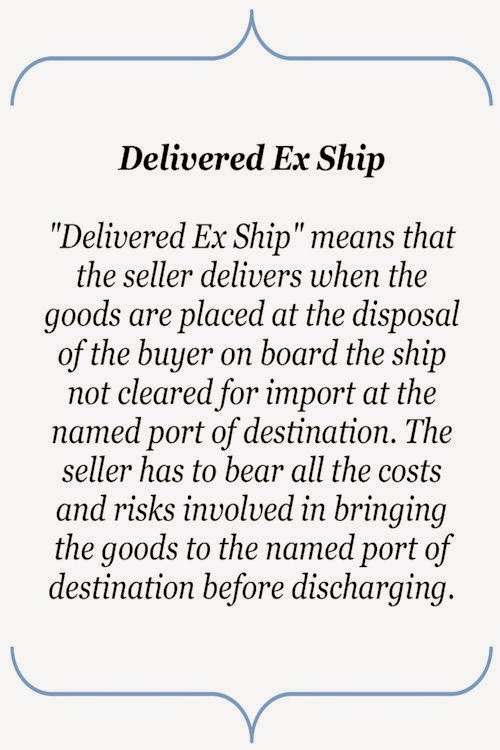
This new deal was announced during the World Petroleum Congress in Doha, Qatar (December 4-8, 2011) and was signed by the Qatari minister of energy and industry, Mohammed Bin Saleh Al Sada, Chubu Electric Power Company's general manager of the fuels department, Yuji Kakimi and Shizouka Gas' chairman and C.E.O., Seigo Iwasaki. Qatargas is already exporting to Japan 10 million tons of L.N.G. per year. This new deal will last for five years from 2016 to 2021 and according to the agreement every year Qatargas will be supplying to the Japanese companies 200,000 tons of L.N.G. (the final supplied quantity will be approximately 1,200,000 tons). The two companies will decide how to share the L.N.G. This will be delivered ex-ship to the following group of receiving terminals: Chita, Kawagoe, Yokkaichi, Joetsu and Sodeshi.

BACCI-Delivered-Ex-Ship


Also for this new S.P.A. the Qatari L.N.G. will be shipped from Qatargas 1, which has three trains (with an annual production of 2 million tons each) and is a joint venture with several stakeholders: state-owned Qatar Petroleum, U.S. ExxonMobil, France's Total and Japan's trading houses Mitsui and Marubeni.

“This agreement is remarkable in many aspects. It further nurtures our long lasting relationship with Chubu Electric Power Company while it welcomes Shizuoka Gas Company as the first new long-term Japanese buyer of L.N.G., in addition to those eight buyers which formed the currently existing consortium purchasing L.N.G. from Qatargas 1 joint venture for contracts signed in 1992 and 1994. It is also an example of how Qatargas can grow its share of the Japanese gas market in partnership with Chubu Electric Power Company” said Qatargas's C.E.O., Khalid Bin Khalifa Al-Thani. He also specified that "this agreement is further testimony of our long-term reliable commitment to Japan and the innovative ways in which Qatargas is able support new customers. Whether for a very large sale of L.N.G. or for a smaller volume like under this Tripartite S.P.A., Qatargas values all of its customers and seeks to assist them all in their aspirations to grow in the future.”

BACCI-Outline-of-the-LNG Contracts-Signed-at-the-World-Petroleum-Congress-December-2011

It should be underlined that during the World Petroleum Congress in Doha two other Qatari companies accomplished important results. Qatar's RasGas, the world's second largest L.N.G. producer after QatarGas, made public a contract with Taiwan's C.P.C. Corporation aimed at shipping 1.5 million tons per annum of Qatari L.N.G. This deal will have a 20-year duration. Moreover, Qatar Petroleum signed a memorandum of understanding (M.O.U.) with U.K. Centrica aimed at investments in upstream assets, facilities for gas storage, combined-cycle gas turbine generation assets and downstream opportunities. Still in 2011, Centrica had previously signed a three-year contract (valued $3.1 billion) with Qatar's state oil company, Qatar Petroleum International (Q.P.I., it's the international investment division of Qatar Petroleum) in order to receive 2.4 million tons per annum of L.N.G. Centrica has been having an established commercial relation with Qatar since 2003.

In recent years, Qatar has increased its L.N.G. supplies to both Europe and Asia. This was possible thanks to new facilities that were ready at the end of the 2010s. Japan has been buying L.N.G. for decades and now, after the Fukushima disaster of March 2011, L.N.G. imports will increase. In fact, the country is implementing some stress tests for all of the Japanese nuclear power plants while at the same time some nuclear plants are shut down for inspection and maintenance. At the end of November 2011, only 10 out of  54 nuclear units were in operations. It's quite evident that Japan's power companies are boosting their gas purchases. And L.N.G. is the best currently available solution. Estimates envisage for Japan a 2011 L.N.G. demand increase by at least 12 million tons. And Daisuke Harada, deputy general manager of Japan Oil, Gas and Metals National Corporation (Jogmec), has recently stated in 20 million tons the additional L.N.G. demand for 2012 if some nuclear reactors do not restart operations.

FLOWERLNG-Japan's LNG-Imports-by-Source-October2010-October2011


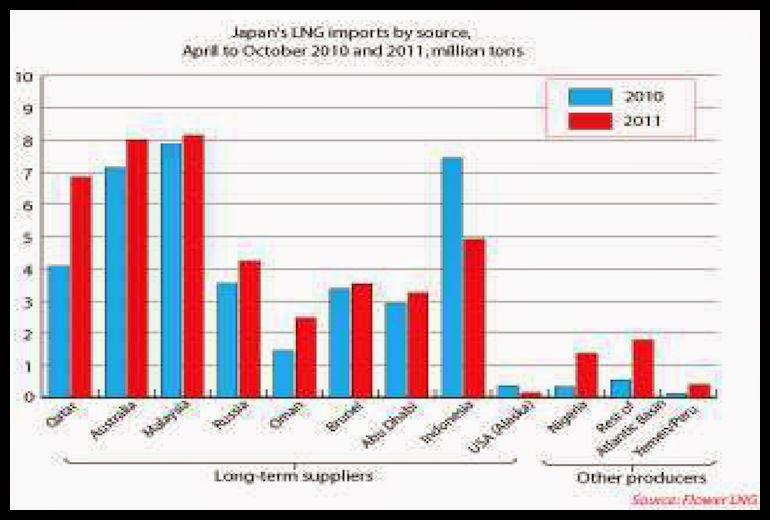
Data about L.N.G. imports for the period April-October 2011  showed a relevant increase of L.N.G. imports in comparison to the same months in 2010. The above graph from Flower L.N.G., a consultancy, well illustrates this trend. From April 2011 to October 2011, Qatar supplied almost 7 million tons of L.N.G., in practice 2.77 million tons more than the same period in 2010 (65.4 percent increase only from Qatar). Similarly, the other L.N.G. producers of the Atlantic Basin, not including Libya, increased their shipments (+1.24 million tons) as well as did  the two newest L.N.G. producers, Peru and Yemen (+0.27 million tons). Still, with reference to the period April-October 2011, among the long-term suppliers, apart from Qatar that increased by 65 percent its L.N.G. exports, also Australia (+0.87 million tons), Russia (+0.7 million tons) and Oman (+1.01 million tons) shipped more L.N.G. to Japan. At the same time, Japan received less L.N.G. from Indonesia (-2.51 million tons) and Alaska (-0.21 million tons). Among the other producers (those not bound through a long-term agreement), it's important to consider Nigeria (+1.03 million tons).

According to Japan's Ministry of Finance, in October 2011 the country overall imported 6.12 million tons of L.N.G. with a 17.9 percent increase in comparison to October 2010 (the highest annual increase since August 2011, when Japan imported a record 7.55 million tons meaning a 18.2 percent increase than the August 2010 imports). Considering these data, it's highly probable that adding all the involved exporters, Japan's L.N.G. imports for 2011 will reach the amount of 78 million tons to 80 million tons from 70 million tons in 2010 (with at least a 10 percent increase).

BACCI-Natural-Gas-Measures-and-Conversions


These Japanese purchases will not be without consequences in Asia. In fact, already few days ago, Nanang Untung, senior vice president of Indonesia's Gas PT Pertamina (Persero) stated that Qatar seems currently less attracted by the idea of exporting its L.N.G. to Indonesia than by the idea of exporting to Japan. This could very soon be a problem for Indonesia, which has recently encouraged the procurement of floating storage regasification units (F.S.R.U.s). These units are the three F.S.R.U.s located in Belawan, Teluk Jakarta and East Java (each has a capacity of 3 million tons per year). It's quite evident that at least the F.S.R.U. in East Java could experience a shortage of L.N.G. supply (up to now it has not secured any L.N.G. supply). All this situation derives from the fact that Japan — given the strategic importance for its economy of L.N.G. — is capable of purchasing L.N.G. at the price of $14 per million British thermal unit (MMBtu), while Indonesia may arrived at $11 per MMBtu (Japanese price is 27.2 percent higher than the Indonesian price). Obviously, high prices will soon put some stress on the business results of the Japanese power producers, but viable alternatives do not abound. And rates for the December 2011 L.N.G. delivery is from $17 per MMBtu to $17.50 MMBtu.

With no doubt, Qatar with its production capacity of 77 million tons of L.N.G. per year (by far the largest L.N.G. exporter in the world) could profit from the upsurge of L.N.G. prices in the short-to medium-term in the Asia-Pacific Region. In 2012, Japan and South Korea will necessitate probably 25 million metric tons, which could rise to 49 million tons in 2015 according to report released in December 2011 by Credit Suisse, a Swiss bank. Not to mention an increase in the Chinese and Indian L.N.G. needs. And this gas will come from Qatar. In fact, in the near term, the only player capable of increasing its exports catching the L.N.G. demand without a long-term contract is Qatar. Geographically speaking, Australia could supply the Asia-Pacific Region, but its new liquefaction plants (among them Gorgon and Queensland Curtis) won't be ready before 2014 with no significant contribution to global L.N.G. production before 2015. Russia, already an L.N.G. seller to Japan, would be an obvious candidate to supply additional tons of gas. In fact, for Russia it's preferable selling gas to Japan and South Korea than to China. Apart from Russia's gas projects in the Pacific also the Yamal L.N.G. project, located in the Yamal Peninsula (facing the Arctic Ocean), is developed targeting Asian buyers and one of them could certainly be Japan. And in order to partially lower L.N.G. prices it could also be of huge utility for Japan to have different sellers like Qatar, Australia and Russia. The problem is that apart from Sakhalin-2, which already well serves Japan, the other Russian L.N.G. projects will take time before being operative.

In other words, up to 2015 the real player with monopoly power in relations to short-term supply to be delivered to Asia — and consequently to Japan — will be Qatar. Now, the real job for the Gulf country will be to convert short-term supply into long-term supply based onto long-term contracts. The 2.77 million tons increase in L.N.G. sold to Japan from April to October were mainly diverted cargoes, which initially were supposed to ship L.N.G. volumes to Europe. At this regard, in September 2011, Qatar publicized plans of doubling its long-term contracts to Asian countries in the next years up to 20 million metric tons annually. In the end, at least for the next three years, Qatar has now metaphorically and concretely the power of moving the rudder.