Thursday, November 29, 2012

Does Lukoil Enter the Fray for Kurdistan's Oil?


November 29, 2012
 
BEIRUT, Lebanon Lukoil, Russia's second largest oil company and its second largest producer of oil, has recently bought condensate (very light oil) from Iraqi Kurdistan, notwithstanding Baghdad's position centered around the pivot point that only the central government has the right to negotiate oil deals in all Iraq. For the time being, the Russian company has not been the target of any economic reprisals by Baghdad and it maintains intact its desire of developing Iraq's southern oil fields.

Currently, Lukoil's Geneva-based trading arm, Litasco is the third company that has bought Kurdish condensate. The company has followed the two Dutch companies Trafigura and Vitol, which started their operations in October 2012. According to a spokesman with the Kurdistan Regional Government (K.R.G.) talking with reference to Trafigura's and Vitol's deals, the Kurdish condensate is swapped for refined products with a private Turkish company, with no cash transactions between the involved parties. Given the fact that there are no pipelines between Iraqi Kurdistan and Turkey, Kurdish oil is trucked from Iraqi Kurdistan to Turkey where it is loaded onto cargoes.

Up to now, it's not clear what will be Baghdad's reply to Lukoil's deal, especially bearing in mind that Lukoil was considered by the Iraqi government the most plausible purchaser of ExxonMobil's stake in West Qurna-1 oil field, which is located north of the Rumaila oil field, west of Basra (southern Iraq). ExxonMobil is now in talks for selling its stake in West Qurna-1 because of its energy deals with the Kurdish authorities. Deals that Exxon signed without having previously gotten the authorization from the central government. In fact, Baghdad considered ExxonMobil's Kurdish deals illegal and dismissed the American company's contract for West Qurna-1. Other companies that are facing the ire of Baghdad following their relations with the K.R.G. are U.S. Chevron, Russia's Gazprom and France's Total.

Also Trafigura's and Vitol's deals motivated harsh responses from Baghdad, but according to some Iraqi sources it seems now that this time with Lukoil Baghdad will be obliged to maintain a different stance. In any case, the involvement of both Trafigura and Vitol already means that Baghdad would have serious difficulties retaliating because it depends on these two firms for quite a substantial proportion of its refined oil imports (gasoline and diesel). Not buying from these two companies would immediately imply that Baghdad has to pay much higher prices for similar products on the market. Iraq has an insufficient oil refining capacity and suffers shortages of electricity. For this reason, gasoil is used to generate power. Following the war, internal riots and scarce investments, the country is now forced to import fuel for its energy requirements, and it's nowadays one of the biggest buyers of oil products in the Middle East.

"After checking with concerned parties, we got confirmation that LUKOIL has not purchased any kind of crude for the benefit of the K.R.G." said an official from Iraq's state oil marketer State Oil Marketing Organization (SOMO). Until now, the Iraqi government has not released any comment. Another hint that Iraq's position with reference to these oil deals could be softened is linked to the fact that last week it was announced that SOMO had finalized a term deal with British Petroleum (BP) and Vitol (the latter company is a regular supplier of gasoil to Iraq). The deal was related to the purchase of up to 1.097 million tons of gasoil for deliver in 2013. The two companies are likely to ship the gas either from Bahrain or from Kuwait, two countries where they have term contracts.

Industry sources told Reuters that Litasco had chartered the tanker "Cielo di Napoli" to load about 19,000 tons of Kurdish condensate from the port of Toros at Ceyhan in Turkey. The tanker "Cielo di Napoli" sailed on November 21. Lukoil's trading company won its contract outbidding competing bids from Trafigura and Azerbaijan's Socar and bought the condensate in a public tender (with a $3.00 discount to naphtha prices) thanks the intermediary role played by Powertrans.

The condensate trade with Turkey started last July following an agreement with Ankara. The basic idea was to augment the quantity of refined products (kerosene and diesel) for Erbil. Notwithstanding Ankara's blessing, these truck deliveries were immediately considered illegal by Baghdad. According to Kurdish sources, Kurdistan's export volumes were 12,000 barrels per day in October 2012, but deliveries seem now to have increased and to continue to increase. Obviously, it's a tiny fraction of Kurdish oil in comparison to Kurdish oil exports to Iraq, which following last September's agreement between Baghdad and Erbil were set at 200,000 barrels per day during the last quarter of the year. Iraqi Kurdistan obtained an agreement with Baghdad and was  entitled to receive 17 percent of refined products in Iraq. Trade with Turkey should come under that specific quota.

Summing up, there is no doubt that Vitol's and Trafigura's role is very important with reference to Iraq's fuel imports. But Lukoil's role in Iraq has and according to Baghdad should have in the future a much more relevant responsibility for the development of the country's oil sector. In fact, Baghdad, following the quarrel with ExxonMobil, which had invested into Iraqi Kurdistan, started promoting the takeover of West Qurna-1 by Chinese and Russian energy companies. The American company seems rather to be more interested into the contractual terms offered by the K.R.G. and into pulling out of Iraq's $50-billion West Qurna-1 project. Lukoil's move into Iraqi Kurdistan the Russian company is already one of the largest investors in Iraq could be a real attempt at winning contracts in the semiautonomous region of Iraqi Kurdistan (three governorates out of eighteen for the whole Iraq) without Baghdad's preventive authorization, but especially without losing contracts in the other energy-rich areas of the country.

Energy analysts point out that up to now the difference between Erbil's oil contracts and Baghdad's was very noteworthy for a company's balance sheet and that it was difficult to resist Erbil's calling. And being Lukoil Baghdad's preferred candidate for substituting ExxonMobil in southern Iraq, the company could be successful in signing up to contracts with Erbil's government without real possibilities of economic reprisals with reference to its southern contracts.

In fact, in December 2009, Lukoil together with Norway's Statoil was awarded the rights to develop the West Qurna-2 giant oil field. Lukoil is planning to invest about $25 billion during a timeframe of twenty years. This field according to current estimates should be able to produce 500,000 barrels per day in 2014, and then, in the following years, should raise its production up to 1.8 billion barrels per day. No doubt that it would be difficult for Lukoil to work to another big project like West Qurna-1 replacing ExxonMobil while it is also developing West Qurna-2. In this regard, despite a certain interest toward West Qurna-1, the Russian company last week declared that it would decide about its possible involvement in West Qurna-1 by the end of the year. In brief, the company is taking time. Together West Qurna-1 and West Qurna-2 could be producing around 6 percent to 7 percent of world's oil production.

Having closed the doors of southern Iraq to ExxonMobil and the other Big Oil companies involved in Kurdistan could really jeopardize Baghdad's production targets unless valid and reliable substitutes are found quite soon. The exploration auction held in May 2012, which had very few takers in the licensing round, is a clear reminder that current the technical service contracts (T.S.A.s) offered by Iraq are not so appealing for Big Oil companies, which prefer Kurdistan's production sharing agreements (P.S.A.s). The latter contracts offer to an oil company a defined share of the production, which may be added to the company's balance sheets. Thanks to this, a company's valuation increases and the company may obtain more easily bank loans. The offered share stays the same, either if project costs and/or oil prices move upwards or downwards. Instead, Baghdad's T.S.A.s are not very attractive and companies have to undertake the exploration projects while it is much more difficult to raise debt to finance their operations. In this case, only large companies are able to undertake these projects, but, given the fact that it's possible to find better alternatives on the market, it goes by itself that Iraq's T.S.A.s are not easily subscribed right now. Moreover, the business environment and bureaucracy are less chaotic in Iraqi Kurdistan than in Iraq. In the end, Big Oil's moves in Iraqi Kurdistan are much more understandable and rational than it could appear at first sight.


Sunday, October 21, 2012

Rising Tension in Lebanon After Friday's Car Bombing

BACCI-Rising-Tension-in-Lebanon-After-Friday's-Car-Bombing-Oct.-2012
 
October 21, 2012

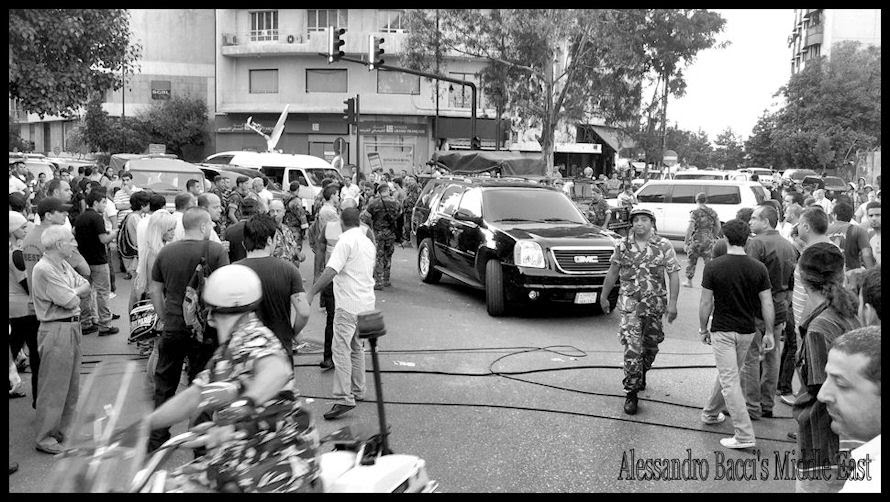
BEIRUT, Lebanon  Tension has been rising sharply in Lebanon after Friday afternoon's car bombing (October 19), which exploded close to Sassine Square in Beirut's Ashrafieh, a Christian central neighborhood. The bomb detonated in a narrow street that is in the proximity of the headquarters of Saad Hariri's 14 March Alliance. The explosion was well heard around the city from adjacent areas like Gemmayze and Mar  Mikhael to the far hilly neighborhood of Baabda. The blast took the life of eight people, wounded scores and completely ripped off at least two buildings.


The target of the bomb was the head of the Lebanese intelligence branch of the Internal Security Forces (I.S.F.), Brig. Gen. Wissam al-Hassan, a Sunni Muslim who was profoundly anti-Syrian and who was very close politically to Saad Hariri. Mr. al-Hassan was probably going to be the I.S.F. next head. A couple of months ago he had been behind the investigation that was later the basis for prosecuting the former Lebanese information minister, Michael Samaha and two Syrians for complotting in order to foment religious hatred in Lebanon.
 
Previously, Mr. al-Hassam directed an investigation into the deaths of the Prime Minister, Rafic Hariri and 21 other people in February 2005. His analysis pointed out strongly toward Syria and Hezbollah's direct implication into the murderous attack. At this regard, it should be noted that the Syrians at the time of the blast still had a military presence in Lebanon. Until last Friday, Mr. al-Hassam had been able to escape several assassination attempts. "He used to move around according to exceptional safety measures and he had his family installed in Paris because he felt himself as a target" added Samir Geagea, a prominent Lebanese politician, senior member with the March 14 Alliance.


Immediately after the blast, many anti-Syrian a politician, like Saad Hariri and Druze leader Walid Jumblatt, started accusing President Bashar al-Assad of Syria to be behind the explosion. And Mr. Hariri's coalition also requested the government, which is run by Prime Minister Najib Mikati, to resign because of its inability to maintain internal security in the country. In fact, Lebanese politicians (especially those belonging to the opposition) are scared by the possible direct involvement of Lebanon into the current Syrian turmoil. It's worth remembering that the Syrian Army withdrew from Lebanon only in 2005, after a 29-year occupation. On Saturday, Mr. Mikati offered to resign so as to create a government of national unity, but President Michel Suleiman requested him to stay in power and to find a way out from this political crisis.


Late Friday, some protests started in Beirut and Tripoli, especially in Sunni-inhabited areas. Currently, people are burning tires and are blocking several roads. On Sunday morning, a fifteen-year-old boy was killed by a random gunfire while confrontations between supporters and opponents of Syria's president occurred in Tripoli. While thousands of Lebanese attended peacefully (but, unequivocally chanting against the government and Syria) the funeral of Mr. al-Hassam in Beirut's Martyrs' Square in the early afternoon of Sunday, then later some people started storming with stones and metallic rods the government offices located nearby. The police retaliated with warning shots and tearing gas.

With reference to the current turmoil in Syria, the Muslim community in Lebanon is almost perfectly split between Shias, who support President Bashar al-Assad of Syria, and Sunnis, who support Syrian rebels (Druze people are much less numerous). Before Friday afternoon's car bombing, tension had already risen in Lebanon for almost a week, following last Sunday's (October 13) Martyrs' Square's sit-in. On that occasion, the powerful Salafist Sheikh al-Assir from Saida (Sidon) he gained a lot of popularity some months ago after that he and his followers had blocked the road between Sidon and Beirut held a Sunni sit-in in Martyrs' Square, which is the same square where today was celebrated the funeral. While on stage, he hurled all his anger toward Syria's president and Hezbollah. The Sunni rally ended peacefully, but later Sheikh al-Assir's convoy was pelted with stones in central Beirut on its way back to Saida.


The situation looks quite unstable right now and there is now fear that the country may fall back to a cycle of sectarian violence and reprisals, which it has undergone in the past four decades. The only real hope is that Friday's car bombing was only an isolated sort of reprisal against a man who was deeply anti-Syrian and who, as said above, had already escaped some assassination attempts. Instead, were this car bombing the first piece in a series of terrorist attacks, the situation could really push Lebanon into another civil war.

At the beginning of al-Hassan's funeral, politicians, the military and security officials attended at the I.S.F. headquarters a ceremony held with full military honors. There, President Suleiman said that the government and Lebanese people must work "shoulder to shoulder" to overcome these sad events. And then he added: "I tell the judiciary do not hesitate, the people are with you, and I tell the security be firm, the people are with you, with you. And I tell the politicians and the government do not provide cover to the perpetrator." Beautiful words, indeed.

The next days will now prove whether Lebanon will continue with the peaceful normality of the last four years or it will revert to the previous turmoil.


Tuesday, September 4, 2012

Hydrocarbons Tensions Between Erbil and Baghdad Don't Seem to Abase


 September 4, 2012
 
On Thursday July 19, 2012, the American oil giant Chevron declared that it was in the process of purchasing oil interests in Iraq's semi-autonomous Kurdistan region. In specific, the super-major stated that it would acquire from India's Reliance Industries Ltd. an 80 percent stake of two blocks (called Rovi and Sarta, with the related operational control) located north of the city of Erbil within Iraqi Kurdistan. The junior partner in the two blocks would be Austria's O.M.V. (O.M.V. Rovi GmbH and O.M.V. Sarta GmbH). Unconfirmed sources spoke of a $300 million deal.

A few days later on Tuesday, July 24, 2012, the Ministry of Oil of Iraq released a statement that explicitly stated that "Chevron is barred [banned] from any agreement or contract with the federal ministry of oil and its companies ... unless it retreats from the contract it signed in the Kurdistan region". The latter in turn stated that all and any deals it had signed well complied with the country's new constitution. In other words, Chevron was disqualified from doing business in the central and southern part of Iraq, where it previously had prequalified to bid. Chevron, when replying to the ministry's statement, explained that it had been working in Iraq since 2003 and that it would be interested into participating to new businesses if these met its investment criteria. Moreover, at the time of reply, Chevron had no stake to lose in southern Iraq as a consequence of this disqualification.

This banning was the direct consequence of the long dispute between Iraq's federal government in Baghdad and the Kurdish Regional Government (K.R.G.) in Erbil in relation to the control of Kurdish hydrocarbons production and the related consequent export from Iraqi Kurdistan. This current confrontation was and still is today well amplified by the lack of legislation for the energy sector in Iraq.

Because of the current argument between Baghdad and Erbil, several major foreign oil companies up to now have preferred to avoid buying or just being involved with assets located in Iraqi Kurdistan and/or in the territory right now disputed between Baghdad and Erbil. Certainly, signing directly with the K.R.G. a contract that could be nullified by the central government is not the best way to conduct oil operations in an already-difficult country like Iraq.

Until this spring, the only super-major operating in Iraqi Kurdistan had been ExxonMobil, which in October 2011 declared that it was the first oil super-major to purchase the rights for some oil fields within Kurdistan — in specific, the deal concerned six oil fields. Also in this case the central government's subsequent move was to ban Exxon from any future oil and gas deal with Iraq. It should be noted that ExxonMobil was already running a very giant oil project in southern Iraq.

What was immediately clear was that the central government's opposition to the K.R.G. contracts would lose weight if another super-major started operating in Kurdistan. In fact, already in the previous months of 2012, other foreign big-oil companies seemed interested into working in Iraqi Kurdistan, notwithstanding the fact of being consequently excluded from energy operations in central and southern Iraq. To support this thesis, last spring's energy auction (Iraq's fourth energy auction, which included both oil and gas blocks) held by the federal government for twelve blocks located in southern Iraq raised very limited interest from foreign companies. In practice, only two blocks were sold and not to the big companies.

Big-oil companies do consider the terms imposed by the Iraqi Oil Ministry for investing in Iraq as excessively onerous with reference both to payment terms and the revision of the original targets so as to increase capacity. In practice, Erbil permits production sharing agreements (P.S.A.s) in its oil fields, while Baghdad only signs simple fee-based service contracts. Before Chevron's arrival, in Kurdistan were already working several small- and mid-sized oil and gas companies (among them, Norway's D.N.O. and Austria's O.M.V., which is partially owned by Abu Dhabi's International Petroleum Investment Company (IPIC)). With no doubt, if big players could really add to the minor oil and gas companies it would be a good outcome for the local energy sector, which requires, especially in the initial phases, imposing investments. So, the scarce attractiveness of Baghdad's contracts pushed big-oil companies to be focused much more than in the past on Iraqi Kurdistan. And a few days after Chevron's move, at the end of July, France's Total followed suit in Iraqi Kurdistan buying a 35 percent stake in the Harir and Safen blocks (covering an area of 705 square miles) from U.S. Marathon Oil Corp. Until this summer, the K.R.G. had signed about 50 exploration contracts with minor oil and gas companies (some of them are really wildcatters). And indeed Baghdad considered all these deals to be illegal and already blacklisted some companies that had negotiated with Kurdistan (one of these is U.S. Hess Corp. which like ExxonMobil was excluded from Iraq's fourth energy auction). Three months ago Iraq explicitly asked President Barak Obama to convince Exxon not to explore in Kurdistan, signaling in this way the importance for Baghdad to completely control its hydrocarbons sector.

On April 1, the K.R.G. stopped its oil export consisting of around 120,000 barrels a day through a Baghdad-controlled pipeline from Kirkuk to the Turkish port of Ceyhan. The reason behind this move was that the central government was retarding the payment of approximately $1.5 billion to the contracting companies. Later, on August 7, the K.R.G. restarted the oil shipments, but it clearly stated that it would interrupt them one more time, if within one month there would be no agreement on the payment that Baghdad should give to the contracting companies. Lately, on Saturday September 1, according to Kurdish sources, the K.R.G. extended the deadline until September 15 as a goodwill gesture. This move should permit Baghdad to have more time in order to resolve the payment issue.

Currently, shipments from Kurdistan are around 120,000 barrels per day, although Baghdad affirms that the amount should be 175,000 barrels per day (something less than 5 percent of Iraq's total production, which reached in August 2012, 3 million barrels per day), which, in October 2011, were agreed upon for year 2012. Iraq between 2010 and 2012, as a consequence of the interruptions of the K.R.G. shipments lost some $8.5 billion and according to Deputy Prime Minister Hussein al-Shahristani of Iraq it would be correct if the government deducted this sum from the national budget allocated to the K.R.G.

In any case, it should be understood that presently Kurdistan does not have any available shipping alternative to the Iraqi pipeline  trucking oil to Turkey or Iran is absolutely not a 100 percent substitute and that Kurdistan is strongly dependent on the yearly budget allocation it receives from Baghdad. This allocation  reached in 2012 almost $11 billion (It's about 17 percent of the whole Iraqi national budget, although Erbil receives something less, probably just 13 percent, as a result of deductions utilized to cover federal expenditures for a range of items of which the Kurdish region benefits like the rest of Iraq). But  and here lies the problem for Baghdad according to Ashti Hawrami, the natural resources minister of the K.R.G., Erbil wants to reach 1 million barrels per day by 2015. In reality, if Erbil were able to produce just 400,000 barrels per day of oil and to export them with a new Kurdish pipeline to Turkey, it could make $14.6 billion (considering a $100 per barrel of oil ). This value is consistently superior to the budget allocation Erbil receives now from Baghdad. In other words, economic self-sufficiency could be a potent tool to lately declare independence from Iraq. And of course, when Kurdistan and Turkey announced last May that they were planning to build this direct pipeline (with one million barrels per day of capacity) from the K.R.G. to Turkey by 2013 in this way bypassing Iraq, the federal government instantly defined this plan as very hostile. Plus, toward the end of July, Iraq accused Turkey and Kurdistan of doing illegal oil trade on the basis that only Iraq's central government may export oil. And adding oil to the fire, the visit of Turkey's foreign minister, Ahmet DavutoÄŸlu, to Erbil on August 2012 increased tension.

Chevron's move indeed follows a protracted stand-off between Iraq’s federal government and the K.R.G. over the control of oil production and exports from Kurdistan. It immediately seemed quite improbable that Baghdad could completely boycott Kurdistan while at the same time its own energy auctions had reaped so scarce an interest. According to Kurdish sources, Erbil would like to reach a production of 2 million barrels a day by 2019 (the intermediate step will be 1 million barrels a day by 2015 as pointed out by Mr. Hawrami ) from a current value of only 300,000 barrels a day.

Almost nine years have passed since that December 13, 2003 when President Saddam Hussein was captured by the U.S. forces near Tikrit. Iraq, an OPEC member which owns the third largest proven oil reserves in the world (143 billion barrels) does not possess yet a binding hydrocarbon law, the so-called Iraqi Federal Oil and Gas Law (FOGL). In fact, the 2007 draft law was immediately marred by political infighting among different factions. The current dispute between Erbil and Baghdad is the direct consequence of their century-old struggle, and now, dangerously, hydrocarbons could buttress Iraqi Kurdistan's economic autonomy if not in the future its independence.