
BEIRUT, Lebanon — Recent events in Iraq have shown that the Islamic State has partially lost some of its initial offensive capabilities, and it is now more on the defensive. Today it is difficult to have a clear idea of what will happen to Iraq as a country in a medium- to long-term time frame. Many are the political possibilities. But, with reference to the Iraqi oil sector it is already possible to sketch some basic features. In particular, it is emerging more and more a structural and marketing separation between the two most important Iraqi oil-producing areas, i.e., southern Iraq and northern Iraq, the latter including both the fields within the Kurdistan Regional Government (the K.R.G.) and the fields within Kirkuk Governorate. This separation is reinforced by the poor status of the main pipelines used to export crude oil produced in Iraq. At the same time, notwithstanding the current difficult conditions of doing business in the entire Iraq, for international oil companies (I.O.C.s) both the fields in northern Iraq and those in southern Iraq represent important investment opportunities on a long-term horizon. The aim of this analysis is to show why.
A Political Premise in Order to
Better Understand the Current Oil Developments in Iraq
Recent
developments in Iraq show that the Islamic State is now on the defensive. The attacks carried out by Iraqi, Kurdish and American forces are presently reversing the military gains that the Islamic State obtained last year when the
terrorist organization menaced both Erbil and Baghdad. This is indeed very good
news. At the same time a huge question mark is what will happen next at the
political level, i.e., what will happen to Iraq as a state? In fact, political
reconciliation between, primarily Sunnis and Shia, is not progressing as quickly
as it should. In this regard, much of the Islamic State success in 2014 was
based and facilitated by the non opposition of many Sunni communities in
central and western Iraq; these communities were completely disenfranchised
from the divisive policies implemented until last August by the central government
in Baghdad at that time under the premiership of Nuri Kamal al-Maliki.
Iraq's
new prime minister, Haider al-Abadi, who assumed office in September 2014,
since last fall has been doing a great job at smoothing down the differences between
the different components of the Iraqi society. His job is not easy; he
faces strong opposition especially from the State of Law coalition (Shia) of
Mr. al-Maliki; and he has to follow at least some directives emanating from Iran.
Under these current conditions it is difficult that the central government will
be able to win the hearts of the Sunni people of central and western Iraq, who
are completely scared by the possibility of being, for a second time in a few years, second-tier
citizens under the effects of a political marginalization, if not an ethnic
cleansing. One of the possible scenarios of the coming months is that Iraq will
continue to be a fragmented country where, the Islamic State, after having lost part of its military capacities, which are of paramount importance if it wants to continue conquering additional parts of
Iraq, will retrench back to that ample swath of territory comprised between eastern Syria
and central and western Iraq. Summing up, the months ahead won't be absolutely
easy for Iraq.
Surely, in 1932, King Faisal I of Iraq's words were quite prophetic:
In this regard and with my heart filled with sadness, I have to say that it is my belief that there is no Iraqi people inside Iraq. There are only diverse groups with no national sentiments. They are filled with superstitious and false religious traditions with no common grounds between them. They easily accept rumors and are prone to chaos, prepared always to revolt against any government.
The Current Upstream Structure
of Iraq's Oil Sector
The political
premise was necessary in order to understand the evolution of the crude oil
business in Iraqi Kurdistan and Iraq proper. According to the Oil & Gas
Journal, Iraq owned 144 billion barrels of proved crude oil reserves as of
January 1, 2015. These oil reserves represent around 18 percent of the proved
reserves in the Middle East and 9 percent of the world's proved reserves. Iraq
has the fifth largest proved crude oil reserves after Venezuela, Saudi Arabia,
Canada and Iran — of course crude oils from these countries have different
characteristics and different costs of extraction.

The
table below released by the U.S. Energy Information Administration (E.I.A.) at the end of January 2015 well summarizes Iraq's oil current development.

In specific, the table shows how most oil reserves are concentrated in:
In specific, the table shows how most oil reserves are concentrated in:
- SOUTHERN IRAQ, which is a Shia area under the control of the central government
- NORTHERN IRAQ, which could be split in two sub-areas: Iraqi Kurdistan, a Kurdish area, and the Kirkuk Governorate, which has a mixed population.
Iraqi
Kurdistan is already a semi-autonomous region with special powers: In practice
it is a Kurdish area within an Arab country. But, with reference to Kirkuk
Governorate, which is one of the three governorates disputed between the Kurdistan Regional Government and Iraq proper, things are not so
straightforward. For more information please see: BACCI, A., Iraqi Kurdistan's Occupation of Kirkuk Oil Field Will Deeply Affect the Iraqi Oil Sector, June 2014. On June 12, 2014, Kirkuk was taken by Kurdish forces,
which in this way blocked the possibility that the city and its precious oil
reserves fell in the hands of the Islamic State.
Data
from the above table clarify how the bulk of the Iraqi production comes from five
giant oil fields in southern Iraq (Rumaila, West Qurna-1, West Qurna-2, Zubair
and Majnoon), two oil fields in Kirkuk Governorate (Kirkuk and Bai Hasan) and
three fields in the K.R.G. (Khurmala Dome, Tawke and Taq Taq). In the central
Iraq under government control, for the time being, only the Ahdad field in
Wasit Governorate has a relevant production capacity (140,000 bbl/d); this
field is linked to the southern export infrastructure. Instead, the area under
the Islamic State occupation is an area that to date has never been seriously developed with reference to oil and gas reserves. The nine oil fields mentioned above are the
bulk of Iraq's oil production, which in 2014 was approximately 3.4 million
bbl/d with an overall export of 2.82 million bbl/d in January 2015 (150,000
bbl/d from the K.R.G. and the remaining 2.67 million bbl/d from southern Iraq).
The
separation of Iraq's two oil-producing areas (southern Iraq and northern
Iraq, the latter including both the fields in the K.R.G. and in Kirkuk
Governorate) is reinforced by the poor status of the main pipelines used to
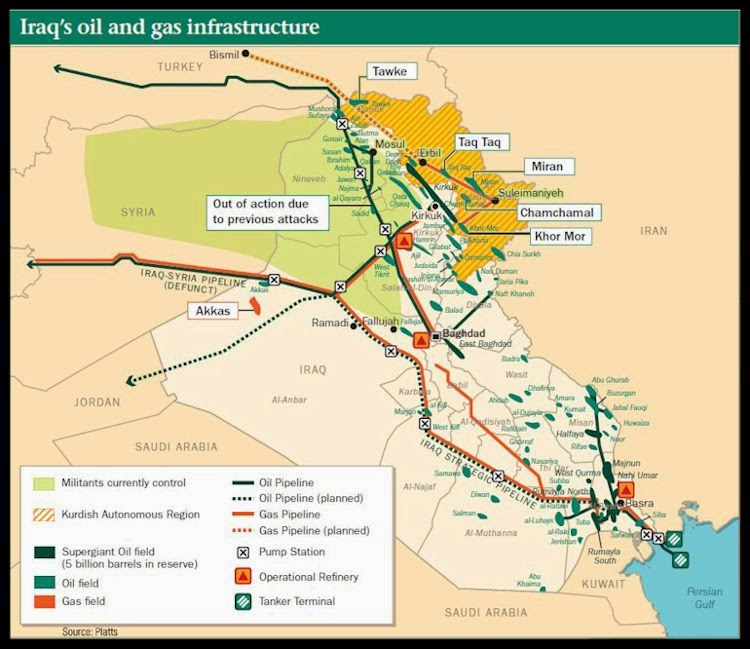
export crude oil produced in Iraq. In fact, of the three international crude
oil pipelines present on the Iraqi soil, two are completely not operating, and the
Kirkuk-Ceyhan pipeline has in operation only the section related to the Turkish
part from Fishkhabur (Iraq-Turkey border) to the port city of Ceyhan in Turkey.
The Iraqi section of the Kirkuk-Ceyhan pipeline (from Kirkuk to Fishkhabur) has
been out of service since March 2014 as a consequence of repeated militant
attacks. In fact, this pipeline runs through Islamic State-controlled
territory.

In the last years, the Kurds have built two pipelines that enter the Kirkuk-Ceyhan pipeline at Fishkhabur:
In the last years, the Kurds have built two pipelines that enter the Kirkuk-Ceyhan pipeline at Fishkhabur:
- The Khurmala Dome-Fishkhabur, which has a nameplate capacity of 300,000 bbl/d, and which moves crude oil from the Khurmala Dome field (Iraqi Kurdistan's KAR Group) and the Taq Taq field (U.K. Genel Energy and China's Sinopec) to the border with Turkey. The K.R.G. is currently working in order to increase the capacity of this pipeline.
- The Tawke field-Fishkhabur pipeline, which has a nameplate capacity of 100,000 bbl/d, and which moves oil from the Tawke field (Norway's D.N.O. and Genel Energy). The companies working at the Tawke field are presently expanding the pipeline's capacity.
Since
May 2014 the K.R.G. has been exporting its crude oil to Turkey via its new
Kurdish pipeline system, which is connected to the Turkish section of the
Kirkuk-Ceyhan pipeline. Baghdad strongly opposes these exports, which it deems completely
illegal.
 |
| The Taq Taq-Fishkhabur Oil Pipeline - Source: The American Interest (Dec. 2013) |
In
addition, the Strategic pipeline, the major Iraqi internal pipeline, which runs from
Kirkuk to the Persian Gulf, is not operating. This is a reversible pipeline
meant to transport Kirkuk's crude oil to the port city of Basra in southern
Iraq and vice versa. Today the only part of the pipeline working is the section
from Basra to Karbala, and it is used in order to send crude oil to the
refineries in Baghdad.

Iraq's
political framework, coupled with the current infrastructural separation
between the fields of northern Iraq (the K.R.G. fields and the fields in Kirkuk
Governorate) and the fields of southern Iraq, exemplify the fact that Iraq's
two principal oil-producing areas are practically two separate entities. Crude
oil from the northern fields no longer may be exported from the port of Basra
or the port of Khor al-Amaya; northern crude oil has necessarily only one
exporting route from Iraq, i.e., the one that goes north to Turkey via the
Turkish section of the Kirkuk-Ceyhan pipeline. And Turkey is not only a
significant oil consumer in its own right, but it is also a natural energy hub
between three major oil-producing areas (Russia, the Caspian Sea basin and the
Middle East) and the European consumer markets. Moreover, Ceyhan is a port that
is able to accommodate very large crude carriers (V.L.C.C.) and ultra large
crude carriers (U.L.C.C.).
Conversely,
from southern Iraq crude oil is easily exported to Asia. In this regard,
according to E.I.A. in 2014 about 95 percent (or approximately 2.47 million bbl/d) of Iraq's
crude oil exports came from the country's southern export terminals in the
Persian Gulf. Of the total Iraqi exports in 2014, 58 percent went to Asia —
China 22 percent, India 19 percent, South Korea 9 percent, other Asian
customers 8 percent) — 19 percent to Europe, 17 percent to the Americas and 6
percent to other customers. In other words, southern Iraq is a perfect location
in order to ship crude oil to Asia.

ExxonMobil Understood This
Separation Between the Two Producing Areas Almost Four Years Ago
U.S.
ExxonMobil perfectly understood the virtual separation of the two producing
areas almost four years ago; in October 2011, the American company and the
semi-autonomous Iraqi Kurdistan signed an oil deal aimed at developing six
Kurdish exploration blocks, of which at least two (the Qush and Bashiqa blocks)
were within the territories disputed between Erbil and Baghdad. For more information please see: BACCI., A., ExxonMobil Caught Between Erbil and Baghdad, February 2013.
In this
way, the American energy company bypassed Baghdad's authorization. In fact,
Baghdad affirms that it alone has the right to negotiate and sign energy
deals for the entire Iraqi territory, the K.R.G. included. Erbil insists
that Iraq's Constitution allows it to agree to contracts, and as a
result to ship oil independently of the central government. After ExxonMobil
other I.O.C.s followed suit. Among them, U.S. Chevron, France's Total and
Russia's Gazprom Neft. An additional problem was the type of contract signed by
the K.R.G. In fact, Erbil started to sign production sharing contracts
(P.S.C.s), which Iraq's central government has always deemed illegal because the only oil
and gas contracts legal in Iraq should be technical service contracts
(T.S.C.s). For more information please see: BACCI, A., Chevron and Total Continue Investing in the K.R.G. A Brief Analysis of Baghdad's T.S.C.s vs. Erbil's P.S.C.s, June 2013.
Immediately after the signature of the deal between
ExxonMobil and the K.R.G., started ExxonMobil's a dispute with the central
government, with the latter threatening, as a retaliatory move following the
Kurdish deal, cancellation of the U.S. company's 20-year T.S.C. related to
the development of the giant West Qurna-1 oilfield in southern Iraq where
ExxonMobil was the operator with a 60 percent stake in the project. For more information please see: BACCI, A., ExxonMobil Caught Between Erbil and Baghdad, February 2013. Despite
rolling declarations the federal government did not accomplish much. After
two years, in November 2013, PetroChina agreed to buy a 25 percent stake in
West Qurna-1 from ExxonMobil's stake. This move had well been planned in
advance by ExxonMobil which wanted to reduce its investment in West Qurna-1 diminishing its economic exposure while at the same time remaining the operator of the
field — today ExxonMobil is still the operator in West Qurna-1. After this
sale, the dispute between ExxonMobil and Iraq proper left the place in the
federal government's priorities to more contingent and risky events like the
emergence of the Islamic State insurrection.
ExxonMobil's position with reference to its
activities in the K.R.G. also created some friction points — at least this was
what emerged through public communications — with the Department of State, which
was worried that I.O.C.s' investments in the K.R.G. could create irreparable
fissures and cracks in the edifice of the Iraqi state with unintended
consequences for the entire Middle East. But, ExxonMobil's position, as well as
Chevron's position some months later, was very clear from a business
perspective. Iraqi Kurdistan was, and still is today, a good investment for an
I.O.C. ExxonMobil and Chevron are multinational corporations and need
to manage the interests of their shareholders, employees, and worldwide
affiliates that pay taxes in several different countries. In general, American
I.O.C.s "act in harmony with the U.S. foreign and energy security policy only when their interests are congruent, or under severe threat, such as that of legal action." (Vivoda, 2010). With reference to the K.R.G./Iraq proper
conundrum, the U.S. position has partially changed in the last months as it
became apparent through the declaration of Deputy Spokesperson Marie Harf of the State Department, who at the beginning of January said "that the United States doesn't have a ban on oil sales from any part of Iraq and that Iraqis have to come to an agreement on energy issues to avoid 'any legal ramifications'."
The
December 2014's Agreement and Iraq's
2015 Budget
An improvement in the relations between Erbil and
Baghdad occurred last December when after three months of lengthy
discussions, the two parties reached a deal with reference to the distribution
of oil revenues in Iraq. According to this agreement, which should have one-year
validity, the K.R.G. has to supply to Iraq's State Organization for Marketing of Oil (SOMO) 550,000
bbl/d via the Kurdish pipelines to the port city of Ceyhan. About 250,000 bbl/d
will flow directly from Iraqi Kurdistan and 300,000 bbl/d from Kirkuk.
According to Iraqi officials, the K.R.G. can continue to export more than
250,000 bbl/d, but there is a caveat: The legal action undertaken by the federal
government against the K.R.G. regarding the K.R.G. independent oil exports will also continue. A
supply of 550,000 bbl/d is not easy to achieve immediately. At the beginning of 2015, the K.R.G. is now able to
move to Fishkhabur approximately 400,000 bbl/d — it plans to reach 1 million
bbl/d by the end of 2015, said last December Natural Resources Minister Ashti
Hawrami of the K.R.G. In this regard, on January 20, Oil Minister Adil Abdul-Mahdi of Iraq detailed
a plan to export 375,000 bbl/d from Kirkuk and the Kurdistan region in the first
three months of 2015. If on the one side, this agreement has improved the
relationship between the K.R.G. and Iraq proper, on the other side, it is roughly
outlined and defers a number of contentious issues to future discussions — in
specific about the K.R.G. energy policy and the control of the Kirkuk oil field. For
more information please see: BACCI, A., The Iraqi-Kurdish Oil Deal, December 2014.
After fighting the Islamic State
insurgency, the most pressing problem that both the K.R.G. and Iraq proper currently have to face is the shrunken revenues linked to the plunging of oil prices;
85 percent of Iraq's economy is based on oil. The federal budget for the year 2014
was never approved, and the budget for 2015, which was approved and passed by
Parliament — despite the opposition of the State of Law — at the end of January,
is short of what was initially planned. The new budget is worth 119 trillion
Iraqi dinars, i.e., 105 billion dollars. The price of oil envisaged by the
budged is fixed at $56 a barrel — initially it was assumed a price of $70 per
barrel and this price difference means that there is a deficit of 25 trillion
dinars, i.e., 22 trillion dollars. The budget of the Peshmerga forces was
included within the budget of Iraq's Ministry of Defense. Following the vote of
the budget, the federal government is obliged to provide again 17 percent of
the federal budget to the K.R.G. as written in the Iraqi Constitution — in
January 2014 Baghdad stopped its payments to Erbil as a protest against the
K.R.G. independent energy policy.
For
an I.O.C. Investing in the K.R.G. and/or Southern Iraq Makes Sense on a Long-Term Basis
The International Energy Agency (I.E.A.) estimates that Iraq is
going to account for as much as 45 percent of the increase of the global oil
production until 2035. In other words, if there is a country that in the coming
years could provide an additional and important crude oil supply, this country
is Iraq, where, in addition to relevant supplies, production costs are very
low. We are referring here to the so-called "accounting
breakeven" of the project, i.e. the oil price necessary for an
oil-drilling project to create profits. On average, in
Iraq proper it costs about $5 to produce a barrel of oil; with reference to the
K.R.G., we are in the same range. For instance, Genel Energy, one of the operators in Iraqi Kurdistan, has finding and
development costs (F&D) less than $3 a barrel and operating expenses (OPEX)
less than $2. Tony Hayward of Genel Energy
has recently declared that his company could still profitably produce a barrel
of oil with oil prices around $20 a barrel. In times of low oil prices, low
production costs are a huge advantage for oil-producing countries and the
companies technically doing the job.
At the time of this writing both the fields in northern Iraq and those
in southern Iraq remain unscathed by the Islamic State militants. It's probable
that the Islamic State won't be able to enter easily those two areas. This
means that production from those two areas will continue notwithstanding many
difficulties. Moreover, with reference to the goal of improving their fiscal
position, both the K.R.G. and Iraq proper have no real viable alternative to
exporting crude oil. No matter what the price of oil is on the international
markets, both the K.R.G. and Iraq proper need to export their oil. The current
slump in the price of oil is forcing many OPEC members, and among them Iraq, to
cut their price in order to defend their market share; in January, Iraq proper set the price of its Basra Light at a discount of
$3.70 a barrel to the average of Middle Eastern benchmark Oman and Dubai grades
(widest discount since August 2003). Iraq (including
the K.R.G.) remains a member of OPEC, but the Iraqi production has not been
part of any OPEC quota since March 2008.
In the K.R.G. and Kirkuk Governorate the problems are
primarily at the political level. The complexity of the December 2014 agreement
between Erbil and Baghdad, with the postponement of addressing the most
striking friction points, is a clear remainder that in the coming months there
will be difficult and complex discussions between the two parties. But one
point is already clear: Without the K.R.G., unless there is a complete victory
over the Islamic State, it is impossible to export oil from Kirkuk. At the same
time, Erbil has been exporting its crude oil to Turkey since last May because
it desperately needs a source of income.
In the southern oil fields the problems are
primarily at the infrastructural level: According to Bassam
Fattouh of the Oxford Institute for Energy Studies, there are currently "at least 200,000 [bbl/d] of southern production bottlenecked by insufficient midstream and export infrastructure." The most pressing infrastructural challenges are
related to terminal storage (only seven days of storage capacity), pumping
capacity, water availability for reinjection in several southern fields
(Rumaila, Zubair and West Qurna-1) and gas handling. Indeed, these problems
exist, but if we consider the extraction of southern crude oil as an activity
that will stretch over some decades to come, today's presence of
infrastructural gaps is quite normal.
With reference to investing in Iraq, the events of 2014 have been a watershed. Before 2014, for I.O.C.s there was a risk in investing in the K.R.G.; some companies that had important assets in southern Iraq preferred not to risk any quarrel with Baghdad. One of these companies was British Petroleum, which is the operator at the supergiant Rumaila field where the production capacity is 1,400,000 bbl/d. For more information please see: BACCI, A., BP Continues Investing in Iraq. With T.S.C.s the Devil Is Always in the Detail(s), October 2013. Instead, ExxonMobil presciently decided to invest both in the K.R.G. and in southern Iraq. Today, with the current working separation between the two producing areas, this decision could pay well.
Of course, one consideration stands out above all: The companies that invest in the fields of northern Iraq and/or southern Iraq need to invest on a long-term basis. Monetizing immediately the investments is absolutely not guaranteed, as the mid-size oil companies that have invested in the K.R.G. are experiencing right now. In fact, these companies, such as Genel Energy, D.N.O. and U.K. Gulf Keystone still have not been fully paid for their 2014 exports. Genel Energy is owned $230 million, Gulf Keystone $100 million (up to last November), and D.N.O. probably $100 million. These three companies to date have received between them only $75 million with reference to their exports for 2014. And now, they are starting to sell oil on the Kurdish domestic market because there payments are more reliable.
The K.R.G. and Its Relations with Turkey
There is a strong economic complementarity between
Iraqi Kurdistan and Turkey. The latter needs the K.R.G. oil and gas, no matter
who's in charge in Erbil, while the K.R.G. needs Turkey economically and politically
too.
According to the E.I.A.:
In 2013, Turkey's total liquid fuels consumption averaged 734,800 bbl/d. More than 90% of crude oil consumption and significant quantities of petroleum products came from imports. According to the IEA, Turkey's crude oil imports are expected to double over the next decade. In 2012, the majority of Turkey's crude oil imports came from Iran, which supplied 35% of the country's crude oil. Russia, once the largest source country of Turkey's crude oil, has fallen behind Middle East suppliers in terms of volume and is now the fourth-largest supplier of crude oil to Turkey.


Similarly,
in relation to natural gas, in 2012 Turkey consumed 1.6 trillion cubic feet, while its production was 22 billion cubic feet. The difference between consumption and production is huge. Turkey is increasingly
dependent on natural gas imports as its domestic consumption rises year after
year. Natural gas is used domestically mainly in the electric power
sector.


The
above numbers are scary numbers for Turkey, and they explain the importance for Turkey of Iraqi Kurdistan, which is a region well endowed with oil and gas. These
data explain why, with reference to Iraqi Kurdistan, in the last years,
notwithstanding the opposition of the U.S., Iraq and Iran, Ankara has signed energy
agreements, approved the construction of a pipeline connected with the Turkish
side of the Kirkuk-Ceyhan pipeline and later transported Kurdish oil to Turkey. In other
words, if crude oil from Iraqi Kurdistan goes on the market, Turkey needs to
buy it or to manage it. Turkish interest toward Kurdish oil and gas is an additional
positive element for the I.O.C.s that invest in the K.R.G., no matter whether
Iraqi Kurdistan will continue to be a semi-autonomous region within Iraq or
will become one day an independent state. The point is that in northern Iraq
there are oil and gas fields (with cheap extraction costs), and they are very
close to an important market, Turkey, capable of absorbing a good part of this oil and
gas production.