Saturday, May 16, 2015

Lebanon's Offshore Natural Gas: A Complicated Story

BACCI-Lebanon-Offshore-Natural-Gas-A-Complicated-Story-Cover-May-2015

May 16, 2015
BEIRUT, Lebanon
I have recently participated in a couple of conferences related to the possible development of an energy sector in Lebanon. Although one of the conferences covered in a very intelligent way also the possibility of the development of renewable energy sources in Lebanon (the country is quite gifted in this regard), the country's energy future seems to be strongly linked to fossil fuels (especially natural gas) located offshore. According to Spectrum, a Norwegian company working in the seismic services market, Lebanon could have up to 25.4 TCF of recoverable offshore gas reserves. In other words, the real game changer will be natural gas buried in the eastern Mediterranean. At the time of this writing surveys are being conducted with reference to Lebanon's onshore territory and some results will be released soon. It is worth remembering that no oil or gas has yet been found in Lebanon’s waters, but that the surveying activity to date has indicated that Lebanon has much potential.
During the two events and then in the following days some people wanted to have my opinion about the possibility of the development of the Lebanese natural gas sector. In fact, according to many participants in the conferences, things are not progressing as quickly as they should; across the audience and the intervening lecturers there was certain disillusionment in relation to the possibility of really kick-starting the gas business in a reasonable time frame — it should be clear that even if Lebanon sped up the gas development, it would not become a gas producer before 2025. As a matter of fact, in order to advance with the gas business it is necessary (a conditio sine qua non) that the government approve a couple of decrees.
The first one concerns the demarcation of 10 maritime blocks (and it is linked to the division of the Exclusive Economic Zone (E.E.Z.) into several blocks that are not entirely equal). Some of the southern blocks straddle a contested area between Lebanon and Israel — technically Lebanon is still at war with Israel, and surely a good idea for both countries would be not to proceed with offshore activities in the straddling areas. The second one concerns the details of the production sharing contracts (P.S.C.s) to sign with the international oil companies (I.O.C.s). The scheme below (below the map of the blocks)  shows the envisaged design of the Lebanese P.S.C. The government take would be structured around three components: royalty (in cash or in kind), profit petroleum and income tax. On paper, this type of contracts could be valid but there are still too many elements to specify (for instance, cost oil recovery, the different profit-sharing percentages according to various levels of production, and state participation) that do not permit a comprehensive evaluation.
      
BACCI-Lebanon-Offshore-Natural-Gas-A-Complicated-Story-1-May-2015
The Offshore Blocks — Source: Lebanese Petroleum Administration (L.P.A.)

BACCI-Lebanon-Offshore-Natural-Gas-A-Complicated-Story-2-May-2015

Without these two decrees it is not possible to have the auction for the assignment of the selected blocks. The auction had to be held for the first time in October 2013, but since then it has been postponed several times. Now it is not anymore confirmed that all the 46 companies (12 as operators) that pre-qualified for the auction will continue to show interest for Lebanon's natural gas (For more information see: BACCI, A., Forty-Six I.O.C.s Will Bid for Lebanon's Offshore Hydrocarbon Exploration, April 2013). The result is that the government started to authorize surveys concerning the onshore territory putting on hold the development of the offshore resources. Clearly, the energy companies require a detailed framework in order to participate in a bidding process.   
In addition, there is a quite complete 2-D and 3-D analysis of offshore Lebanon (around 70 percent): This means that what could be done at the geologic level without starting to drill has already been done. These data are property of the Lebanese state. Now it is time for Lebanon to decide really whether — and this is a big 'whether' — it seriously wants to go ahead with the development of its hydrocarbons. Be it clear, this is not an easy decision, and it is always very difficult in any country desiring to develop a hydrocarbon sector.
This paper will try to focus its attention on the most pressing and real issues related to the development of offshore natural gas in Lebanon. The Lebanese government and Parliament should decide only on the basis of what the development of a hydrocarbon sector may bring to Lebanon. All possible political considerations linked to connections with foreign actors requiring Lebanon to develop or not to develop an energy sector should be put aside. The reason is simple: Today's shaky political alliances, which could change consistently in the coming years, could stop irreversibly the development of an economic sector that would have an economic impact for approximately 30 years. This is the time frame of a fossil-fuel business. Will today's political alliances and compromises still be valid in 10 years, 20 years or 30 years? It's difficult to say, but it's probable that there will be some transformations in the Middle Eastern energy markets in light of the fact that many countries are already implementing policies oriented toward an increase in their hydrocarbons production. For this reason, an additional oil and gas producer will always be an additional competitor for all of the other Middle Eastern producers — friendly countries and unfriendly countries too. This means that patronage connections existing today could go bust or lose value — of course it's too early to figure out the outcomes.
So, summing up, Lebanese oil and gas should help Lebanon and should be evaluated purely on the basis of the benefits for Lebanon's society. Among these benefits:
BACCI-Lebanon-Offshore-Natural-Gas-A-Complicated-Story-3-May-2015
Source: International Energy Agency (I.E.A.)

2) Reducing the country's public debt. Gross public debt reached $66.2 billion in the last months of 2014. Gross public debt accounts for 146 percent of Lebanon’s G.D.P., compared to 140 percent of G.D.P. in December 2013. Public debt is rising and the country simply does not have many available options to break this debt cycle. Petroleum could enlarge the economy so that the debt to G.D.P. ratio could be reduced.   
3) Creating a sovereign wealth fund (S.W.F.) for the benefit of future generations and using the residue for public investments. Gas is a country's natural capital that cannot be regenerated (nonrenewable form of wealth), so for a producing country it's all-important to replace the sold assets (natural gas) with new physical capital, human capital, social capital or natural capital.      
In this regard, Article III of the Offshore Petroleum Resources Law states:
Article 3: Principles for the Management of Petroleum:
1- The aim of this law is to allow the State to manage Petroleum resources in Waters.
2-The net proceeds collected or received by Government arising out of Petroleum Activities or Petroleum Rights shall be placed in a sovereign fund.
3- The statute regulating the Fund, the rules for its specific management, the principles of investment and use of proceeds shall be regulated by a specific law, based on clear and transparent principles for investment and use of proceeds that shall keep the capital and part of the proceeds in an investment fund for future generations, leaving the other part to be spent according to standards that will guarantee the rights of the State and avoid serious, short or long- term negative economic consequences.   
In brief, if the two above-mentioned decrees are not passed because there are some doubts about the economic side of the development of an offshore natural gas sector in Lebanon, this kind of substantiated opposition is perfectly acceptable and could be logic (of course it needs to be explained). But, if the two decrees do not advance for political reasons, this does not serve the long-term interests of Lebanon.
The idea that the presence of petroleum (oil and/or gas) will always be a windfall (manna) for the concerned country is never 100 percent true. In fact, there are two types of problems when we consider a fossil-fuel business. The first one is the so-called 'Resource Curse', while the second one is whether the development of an energy business may really produce a win-win solution for the involved parties, i.e., the government side and the involved I.O.C.s. "Petroleum wealth is overwhelmingly a problem for low- and middle-income countries, not rich, industrialized ones" (Ross 2011); and Lebanon belongs to this group of countries.  
The three main problems that Lebanon could face if it decides to develop a gas sector are:
  • 1) Are Lebanon's public institutions capable of managing a petroleum sector?
  • 2) Will the full-cycle costs of the extracted gas be competitive on the gas markets?
  • 3) If there are sufficient quantities of gas for export, 'where' and 'how' will Lebanon export the produced gas?            

The first problem is completely linked to the issue of the resource curse while the second and the third pertain to the real economic profitability of a petroleum business.

LEBANON'S FIRST PROBLEM — Are Lebanon's Public Institutions Capable of Managing a Petroleum Sector?
The importance of top-notch public institutions is one of the most important factors for the successful development of a petroleum sector avoiding (or at least partially avoiding) the worst effects of the resource curse — for a clear definition of resource curse please check the infographics below.


BACCI-Lebanon-Offshore-Natural-Gas-A-Complicated-Story-4-May-2015


BACCI-Lebanon-Offshore-Natural-Gas-A-Complicated-Story-5-May-2015


BACCI-Lebanon-Offshore-Natural-Gas-A-Complicated-Story-6-May-2015


BACCI-Lebanon-Offshore-Natural-Gas-A-Complicated-Story-7-May-2015

Petroleum revenues have at least four characteristics that make them very difficult to manage. They are:
1) Their exceptionally large size. It is quite normal that the petroleum industry (it's important to remember that petroleum reserves in general belong to governments) generates more revenues than the other industries present in a country. In order to have an idea of this phenomenon, let's consider the latest data by the Energy Information Administration (E.I.A.) for two petroleum exporting countries, Norway (a prosperous mixed economy) and Kuwait (an economy that absolutely needs diversification). In 2012, in Norway, crude oil, natural gas, and pipeline transport services accounted for 52 percent of exports revenues, 23 percent of G.D.P., and 30 percent of government revenues. In 2013, in Kuwait, petroleum export revenues accounted for 60 percent of the country's G.D.P., 94 percent of export revenues and 89 percent of government revenues. The numbers are clear. In practice, the petroleum sector (public) becomes the largest industrial sector, and in some countries, because of the so-called Dutch Disease (see the infographics above for more details), this overstretched public sector may fail to boost private-sector growth with the subsequent decline in a country's manufacturing and agricultural sectors.          
2) Their unusual source. Governments are normally funded by 'taxes', but, when a country, is a petroleum producer its government becomes increasingly less dependent on taxes and starts to depend more on 'nontax revenues'. For governments it is "bureaucratically easier and politically more popular to collect revenues from their oil sectors than to collect taxes from thepopulation at large" (Ross 2011). Of course, collecting revenues (it would be more correct to say rents) from the petroleum sector has relevant consequences at the political level. On the one hand, governments may tend to badly spend the petroleum revenues in order to stay in power, while, on the other hand, citizens might want to obtain large benefits and low taxes closing an eye in relation to the absence of complete democratic institutions.            
3) Their lack of stability. A year a country has relevant petroleum revenues, the following year it earns a lot less. Why? This volatility depends on three factors: changes in oil prices (which in some cases have an impact on gas prices like, for instance, in Japan), changes in the production rates, and changes in the contracts between governments and energy companies. Price volatility is primarily based on the fact that supply and demand for petroleum are in the short term price inelastic. During the time frame of a petroleum project, production may vary consistently, i.e., increasing or decreasing — although it's true that changes in production are always anticipated years in advance. Finally, with reference to petroleum contracts, it's honestly difficult to design a contractual infrastructure capable of withstanding the market modifications of a 30-year time frame. And today, petroleum contracts give I.O.Cs. a relatively fixed part of the profits, while governments collect a larger share, which is also more volatile. The problem is that many times governments sign contracts that destabilize their revenues — see what is currently happening in Iraq proper where, after the decrease in the price of oil since June 2014, the government needs to renegotiate its contracts with the I.O.C.s in relation to the fieldsin southern Iraq.          
4) Their secrecy. It is very simple for governments not to disclose their petroleum revenues. Of course there are countries like the U.S., Norway or New Zealand where all petroleum activities are transparent, but in many countries this is not the rule. Secrecy, which, many times, is obtained through unreported off-budget accounts, derives from two features. First, petroleum reserves belong to the state (not in the U.S.), and the energy companies can access them only through contracts with the hosting country or its national oil company (N.O.C.); these contracts are long, complex and typically secret. Second, the prevalence, since the 1970s, of N.O.C.s.; in many undemocratic countries the budget of the N.O.C. is exempted from parliamentary oversight or when it is submitted to the parliament it is rarely comprehensive.   
Under these premises, if Lebanon's authorities decide to go ahead with the petroleum development, it immediately emerges the necessity of a full commitment and an improved transparency of Lebanon's public institutions. In fact, given the difficult task of setting up a petroleum sector, a less-than-complete commitment by the government, Parliament and the Lebanese Petroleum Administration (the L.P.A., which is under the guidance of the Ministry of Energy and Water) would end up in a failure. Also a country like Norway, which is often and correctly mentioned as an example for successful petroleum development, has been through difficult times since the beginning of its petroleum adventure in the 1960s — difficulties both at the contractual and working level. For instance, at the contractual level, the first large discovery, the Ekofisk oil field, which came online in 1971, was under very poor contractual conditions and, in practice, there was a limited Norwegian stake in the project. At the working level, in April 1977, an oil well blowout occurred at the Ekofisk Bravo platform because of an erroneously installed downhole safety valve (an estimated 80,000 to 126,000 barrels were released into the water); similarly, in March 1980, Alexander L. Kielland, a semi-submersible drilling rig capsized while working in the Ekofisk oil field killing 123 people.

BACCI-Lebanon-Offshore-Natural-Gas-A-Complicated-Story-8-May-2015
The Semi-Submersible Drilling Rig Alexander L. Kielland
Source: kosori.org

The petroleum business is a complex one, but Lebanon could start its offshore petroleum sector fifty years after Norway. This means that Lebanon could well use all the offshore petroleum knowledge developed in the last fifty years and avoid some possible faults. But to get there Lebanon needs responsible and committed institutions; and this is the problem. In Lebanon, there is always rampant corruption when dealing with the public sector. As Globalsecurity.org, a publishing company related to defense, security and geopolitics information, recently pointed out:   
In December 2014, Lebanon dropped nine places to 136th out of 175 in Transparency International’s annual survey on perceptions of public sector corruption, placing it alongside the likes of Nigeria and Kyrgyzstan. According to TI’s 2012 Corruption Perception Index (CPI), Lebanon ranked 128 out of 174 countries worldwide and 14 out of 21 MENA countries. Although this ranking represented an improvement of six spots in TI’s worldwide ranking compared to 2011, Lebanon remained among the top 50 most corrupt countries in the world.
TI noted that the country’s “deeply entrenched nepotism networks” made civil society efforts against corruption very difficult, while anti-corruption legislation exists but is not properly enforced. The LTA [Lebanese Transparency Association] blames political paralysis for preventing the passage of various legal reforms (including draft laws against illicit enrichment, access to information, and whistleblower protection) on which the organization has been closely involved to combat corruption. The index measures the perception of corruption by public officials and politicians and focuses on corruption in the public sector, defined as an abuse of official power for private interests.
There is no need to add other tables or graphs because these data are definitely quite evident and scary, and surely it won't be easy for Lebanon to eventually avoid the resource curse. In addition, it is true that, at least partially, the country is already experiencing some effects linked to the resource curse. This is due to the country's important dependence on foreign remittances. According to the World Bank, expatriates' remittances to Lebanon were approximately $8.9 billion, i.e., 17.8 percent of the G.D.P. in 2014 (the 11th such ratio in the world). The World Bank estimated remittances to Arab countries in 2014 at $52.5 billion, which is equivalent to 2 percent of the region's G.D.P. last year.  

LEBANON'S SECOND PROBLEM — Will the full-cycle costs of the extracted gas be competitive on the gas markets?
Notwithstanding the importance of full-cycle costs, too many a time conferences and the media only lightly touched on this subject. The full-cycle costs of the extracted gas (of course, if discovered) is a huge unknown. Until the energy companies start exploring for gas, find gas, and carry out an appraisal well, it is almost impossible to have a precise idea. Lebanese gas resources are located below the seabed at a depth from 1,000 meters to 2,500 meters so that top-notch oil-extraction expertise is required. These depths mean deepwater (between 500 and 1,499 meters) and ultra-deepwater activities (1,500 meters and more); and generally speaking, the deeper the water, the higher the extraction costs.

BACCI-Lebanon-Offshore-Natural-Gas-A-Complicated-Story-9-May-2015
Source: World Ocean Review

Because of gas extraction from deepwater and ultra deepwater, it seems quite difficult to have full-cycle costs competitive with reference to the U.S. Henry Hub spot price, which in April 2015 stood at $2.61 per million of British thermal unit (MMBtu). Scarce competitiveness versus the American price is a hurdle because the U.S. gas industry is planning to flood world markets with important quantities of natural gas. According to Secretary of State Ernest Moniz, the first wave of shipments may already have the green light before the end of 2015 or at the beginning of 2016. Mr. Moniz believes that in the L.N.G. business, already in this decade, the U.S. could be on par with Qatar, which exports 100 billion cubic meters (BCM) and is the world's largest L.N.G. exporter. Australia is currently the second largest exporter, but, during this decade, it could overpass Qatar as the largest L.N.G. exporter thanks to projects in Queensland and Western Australia — although Australia has become a very expensive place for the development of new L.N.G. projects (contract prices of at least $11 per MMBtu for a brownfield expansion and $14 per MMBtu for greenfield projects). In brief, the U.S. may have a serious cost advantage in the gas business.    

BACCI-Lebanon-Offshore-Natural-Gas-A-Complicated-Story-10-May-2015

Things are not exactly much better when we consider the other two most important natural gas benchmarks: the U.K. National Balancing Point (N.B.P.) and the Japan Crude Cocktail (J.C.C.). In April, the U.K. N.B.P. had an average price of $6 to $7 per MMBtu, while the average price of spot-L.N.G. imported into Japan was $7.6 MMBtu. These numbers do not leave a lot of margin for a natural gas producer who could have a high break-even point.
Many commentators have immediately praised Lebanon's geographic proximity to Turkey and Europe but they have probably overlooked Lebanon's difficulty in providing Ankara and the other European capitals with a competitive gas price. Russia and other gas providers could really do a better job. Among them, there is Qatar whose production costs are among the lowest in the world (if not the lowest) while this country plays already a certain role in determining gas flows to Europe. In fact, Qatar's production is partially non-contracted and may serve the spot market.
Most of this L.N.G. flows to Asia.  But when Asian spot prices are weak and liquidity is poor, additional volumes can act to drive prices even lower.  It is not in the Qatari’s strategic interest to drive a slump in spot prices in their primary market.  So, surplus L.N.G. is typically sold into Europe ... (Perry, March 2014). 
The possibility that Lebanon's natural gas could be expensive to produce is confirmed by the recent study "Export Infrastructure and Monetizing Options for Lebanon’s Natural Gas" by Johannes Ardiant and Ahmed Warfa of Harvard University. This preliminary study considers Lebanon's different export possibilities and proposes the break-even prices. In specific:
1) Onshore L.N.G. = $9.92 to $14 per MMBtu
2) Floating Liquefied Natural Gas (F.L.N.G.) = $9.07 to $18.73 per MMBtu
3) Egypt: Direct Sales Option = Lifting costs are lower than the contracted price with the Egyptian government, currently $2.65 to $5.88 per MMBtu, and Lebanon could negotiate with the Arab Gas Pipeline (A.G.P.) transit countries for favorable transit fees and regulations.   
4) Egypt: Lease Option = This option would be economically feasible if liquefaction tolls anchored at around $3 per MMBtu and are less than the feedstock costs.   
5) Egypt: Expanding the existing Egyptian L.N.G. plant at Idku by adding more L.N.G. trains = $5.99 to $10.22 per MMBtu
The break-even prices for the construction of an L.N.G. or an F.L.N.G. in Lebanese territory are quite high. And all the three Egyptian options — L.N.G. (2 types) and pipeline (1 type) — are difficult to evaluate because there are many unknown factors; not to mention the geopolitical considerations because Lebanon would completely rely on a foreign country (will it be a stable or an unstable country?) for the export, i.e., the monetization of what will probably become Lebanon's most important industrial sector — this would be a real gamble.          

LEBANON'S THIRD PROBLEM — If there are sufficient quantities of gas for export 'where' and 'how' will Lebanon export the produced gas?
Once the exploratory phase confirms the presence of commercially recoverable offshore natural gas, Lebanon will have to decide how to employ its gas. Of course, completely replacing fuel oil in the power sector will be of paramount importance. Presently, natural gas is completely absent from Lebanon's energy mix. In 2009, the Arab Gas Pipeline started to supply Egyptian gas to Israel, Jordan, Lebanon and Syria — there was a branch from the Arab Gas Pipeline main axis arriving in Tripoli, in north Lebanon. But at the end of 2010 the deliveries stopped.

The Arab Gas Pipeline — Source: Wikipedia

If the discovered quantities permit Lebanon to export gas, the country will have to decide to which countries, and how, it wants to export its natural gas. A simple look at the map clarifies that Lebanon is well positioned in order to export petroleum. But, export problems completely emerge when we factor in the strained political situation of the countries of the eastern Mediterranean. In a peaceful Levant, the most logic path to exporting Lebanese gas would be through pipeline. Lebanon could still use the Arab Gas pipeline, through which it could easily serve Syria, Egypt and Jordan. But, at the moment, as a result of the current events in Syria, this road is out of question. It's true that Lebanon won't be a gas producer before 2025, so it's possible that the situation in Syria may stabilize, but, for the time being, this is not an open option. If the discovered quantities were significant (around 12 TCF), probably the most flexible and most secure option for both Lebanon and the I.O.C.s would to export gas via L.N.G. tankers to Europe and Asia. It is already evident that an L.N.G. business requires long-term contracts (duration of at least 15 to 20 years). Thinking of developing an L.N.G. business only with spot sales is economically not viable. Lebanon could also decide to develop its L.N.G. business through an F.L.N.G., but this road has never been tested as the only exporting vehicle for a country's L.N.G. export. There are construction and financing risks. The coming years will provide some additional information in this regard because Australia is considering several F.L.N.G.s — it has already experienced an increase in its initial cost estimate in the range of 25 percent. In addition, there are some talk of developing a joint L.N.G. facility between Cyprus and Lebanon.  
With reference to kick-starting its gas business, Lebanon has lost a lot of time and this could strongly reduced its export possibilities via pipeline as well as via L.N.G. As Bassam Fattouh and Laura El-Katiri of the Oxford Institute for Energy Studies recently pointed out:
By the time Lebanese LNG might be available — not before the mid-2020s — Lebanon will be competing with new entrants with considerably more market weight, including Australia (expected to bring some 56 mtpa on stream by the early to mid-2020s), East Africa (20 mtpa by the early 2020s, 30-40 mtpa by 2028) and, potentially, North America (up to 125 mtpa). Existing contracting for Australian and East African LNG suggests that by the early 2020s, before Lebanese gas comes on stream, a significant share of the market will be locked up in long-term supply contracts. Given likely production costs, Lebanon may also find it difficult to compete on price.


BACCI-Lebanon-Offshore-Natural-Gas-A-Complicated-Story-12-May-2015
Mountain of New Supply over the Next 5 Years
Table from the website www.timera-energy.com

In practice, despite an oversupply, the L.N.G. market will grow consistently in the coming five years. The real problem — and this will be critical for Lebanon — is to understand whether additional L.N.G. demand growth from Asian countries will absorb this new supply.  Similarly, with reference to pipeline exports, Jordan could be a very interesting market (although there are no common borders between Lebanon and Jordan), but there it seems the Israel may have the upper hand because it has already started producing its offshore gas. In September 2014, the partners of the Israeli Leviathan gas field signed a memorandum of understanding with the Jordanian Electric Power Company (Jepco) to export $15 billion worth of natural gas over 15 years. The Leviathan partners have to export 3 to 4 billion cubic meters (BCM) of gas each year for a total of 45 BCM. Because of bureaucratic technicalities related to the structure of Israel's natural gas sector the agreement has still to be signed. But, notwithstanding this delay, now Israel would like to finalize the agreement and to exclude Jordan from its overall export quota in order to be able to deliver more gas to Jordan. The reason is quite simple Jordan needs desperately natural gas — in this regard there have already been talks to buy gas from Palestine's Marine field, 35 kilometers off the coast of Gaza — and Israel has it. Similarly, in April 2015, Israel authorized a $500-million gas deal with Jordan. Under the terms of this contract, "the Tamar natural gas reservoir partnership will sell 1.87 billion cubic meters of natural gas to Jordanian companies Arab Potash and its affiliate Jordan Bromine over the next 15 years". The final consideration is that Lebanon will probably have available natural gas in 2025 while some of its neighbors want gas now in 2015.


BACCI-Lebanon-Offshore-Natural-Gas-A-Complicated-Story-13-May-2015

For more information please see:


Thursday, April 23, 2015

My Interview With the Organizers of the Arab Governance Energy Forum – Lebanon 2015

BACCI-Arab-Governance-Energy-Forum-April-2015-Cover


Interview given in Lebanon on April 23, 2015 

Published in Canada on November 26, 2016


Dear friends,

I would like to share with you my interview with the organizers of the Arab Governance Energy Forum – Lebanon 2015. This energy forum, organized by the Arab Society of Faculties of Business, Economic & Political Sciences (BEPS) and the Faculty of Business and Commercial Sciences at the Holy Spirit University of Kaslik (USEK), was held in Kaslik, Lebanon, on the premises of USEK, on April 23, 2015.

In April 2015, after the conference, I checked the website of the energy forum to see whether my interview had been published, but the webpage was under construction. Last week, for a technical problem, I was forced to change the hard disk of my PC, and when I was reorganizing the list of my favorites, I noticed that I still had maintained the webpage of the energy forum. I opened the link, and this time my interview was there.

I am advertising the interview today, but on Alessandro Bacci’s Middle East the post concerning the interview has the date when the interview was filmed, which is April 23, 2015.

Thank you

Best regards,

Alessandro


Sunday, March 29, 2015

An Analysis of the K.R.G. Oil Sector According to the Five Forces Framework

BACCI-An-Analysis-of-the-KRG-Oil-Sector-According-to-the-Five-Forces-Framework-Cover-March-2015

 March 29, 2015
BEIRUT, Lebanon
ABSTRACT
This essay is the direct consequence of a request for advice that I have recently received from a European broker who wanted to better understand the structure of the upstream oil industry of the Kurdistan Regional Government (K.R.G.). After an initial preamble recounting the difficulties that the broker experienced, the paper applies the five forces analysis to the K.R.G. upstream oil sector. The five forces analysis, developed by Professor Michael Porter of Harvard University, is one of the most powerful business frameworks in order to understand the structure of whatever industrial sector, upstream oil sector included. This essay is strongly indebted to the book "Understanding Michael Porter" by Joan Magretta and the paper "The Five Competitive Forces That Shape Strategy" by Michael Porter.    

PREAMBLE
Approximately a month ago, a European commodities broker wanted my advice in relation to a possible deal that he was negotiating with reference to oil from the Kurdistan Regional Government (K.R.G.). In an initial phase, this broker and his team had negotiated with some local Kurdish intermediaries in order to have a meeting at the K.R.G. Ministry of Natural Resources (M.N.R.), but later they were not very satisfied with the result. In fact, when they had gone to Erbil they had discovered that they did not have any direct access to the M.N.R. and that those people they were dealing with were probably simple wheeler-dealers offering crude oil with a paltry discount — just around $2, with a commission fee of $1; at the beginning the talks had revolved around a possible discount of $8 to $10 with reference to Dubai Crude (A.P.I. gravity of 31 degrees and 2 percent sulfur content). So, the negotiations were interrupted. Later, when I was contacted, the broker told me that he was negotiating a medium light from Khurmala (with A.P.I. gravity of 34 degrees) with a $5 to $6 discount and a free on board (F.O.B.) delivery at Ceyhan, Turkey. In specific, he was looking for 2 million barrels of crude oil every month. With no doubt an important quantity. Also these negotiations did not end well because the Kurds after a while replied that at least for the coming six months they would not have any available free quantity of crude oil to sell.
This reply could make sense in light of the current difficult implementation of the December 2014 oil deal between Erbil and Baghdad. This agreement established that the K.R.G. should export 250,000 barrels per day of its own oil and 300,000 barrels per day from the Kirkuk fields that the K.R.G. currently controls — 550,000 bbl/d in total (for more information please see: BACCI, A., The Iraqi-Kurdish Oil Deal, December 2014). But, already last December when it was discussed, the deal appeared very shaky; and since then both sides have presented different numbers in relation to the oil currently exported by the K.R.G.; indeed, as a consequence of this confusion, it's not easy to find an acceptable compromise. The federal government affirms that the K.R.G. is presently delivering only 135,000 bbl/d to Iraq's central State Organization for Marketing Oil (SOMO), while Erbil responds that it is delivering approximately 400,000 bbl/d, which is the highest production it can reach at the moment. Kurdish sources affirm that by the end of April the K.R.G. will be able to export 625,000 bbl/d. At the same time, the Iraqi federal government has not been able to hold up its side of the deal. In fact, Baghdad sent to Erbil a first payment of around US$200 million at the beginning of March and then around mid-March a $420million budget payment. The problem is that it is still short of its December 2014 commitments. In any case, in light of the relevant quantity requested, I immediately suggested that the broker and his team have contact only and exclusively with the Ministry of Natural Resources. The daily production of Iraqi Kurdistan is currently 400,000 bbl/d, i.e., around 12 million bbl/m, so a monthly request of two million barrels means one-sixth of the overall Kurdish production in a month. Moreover, in order to have some additional information on the part of the international oil companies (I.O.C.s) working in Iraqi Kurdistan, I contacted Genel Energy, an Anglo-Turkish company, which is the most important producer of crude oil in the K.R.G — it is the lead foreign partner in the development of the Taq Taq field (A.P.I. gravity of 48 degrees) whose production capacity is 130,000 bbl/d according to the U.S. Energy Information Administration (E.I.A., January 2015). Head of Public Relations, Andrew Benbow, rightly confirmed me by e-mail that as Genel Energy passed on its oil at the wellhead and the K.R.G. was the exporter, it was the K.R.G. that a buyer needed to contact.    

THE IDEA BEHIND THIS ANALYSIS
The basic idea of this analysis is to define the industry structure of the K.R.G. oil sector according to Michael Porter's five forces framework. As Professor Porter points out "the real point of competition is not to beat your rivals. It's to earn profits." And, according to the story I have presented in the previous paragraphs, it has clearly emerged that an evaluation of the K.R.G. oil sector could be very helpful in order to understand how to work in Iraqi Kurdistan.   


BACCI-An-Analysis-of-the-KRG-Oil-Sector-According-to-the-Five-Forces-Framework-1-March-2015
Elements of Industry Structure — Source: Wikipedia

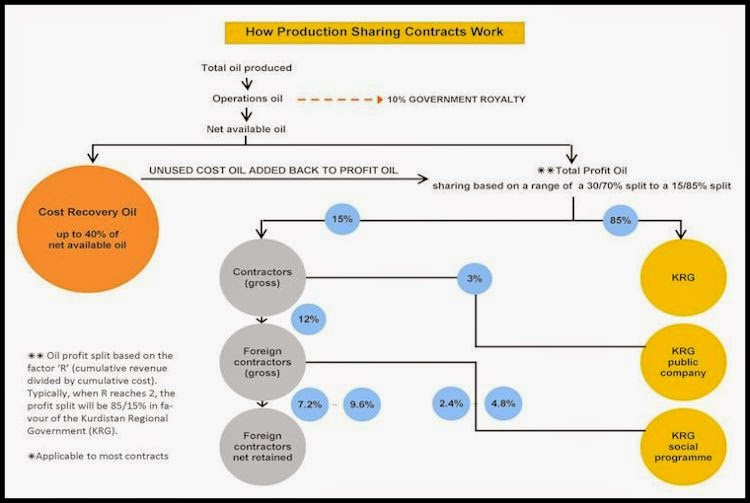
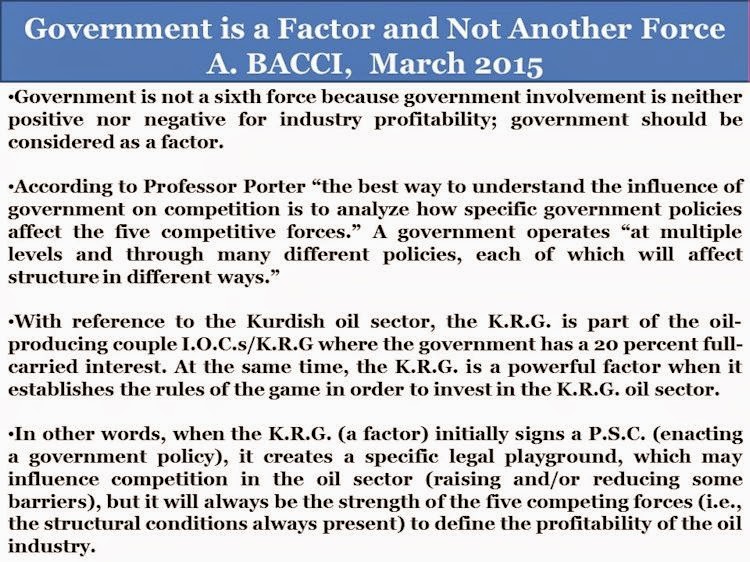
The perspective of this analysis is centered on the couple I.O.C.s/K.R.G., which is to be considered as the "oil-producing entity". In Iraqi Kurdistan, I.O.C.s and the K.R.G. are linked through a production sharing contract (P.S.C.). Under a P.S.C. the contractor makes risk investments and provides technical and management services in return for a share of production to recover its costs (“Cost Oil”) and a share of the remaining oil (“Profit Oil”) as its profit. The contractor has the right to market its share of oil and "book" the reserves. In the production phase, however, the government of the hosting country may take a direct stake in the project. In general, the extent of the government's participation varies from less than 30 percent to as much as 70 percent. As a consequence, the government shares "rewards and technical, price, and operating cost risks with the I.O.C. in proportion to itsshare in the project" (Maurer - Tarontsi, 2009). In addition, the government collects taxes and royalty payments.


BACCI-An-Analysis-of-the-KRG-Oil-Sector-According-to-the-Five-Forces-Framework-2-March-2015
Source: The K.R.G. Ministry of Natural Resources

According to Paragraph 1 under the title "Government Interest" of Article 4 — Options of Government Participation and Third Party Participation of the Production Sharing Contract Model of the K.R.G.:
The GOVERNMENT shall have the option of participating through a Public Company in this Contract, in respect of the entire Contract Area, as a CONTRACTOR Entity, with an undivided interest in the Petroleum Operations and all the other rights, duties, obligations and liabilities of the CONTRACTOR (save as provided in and subject to this Article 4) under this Contract in respect of the Contract Area, of up to [ ] per cent ([ ]%), and not less than five per cent (5%) (the “Government Interest”), such option being referred to herein as the “Option of Government Participation”. The GOVERNMENT shall be entitled to exercise the Option of Government Participation by notifying the CONTRACTOR in writing of such election and the size of the Government Interest.
So, according to these considerations, it makes sense to analyze the industry structure of the K.R.G. through the perspective of the oil-producing couple I.O.C.s/K.R.G.


BACCI-An-Analysis-of-the-KRG-Oil-Sector-According-to-the-Five-Forces-Framework-3-March-2015


BACCI-An-Analysis-of-the-KRG-Oil-Sector-According-to-the-Five-Forces-Framework-4-March-2015


THE K.R.G. OIL RESERVES
The International Energy Agency (I.E.A.) in its Iraq Energy Outlook of November 2012 estimated that Iraqi Kurdistan contained 4 billion barrels of proved reserves. Instead, the K.R.G. estimates are much higher because they include unproved resources too. Quite recently the K.R.G. has increased its oil resources estimate from 45 billion barrels to 60 billion barrels — some resources are in the areas disputed between Erbil and Baghdad.   

BACCI-An-Analysis-of-the-KRG-Oil-Sector-According-to-the-Five-Forces-Framework-6-March-2015
The Kurdistan Region — Source: Petroleum Economist


BACCI-An-Analysis-of-the-KRG-Oil-Sector-According-to-the-Five-Forces-Framework-6-March-2015
The Kurdistan Region — Source: Petroleum Economist

On average, in Iraq proper it costs about $5 to produce a barrel of oil; with reference to the K.R.G., we are in the same range. For instance, Genel Energy, one of the operators in Iraqi Kurdistan, has finding and development costs (F&D) less than $3 a barrel and operating expenses (OPEX) less than $2. Tony Hayward of Genel Energy has recently declared that his company could still profitably produce a barrel of oil with oil prices around $20 a barrel. In times of low oil prices, low production costs are a huge advantage for oil-producing countries and the companies technically doing the job. For more information please see: BACCI, A., Why Do I.O.C.s Have to Invest in Iraqi Kurdistan and/or Southern Iraq?, December 2014
In other words, notwithstanding the current complex and harsh dispute between Erbil and Baghdad, the combination of relevant oil reserves and the low production costs has been a powerful tool capable of attracting to Iraqi Kurdistan in the last years around fifty international oil companies — initially small and medium companies and later large ones. Addax Petroleum — at that time a Swiss company, while today it's a subsidiary of China's Sinopec — and Genel Energy together signed a P.S.C. related to the Taq Taq field as early as May 2004. Today, also four big names are investing in Iraqi Kurdistan: U.S. ExxonMobil and Chevron, France's Total and Russia's Gazprom. For more information please see: BACCI, A., Chevron and Total Continue Investing in the K.R.G. A Brief Analysis of Baghdad's T.S.C.s vs. Erbil's P.S.C.s, June 2013
Four are the most important oil fields in the K.R.G.:*
1) Khurmala Dome (Iraqi Kurdistan's KAR Group, 110,000 bbl/d, A.P.I. gravity of 34 to 25 degrees),
2) Tawke (Norway's D.N.O. and Genel Energy, 130,000 bbl/d, A.P.I. gravity of 26 to 28 degrees),
3) Taq Taq (Genel Energy and Sinopec, 130,000 bbl/d, A.P.I. gravity of 47 to 48 degrees) and
4) Shaikan (Gulf Keystone, 21,000 bbl/d, A.P.I. gravity of 18 degrees).
*(Data relative to January 2015)
BACCI-An-Analysis-of-the-KRG-Oil-Sector-According-to-the-Five-Forces-Framework-7-March-2015
Source: The Energy Information Administration (January 2015)

BACCI-An-Analysis-of-the-KRG-Oil-Sector-According-to-the-Five-Forces-Framework-8-March-2015

This analysis covers the industry structure of the oil sector in the K.R.G. alone; the fields around the city of Kirkuk are not considered. In fact, notwithstanding that the K.R.G. expanded its control over the Kirkuk area in June 2014, it's not clear what the political future of the city and its governorate will be. The Peshmerga forces blocked the possibility that the city and its precious oil reserves fell into the hands of the Islamic State, but already today, one of the most contentious issues between the federal government and the K.R.G. is the destiny of Kirkuk and its oil riches. In fact, the Kurds strongly insist that the oil-rich city of Kirkuk and the surrounding areas be included in the K.R.G. For more information please see: BACCI, A., Iraqi Kurdistan's Occupation of Kirkuk Oil Field Will Deeply Affect the Iraqi Oil Sector, June 2014.   

THE INDUSTRY STRUCTURE OF THE K.R.G. OIL SECTOR
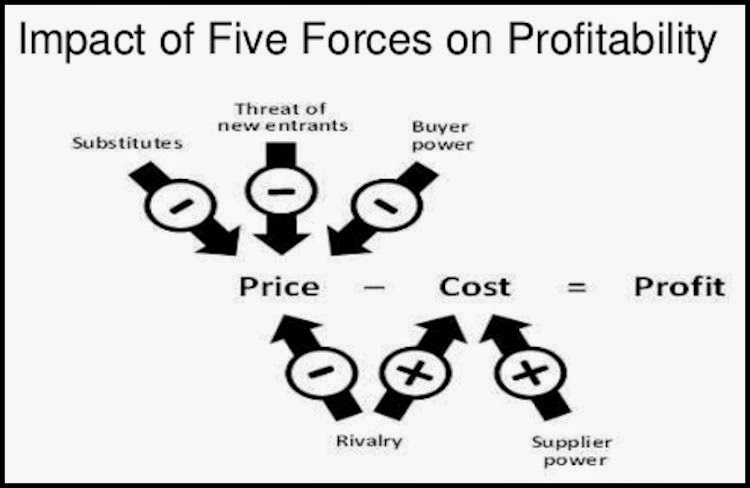
Joan Magretta of the Institute for Strategy and Competitiveness at Harvard Business School correctly explains that "competition is the tug-of-war over profits that occurs not just between rivals but also between a company and its customers, its suppliers, makers of substitutes, and potential new entrants." In other words, it's meaningless to compete in order to be the best for the simple reason that there are many ways to serve customers, who indeed may have very different necessities. In sports it may make sense to speak about "competing in order to be the best"; unquestionably on February 1, 2015, the New England Patriots won the XLIX Super Bowl defeating the Seahawks 28-24. But, in the business arena "competition is more complex, more open ended and multidimensional. Within an industry, there can be multiple contests, not just one, based on which customers and needs are to be served." So the real competition relates to competing for "profits", which derive from the following equation:
PROFITS = PRICE - COST
And this concept is absolutely true in relation to every single P.S.C. that the K.R.G. has signed in the last years with an I.O.C. Both, the government and the I.O.C., work with the goal of doing profits not with the goal of being the best.   
So the industry structure determines profitability. One of the most complete frameworks in order to assess competition in any industry is the analysis of the industry's structure according to Porter's five forces.

BACCI-An-Analysis-of-the-KRG-Oil-Sector-According-to-the-Five-Forces-Framework-9-March-2015
Source: "Understanding Michael Porter" by Joan Magretta


BACCI-An-Analysis-of-the-KRG-Oil-Sector-According-to-the-Five-Forces-Framework-10-March-2015
Source: "Understanding Michael Porter" by Joan Magretta


BACCI-An-Analysis-of-the-KRG-Oil-Sector-According-to-the-Five-Forces-Framework-11-March-2015
Porter’s Five Forces Model of Competition — Source: MAX 360 @AIGROUP

The Threat of New Entrants (Low)     
"The threat of entry in an industry depends on the height of the entry barriers that are present and on the reaction entrants can expect from incumbents" (Porter 1998).
In relation to the oil sector, and this is completely applicable to the K.R.G. upstream oil sector, these are today's main entry barriers:
1)  Supply-side economies of scale   
If an oil contract equitably balances the interests of the involved I.O.C.s and the host country, oil firms producing at larger volumes normally enjoy lower costs per unit because they are able to spread their fixed costs over more units (barrels), they employ more efficient technology or negotiate better terms with equipment suppliers and/or subcontractors. In fact, CAPEX are practically the same if from a reservoir we extract 100 bbl/d or 100,000 bbl/d, but, of course, the more barrels we extract the lower it is their marginal cost. The Kurdish P.S.C.s well align the interests of the investors and the government; both want to find large and low costs oil fields (van Meurs, 2008). In this regard, it should be noted that in the oil business many a time there are contracts (quite often with Service Contracts) where there is no real incentive for the investors to find large low cost fields.              
2) Capital requirements  
The oil sector is a capital intensive business. A company starts spending important economic resources immediately after the signature of an oil contract — no matter what type of contract it has signed. And new oil projects have long time horizons before permitting to recoup some of the investments. So, in light of their reduced cash availability, small companies (the so-called wildcatters) and midsized companies need to have a short timeframe between the exploration phase and the production phase. If these companies do not get stable and continual payments, they risk a bankruptcy. Current developments in the K.R.G. show that the three midsized companies that are already producing crude oil, Genel Energy, D.N.O. and Gulf Keystone are all experiencing economic troubles because they have not received stable and continual payments from the K.R.G.; only Genel Energy has a better financial position because last year it did a bond issue through which it raised $500 million, and because in addition to it, the company has recently completed the private placing of $230 million of bonds.        
3) Restrictive government policy
As a consequence of the nationalizations of the 1970s in the Middle East the oil sector has a widely restricted access — still today Saudi Arabia's oil sector is completely sealed off for foreign companies (although not the non-associated gas sector). Oil belongs to the host country and, in general, if an I.O.C. wants to sign a deal, it has to participate in a bidding process or to negotiate directly with the host country, which will decide all the contractual terms. In a country there could be parts of territory where there are proven, probable or possible reserves, but without a contract there will be no access to them. In the K.R.G. any company interested in developing an oil field needs to sign a very detailed P.S.C. with the regional government. Erbil has developed a production sharing contract model, and every signed contract is based on this model. The decision of using P.S.C.s has been strongly criticized and opposed by the federal government, which has always favored technical service contracts (T.S.C.), which it signs after an auction.

BACCI-An-Analysis-of-the-KRG-Oil-Sector-According-to-the-Five-Forces-Framework-12-March-2015

The Power of Suppliers (Low/Medium)
"Powerful suppliers capture more of the value for themselves by charging higher prices, limiting quality or services, or shifting costs to industry participants. Powerful suppliers, including suppliers of labor, can squeeze profitability out of an industry that is unable to pass on cost increases in its own prices" (Porter, 1998).
The K.R.G. oil sector with reference to the power of suppliers follows the general trend present in the oil and gas industry: a balanced relation between suppliers and oil companies. In fact, it's true that many international oil companies are vertically integrated, but it is also true that, with reference to the specific tasks they have to implement, they utilize many different subcontractors. And, in general, there is a sort of one-to-one relation between suppliers and oil companies: The latter need the specific skills of the former, but, at the same time, the suppliers depend heavily on the oil industry for their revenues because they are not able to serve different industries. There is no doubt that industry participants face switching costs in changing suppliers, that suppliers offer products that are differentiated and that there is no substitute for what the supplier group provides, but, in light of the high specialization (tailor-made services) of the provided services, the suppliers do not have many alternative buyers. Only in recent years, the power of suppliers has partially augmented because some supplier groups have succeeded in integrate forward into the industry so that they have managed projects previously operated exclusively by an I.O.C.    

The Power of Buyers (Final Buyers Low — Direct Buyers Medium)
"Powerful customers—the flip side of powerful suppliers—can capture more value by forcing down prices, demanding better quality or more service (thereby driving up costs), and generally playing industry participants off against one another, all at the expense of industry profitability. Buyers are powerful if they have negotiating leverage relative to industry participants, especially if they are price sensitive, using their clout primarily to pressure price reductions" (Porter 1998).
In the oil business, market demand is a primary factor in setting prices, but it is important to differentiate between the buyers of crude oil in the physical market and buyers of refined products (for instance, gasoline). In fact, the individual purchaser of refined products, who is also the final consumer of the transformed crude oil, is an individual with low bargaining powers. For instance, if a driver needs to use his car, he will always pay the price per gallon as indicated on the billboard at the gas station. He will complain that prices are high, but he will not have any tangible power to lower them.
Instead, when analyzing the structure of the oil industry in a specific area (be it a country, a region or a province) it is probable more useful to focus our attention on the direct buyers, who are most often refiners who process the crude oil into the various petroleum products for commercial and retail customers, or international traders. Most refining capacity in the world is owned and operated by the larger integrated companies, the N.O.C.s and, recently also by independent refining sector companies.
Direct buyers have a relevant negotiating power because:
1) They are not many and because they purchase in volume that are large relative to the size of the vendor.
2) The industry's products are standardized or undifferentiated. Many a time crude oil exports from a specific country are a single blend of all the crude types present in that country. In general, refineries are not able to process all the types of blend present on the market, but still on the market they can purchase alternative blends satisfying the requirements of their processing plants.   
3) Buyers face few switching costs in changing vendors. Although there are different blends, oil is a commodity.
With reference to the K.R.G. there are two different types of direct buyers: Turkey's refiners (for instance, TüpraÅŸ), and international traders and refiners (these may be integrated in an oil company or independent too).    
It is important to focus our attention on Turkey because this country is not only a significant oil consumer in its own right, but it is also a natural energy hub between three major oil-producing areas (Russia, the Caspian Sea basin and the Middle East) and the European consumer markets. Moreover, Ceyhan is a port that is able to accommodate very large crude carriers (V.L.C.C.) and ultra large crude carriers (U.L.C.C.).
According to the U.S. Energy Information Administration (E.I.A.):
In 2013, Turkey's total liquid fuels consumption averaged 734,800 bbl/d. More than 90% of crude oil consumption and significant quantities of petroleum products came from imports. According to the IEA [International Energy Agency], Turkey's crude oil imports are expected to double over the next decade. In 2012, the majority of Turkey's crude oil imports came from Iran, which supplied 35% of the country's crude oil. Russia, once the largest source country of Turkey's crude oil, has fallen behind Middle East suppliers in terms of volume and is now the fourth-largest supplier of crude oil to Turkey.
There is a strong economic complementarity between Iraqi Kurdistan and Turkey. The latter needs the K.R.G. crude oil (and gas too), while Iraqi Kurdistan needs the revenues obtained from selling oil to Turkey. In practice, an oil trade between the K.R.G. and Turkey is a win-win solution for both sides — although for the K.R.G. it would not be advisable to have an important dependence on a single buyer. For more information please see: BACCI, A., Why Do I.O.C.s Have to Invest in Iraqi Kurdistan and/or Southern Iraq? February 2015
After years of flat markets, falling profits and declining margins, international oil traders (for instance, Glencore, Gunvor, Mercuria, Trafigura and Vitol) are currently experiencing very favorable conditions since the global financial crisis of 2008. The rise in oil volatility is helping the traders to obtain improved margins in their transactions —more arbitrage. The current slide in crude oil since mid-June 2104 has also provided an important boost to the profit margins for the ailing European refining industry, which struggled to turn a profit when crude oil remained at or around $100 a barrel.
It is worth remembering that international refiners and traders are price sensitive because:
1) The oil they buy represents a significant fraction of their cost structure or procurement budget.
2) In general they have low margins and/or are under pressure to trim their purchasing costs.
3) The quality of services they provide is little affected by the industry's product.
4) Crude oil has little effect on the buyer's other costs.
All these elements, which are completely valid also for the refiners and traders working with the K.R.G. oil, explain that oil refiners and oil traders have a certain negotiating leverage relative to the K.R.G. This is exactly what happened with the broker who contacted me. He was not satisfied with the terms obtained from the K.R.G. and he walked away without a deal because he knew that he might find some alternatives: Iraqi Kurdistan exports a blended medium (crude oil quality of 30 to 32 degrees A.P.I. and 2.52 percent sulfur content) that is very similar to the Kuwaiti blended medium (crude oil quality of 31.4 degrees A.P.I. and 2.52 percent sulfur content).
In addition, low international oil prices (Brent, the widely used international reference, is at $57 per barrel when last June it was around $115) and the strong confrontation between Erbil and Baghdad with reference to the exports of Kurdish oil from the K.R.G. (a high political risk) are two elements (two external factors, not two forces) that reduce the power of the oil producers versus the buyers. An oversupply of crude oil reduces the prices that the K.R.G. may ask for and at the same time if the buyer may experience a possible lawsuit after purchasing crude oil from the K.R.G., he will necessarily request an important discount — we apply the same logic of the bond market: a higher risk requires a higher reward; the only different is that with bonds there is a higher interest rate and with quantities of crude oil an initial discount.   

The Threat of Substitutes (Low)
"A substitute performs the same or a similar function as an industry’s product by a different means" (Porter 2008).
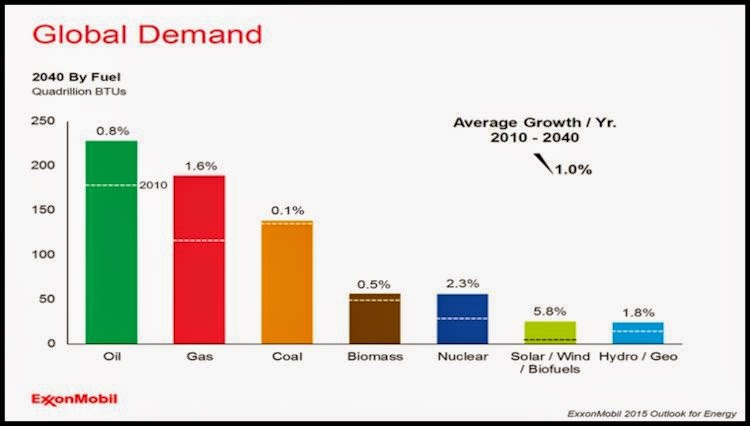
Oil is primarily used as a transportation fuel. According to ExxonMobil "oil is expected to remain the No. 1 energy source and demand will increase by nearly 30 percent, driven by expanding needs for transportation and chemicals". In other words, it is difficult to imagine a real alternative (from renewable energy sources, nuclear power or other fossil fuels) to oil in the transportation business in the coming years. Moreover, there will be an overall increase in the consumption of crude oil in the transportation sector in the coming decades.     
BACCI-An-Analysis-of-the-KRG-Oil-Sector-According-to-the-Five-Forces-Framework-13-March-2015

Rivalry Among Existing Competitors (High)
"Rivalry among existing competitors takes many familiar forms, including price discounting, new product introductions, advertising campaigns, and service improvements. High rivalry limits the profitability of an industry. The degree to which rivalry drives down an industry’s profit potential depends, first, on the intensity with which companies compete and, second, on the basis on which they compete" (Porter 2008).
Rivalry in the upstream oil business is quite high for the following considerations:
1) There are many competitors.
2) Industry growth is slow.
3) Exit barriers are very high.
4) Rivals are highly committed to the business and have aspirations for leadership.
5) The involved actors have a different approach to competing.
In general, "rivalry is especially destructive to profitability if it gravitates solely to price because price competition transfer profits directly from an industry to its customers" (Porter 2008). This occurs when:
1) Products or services of rivals are nearly identical and there are few switching costs for buyers.  
2) Fixed costs are high and marginal costs are low.
3) Capacity must be expanded in large increments to be efficient — with possible oversupply.
4) The product is perishable (this does not happen with crude oil)
Apart from the fourth point, which has no relation with crude oil, the three initial points should be able to force a real price competition capable of transferring profits to customers. This is exactly what has occurred in the last months when consumers around the world have enjoyed reduced prices at the pump. Oil supply and oil demand determine the price of oil, but many times some external factors, like wars, sanctions and cartels, may contribute to cancel the availability of some reserves from the world map. The result is that, notwithstanding the high rivalry in the upstream oil sector among the involved players, it is not automatic that profits are transferred to direct buyers and then to consumers. Currently, this profits transfer is occurring because the increase of the U.S. production of unconventional oil has permitted a considerable reduction in the price of a barrel of oil. 

The I.O.C.s/K.R.G. entities working in Iraqi Kurdistan face an important rivalry at the world level because it is there that they really compete — this is their geographical scope.  In fact, only a reduced quantity of the Kurdish crude oil production, around a quarter, is sold domestically in Iraqi Kurdistan with a price significantly cheaper than the international market price. In specific, the various I.O.C.s/K.R.G. entities pass on their crude oil at the wellhead and then Kurdish Oil Marketing Organization (KOMO) or State Oil Marketing Organization (SOMO) of Iraq proper — the export channel is an important friction point between Erbil and Baghdad — sells approximately three-quarters of the Kurdish crude oil production (the lion's share of the production) abroad, on the world markets, via the Kirkuk-Ceyhan pipeline. The Kurds have built two pipelines that enter the Kirkuk-Ceyhan pipeline at Fishkhabur because the section from Kirkuk to Fishkhabur has been out of service since March 2014 as a consequence of repeated militant attacks. In fact, the Iraqi section of the Kirkuk-Ceyhan pipeline runs through Islamic State-controlled territory. So, Kurdish oil necessarily competes with the production of several different countries, which may have crude oils with characteristic very similar to the Kurdish one.