Friday, April 7, 2017

A Neutral Stance Doesn’t Help Energy Companies in Iraq

BACCI-A-Neutral-Stance-Does-Not-Help-Energy-Companies-in-Iraq-Cover-April-2017


The article A Neutral Stance Doesn't Help Energy Companies in Iraq” has been initially published by Oilpro, a professional network for the oil and gas professionals

April 7, 2017
FLORENCE, Italy — One aspect of corporate foreign policy that is not any longer so basic a tenet as it was during the latter part of the 20th century is the necessity of being or at least appearing neutral. Neutrality may be defined as the state of not supporting or helping (physically and ideologically) either side in a conflict or disagreement. Exactly because for a multinational company, corporate foreign policy, which subsumes in its definition corporate diplomacy and geopolitical due diligence, is becoming central to winning internationally, a basic neutral approach is too limited to guarantee in every instance positive results. 
Starting in the mid-1980s, international companies have presented themselves as a sort of apolitical players, which, among their core goals, have an interest in the advancement of the societal environment of the countries where they invest. Indeed, this attitude is a complete sea change from the corporate foreign policy of the 1950s and 1960s when companies often carried out a neocolonialist strategy, which strongly influenced the internal politics of many weak states.
A good example of the neocolonialist behavior was the complicity of United Fruit Company, an American corporation that traded in tropical fruit, with the U.S. government in the 1954 coup in Guatemala. A coup that ousted the democratically elected leader of Guatemala, President Jacobo Arbenz, and resulted in more than three decades of military strongmen at the helm of the country. 
Since the mid-1980s international companies have shunned any political involvement, while at the same time they have tried to implement a good corporate social responsibility (C.S.R.), to protect and improve their brand perception and reputational risk management, to cultivate stakeholder management, and to adopt better public relations with N.G.O.s.
With hindsight, these promotional tools have never given the international companies a real edge with reference to high-impact geopolitical events such as coups, regional and civil wars, internal power struggles, changes in the political status of key local partners, and changes in the public sentiment toward the company. In other words, only through their neutral approach and the tools developed after the mid-1980s, the international companies cannot really protect themselves and thrive in the much more unstable world that emerged at the end of the Cold War.
A clear illustration of the problems deriving from maintaining a neutral approach concerns the energy investments in Iraq proper and Iraqi Kurdistan. The latter is also known as the Kurdistan Regional Government (the K.R.G.) and is a semi-autonomous region within Iraq. Without entering into too much detail, it’s important to understand that after World War I, for all the 20th century, the relations between the Kurdish population based in what is today’s K.R.G. and those who exerted their rule over that area had been very tense and experienced several episodes of violent conflicts. 
The relations between Erbil and Baghdad worsened again at the end of 2007 when the K.R.G. started signing production sharing contracts (P.S.C.) with small- and medium-sized companies without prior authorization from the federal government — in addition, the latter has never signed P.S.C.s but only technical service contracts (T.S.C.s). Baghdad has always said that it alone has the right to negotiate and sign energy deals for the whole Iraqi territory, the K.R.G. included. Instead, Erbil insists that Iraq's Constitution allows it to agree to contracts, and as a result to ship oil independently of the central government. 
In October 2011, tensions rose to a higher level when the U.S. supermajor Exxon Mobil, a company that was already the operator of West Qurna 1, a giant oilfield in southern Iraq, signed an oil deal related to the development of six exploration blocks in the K.R.G. — in December 2016 Exxon Mobil pulled out of three of these six blocks, but this move was not due to Baghdad’s pressure.
Exxon Mobil was the first supermajor to sign oil deals with Iraqi Kurdistan, and the federal government was literally scared that Exxon Mobil could act as a sort of trailblazer opening Iraqi Kurdistan to Big Oil investments. In fact, for Baghdad, one thing was to confront a K.R.G. receiving its economic legitimacy from small- and medium-size oil companies, one completely different thing was to confront a K.R.G. receiving its economic legitimacy from the supermajors.
The federal government wanted to appear resolute against Exxon Mobil — as it had done until then with the small- and medium-sized companies that had invested in the K.R.G until then. So, Baghdad immediately menaced to push Exxon Mobil out of Iraq proper stripping the company of its West Qurna 1 contract — the U.S. company had a 60 percent share in that oil field — if it hadn’t relinquished its Kurdish investments. Today, after almost 6 years, Exxon Mobil is still an investor in both the K.R.G. (with three blocks) and in Iraq proper (in West Qurna 1, where it’s still the operator, although with a 25 percent share). 
In Iraq (Iraq proper and the K.R.G.), there is a sort of dichotomy regarding the energy investment strategies on the part of the international oil companies (I.O.C.s). In practice, some companies have decided to invest only in the K.R.G. (among them, U.S. Chevron, Korea National Oil Company, China’s Addax Petroleum/Sinopec, and Norway’s D.N.O. ), while others have decided to invest only in Iraq proper (among them, British Petroleum, Anglo-Dutch Shell, Japan Petroleum Exploration Company, Russia’s Lukoil and Rosneft, and China’s Cnooc and C.N.P.C). The only energy companies that escape this dichotomy and consequently have investments in both Iraq proper and the K.R.G. are Exxon Mobil, Russia’s Gazprom, and France’s Total.  
A neutral approach may be useful when in a country there are completely unstable political conditions (for instance, military clashes/open war), and when it seems probable that in the short term there could be a clear and definitive political solution. But, when the quarrelling parties are not physically fighting between themselves, and when it appears highly improbable that there will be a final arrangement any time soon, a neutral approach may represent for a company only a lost economic opportunity. In the case of the K.R.G. and Iraq proper, neutrality is probably not useful.
Both the K.R.G. and Iraq proper have oil and gas reserves located in areas that can be easily protected from the Islamic State — Kirkuk oil fields may be more exposed, but let’s focus our attention only on the fields within the K.R.G. and on those in southern Iraq. Moreover, it seems evident that the tensions between Erbil and Baghdad won’t be gone soon — these tensions date back several decades. In fact, if the emergence of the Islamic State and its destruction of the Iraqi side of the Kirkuk-Ceyhan pipeline has forced the K.R.G. to build its system of export pipelines, which could be seen as a first step toward a K.R.G. economic independence, it also true that low oil prices, a complicated geopolitical environment, and oil reserves not as large as initially thought — a better assessment is needed — could induce the K.R.G. to continue with its tense cohabitation with Iraq proper.   
In the end, can international companies wait for a real improvement in the relations between the K.R.G. and Iraq proper before doing business in the area? In other words, can they wait for a political improvement that might occur one year, three years, five years, or ten years from now? The answer is no, because as usual uncertainty is business’s worst enemy. In Iraq, neutrality is a way to lose economic opportunities. Instead, if companies want to succeed, they have to decide where they want to invest and then they have to act consequently.
India’s Reliance Industries sold its two blocks in the K.R.G. to Chevron because it wanted to pursue other economic ventures in Iraq proper from which it could have been barred if it had continued with its K.R.G. investments. Exxon Mobil, Total, and Gazprom had a different leverage over the federal government when they invested in the K.R.G — respectively in October 2011, July 2012, and August 2012. In fact, at that time, they had already signed service contracts related to the development of three of Iraq’s largest fields
  • ExxonMobil for West Qurna 1 (Iraq's first licensing round in 2009)
  • Total for Halfaya (Iraq's second licensing round in 2009)
  • Gazprom for Badra (Iraq's second licensing round in 2009)
In other words, for Baghdad it was very difficult, because economically unappealing, to strip these three companies of the contracts signed in the previous two or three years — contracts of paramount importance for relaunching and expanding the Iraqi oil sector.    
But, it’s Shell’s approach that confirms how a corporate foreign policy based on a neutral approach could have been a very risky option in Iraq. In fact, if, on the one side, Shell was part to the initial negotiations that Exxon Mobil developed with the K.R.G. in 2011, on the other side, it was already deeply involved in Iraq proper with relevant investments.
In fact, Shell was Exxon Mobil’s junior partner (15 percent share) in the West Qurna 1 field (8.7 billion of recoverable barrels of oil) and the operator (45 percent share) in the Majnoon field in southern Iraq (13 billion of recoverable barrels of oil). But, at that time, Shell was also in the final stages of the talks that would end in November 2011 with the signature of a $17.2 billion’s worth deal with the federal government for collecting and processing all the natural gas from three of Iraq's giant southern oilfields, i.e., Rumaila, West Qurna 1, and Zubair.
In the end, Shell’s real interest in Iraq weights the balance in favor of investing in Iraq proper only. If Shell had signed a deal with the K.R.G., the federal government might have scuttled the gas deal, which was the weak link for Shell — for the same reasons explained above in relation to Exxon Mobil and its investment in West Qurna 1, it would have been quite difficult to strip Shell of the Majnoon contract. Moreover, what is sure is that for Shell a neutral approach would have meant not investing in Iraq proper nor in the K.R.G. with all the economic lost opportunities that this action would have encompassed.

This article covers the topic of the video “A Neutral Stance Doesn’t Help Energy Companies in Iraq,” which was released on April 4, 2017, on Alessandro Bacci’s Middle East. 


Tuesday, April 4, 2017

A Neutral Stance Doesn’t Help Energy Companies in Iraq

BACCI-A-Neutral-Stance-Does-Not-Help-Energy-Companies-in-Iraq-April-2017


April 4, 2017
FLORENCE, Italy

Dear friends,

I would like to share with you my video “A Neutral Stance Doesn’t Help Energy Companies in Iraq.”

One aspect of corporate foreign policy that is not any longer so basic a tenet as it was during the latter part of the 20th century is the necessity of being or at least appearing neutral.

In fact, in the post-Cold War world, a neutral approach does not provide international companies with a real edge with reference to high-impact geopolitical events.

A clear illustration of the problems deriving from maintaining a neutral approach is apparent in the energy investments (oil and gas) in Iraq proper and Iraqi Kurdistan (a.k.a. the Kurdistan Regional Government — K.R.G.).

Thank you

Kind regards,

Alessandro


Wednesday, March 22, 2017

Protecting Iraq’s Oil-Producing Areas

BACCI-Protecting-Iraq-Oil-Producing-Areas-Cover-March-2017


The article “Protecting Iraq’s Oil-Producing Areas” has been initially published by Oilpro, a professional network for the oil and gas professionals

March 22, 2017

FLORENCE, Italy — The Islamic State (a.k.a. ISIS or ISIL) is in retreat in Iraq and Syria. It has lost approximately half the territory straddling between western Iraq and eastern Syria that it controlled after its 2014 expansion when it caught off guard the federal government in Baghdad. This outcome was not difficult to predict already in the summer of 2014, because the Islamic State was a poor and dysfunctional state in relation to the vast conquered territory and the administered population. Add to this that already in August 2014 the U.S. and some allies (Bahrain, Jordan, Qatar, Saudi Arabia and the United Arab Emirates) started launching surgical airstrikes against ISIS positions in Syria, precisely around the city of Raqqa and along the Syrian-Iraqi border. In practice, it was evident that, especially in Iraq, defusing the Islamic State military power was primarily a matter of time and of better organization.  

Last October Iraqi forces and the U.S.-led coalition started an offensive whose goal was the liberation of the city of Mosul, which is the capital of the Islamic State in Iraq. Mosul is the largest city under Islamic State control, with two million residents. At the time of this writing the Iraqi forces have retaken the eastern part of Mosul and around 30 percent of the western part of the city. On March 14, 2017, Prime Minister Hayder al-Abadi declared that the battle was in the final stages and that the cornered Islamic State fighters had to surrender if they didn’t want to be killed. Indeed, recapturing the whole Mosul won’t be easy — with a high probability of civilian casualties in the narrow streets of Mosul’s Old City — but a positive outcome for the Iraqi forces seems already taken for granted.

The Islamic State is losing ground in Syria as well. The Syrian Kurdish People’s Protection Units (Y.P.G.), which is the armed wing of Syria’s Democratic Union Party (P.Y.D., a left-wing Kurdish political party established in 2003 by Kurdish activists in Syria) recently revealed that the Kurdish-dominated Syrian Democratic Forces (S.D.F.) have plans to launch at the beginning of April 2017 the final offensive to retake Raqqa, the Islamic State’s capital in Syria. Last November, the Syrian Democratic Forces launched Euphrates Rage, an operation whose final goal in the long run was to free Raqqa. Also in this case, recapturing Raqqa won’t be immediate, because the city is likely fortified with a network of trenches, booby traps, and car bombs. But, in theory, with the right amount of forces and good military equipment (provided by the U.S.) retaking Raqqa should be only a matter of time.

BACCI-Protecting-Iraq-Oil-Producing-Areas-1-March-2017
Areas Under the Islamic State Control as of March 5, 2017 — Source: Wikipedia

Apparently, the present conditions in relation to Mosul and Raqqa seem similar, but the events may take a different fold. Turkey has long complained about Iran’s increasing influence in Iraq and Syria, and consequently it intends to expand its participation in the two offensives against the Islamic State, the one in Iraq and the one in Syria. But while in Iraq the war against the Islamic State to retake Mosul is by now up and running and sees at the forefront Iraq’s government forces (Iraq’s official army) and the K.R.G. forces (the forces belonging to Iraqi Kurdistan, which is a semi-autonomous region recognized by Iraq’s Constitution) in Syria the present conditions are much more complicated and in flux. This means that Turkey has right now probably more room for maneuver in Syria. In specific, in Syria in the war against the Islamic State Ankara would like to consistently increase the role of the Free Syrian Army (F.S.A.), whose main target is to bring down the government of President Bashar al-Assad, and instead to reduce the role of Y.P.G./P.Y.D., which it considers a terrorist group linked to the Kurdistan’s Workers’ Party (P.K.K., a Kurdish left-wing organization based in Turkey). This Turkish desire of playing a major role in reconquering Raqqa has until now clashed with the U.S. and Russian targets in Syria. In fact, the U.S. has reduced its support to the F.S.A. and it now favors actions led by the Kurdish-dominated S.D.F. While Russia, since the beginning of the conflict, has backed the government of President Bashar al-Assad politically, with military aid, and since September 2015 through a direct military involvement as well.

In light of the above considerations, it’s evident that if the Syrian Civil War is far from being solved, the Islamic State, once expelled from its main strongholds in Iraq and Syria, will return to being what it was before, i.e., a guerrilla movement. And with the Islamic State transforming again into an insurgency movement, in Syria the civil war will continue, and the Islamic State fighters will blend with the host populations and join other more or less radicalized warring factions across the country (for instance Al Qaeda and the Jabhat Fateh al-Sham — the latter was previously known as the Nusra Front). In Iraq, the Islamic State fighters will retrench along the Syria-Iraq border, blend with the host populations, and continue a guerrilla fight against primarily the federal government. On top of this, it’s quite probable that the Islamic State might gradually increase its actions outside the Syrian-Iraqi theater.

Especially in Iraq, once the Islamic State has transformed again into a guerrilla group fighting against the central government, Iraqi civilians will be the primary targets. Suicide bombings and direct attacks against mosques, public squares, markets, festivals, political rallies, and infrastructure will increase. Now that the Islamic State is losing ground, this strategy is by now quite evident. The most striking example of this strategy has been the coordinated bomb attack of July 3, 2016, in Baghdad killing more than 300 people and injuring hundreds more. A few minutes after midnight local time a suicide truck targeted the mainly Shia district of Karrada, busy with late night shoppers for Ramadan. A second roadside bomb was detonated in the suburb of Sha'ab, killing at least five. 

Putting aside the complex relations between Iraq proper and the K.R.G. (this topic is only lightly considered in this article), if the Iraqi government intends to really first pacify and then consistently develop the country, it has to reach out to the Sunni disenfranchised communities, which have provided fertile ground to many radical extremists. It’s important not to repeat the same script that started in 2007, when after the U.S. troop surge, the jihadis moved into the remote frontier lands along the borders of Iraq, Syria, Lebanon, Jordan, and Turkey. There the movement rebuilt itself, and seven years later it attacked again in Syria and Iraq.

BACCI-Protecting-Iraq-Oil-Producing-Areas-2-March-2017


Winning the war against the Islamic State on the field is one thing, pacifying Iraq is a completely different and complicated thing. And since the fall of Saddam Hussein, the Iraqi authorities have not been capable of finding a way to implement a real power sharing among all the sects and ethnicities present in Iraq—be it clear that it’s a very difficult task. So, it appears that a military victory over the Islamic State won’t represent a definitive stabilization of Iraq. Large swaths of Iraq, especially Anbar Governorate (Ramadi), Nineveh Governorate (Mosul) and Saladin Governorate (Tikrit) will not be safe areas because of the Islamic State guerrilla.

BACCI-Protecting-Iraq-Oil-Producing-Areas-3-March-2017
Governorates of Iraq — Source: Wikipedia

Let’s now focus our attention on Iraq, which, with a production of almost 4.6 million bbl/d (600,000 bbl/d from Kurdish fields), is one of the world’s main oil producers. Earlier this month, at the CERAWeek 2017, Oil Minister Jabbar Al-Luaibi affirmed that Iraq would ramp up production capacity to 5 million bbl/d by 2017. This declaration is quite interesting because it shows that Iraq intends to increase its oil production despite this new target might clash with OPEC’s oil cuts.  

Iraq’s economy is almost completely dependent on oil revenues. In 2014, the revenue from crude oil export accounted for 93 percent of the country’s total government revenues and 80 percent of foreign exchange earnings. These numbers explain that a worsening oil sector in Iraq could easily translate into the event triggering the demise of the Iraqi state as we have known it until today. For the Iraqi coffers oil is everything. In 2015, because of the declining oil prices and despite a relevant increase in export volumes, Iraq proper (excluding the K.R.G.) through crude oil exports earned only slightly more than $49 billion, which was $35 billion less than in 2014. If, on the one hand, oil prices are a variable that Iraq cannot control, on the other hand, it might improve the security deficit present across Iraq so that the Iraqi oil industry (Iraq proper and the K.R.G.), could continue its oil production guaranteeing at least part of the revenue the country desperately needs.

Iraq’s oil industry relies on three main producing areas
  1. the southern fields in Basra Governorate (government control)
  2. the Kurdish fields in the K.R.G. (K.R.G. control)
  3. the Kirkuk fields (part under government control and part under K.R.G. control)

The first two areas are completely independent one from the other, while part of the Kirkuk fields oil production is exported through the Kurdish pipeline system, which is used by the Kurdish fields.

Increasing Iraq’s oil production implies having these three areas completely insulated from possible episodes of violence and sabotage. Protecting the southern fields should not be an impossible task. These fields are located in a Shia-dominated area and have been quite safe in the last years. Similarly, the K.R.G. has emerged as the safest territory within Iraq. Only sporadic episodes of violence have occurred in the last years within the K.R.G. And at the same time, despite fighting came close to the fields Khurmala Dome and Shaikan. the Kurdish forces have demonstrated to be capable of well shouldering the attacks of the Islamic State.

Instead, more complicated is the future of the Kirkuk fields. In fact, the oil-rich city of Kirkuk is claimed by both Iraq’s central government and the K.R.G. Erbil is seeking to integrate Kirkuk Province into the K.R.G. claiming it to be historically a Kurdish city, but Baghdad fiercely opposes this Kurdish design. The population is a mix of Kurds, Arabs, Christians and Turkmen. Kirkuk has seen a rise in ethnic tensions after the Islamic State group’s offensive across northern and western Iraq in 2014. Iraqi security forces largely withdrew from Kirkuk, and Kurdish Peshmerga forces took control of the city. Since then, Shiite militia fighters have also massed around the city.

Recently 120,000 bbl/d from Kirkuk oil fields under the control of the central government’s North Oil Company (N.O.C.) have been exported using the same pipeline that the Kurds use to independently export their oil to the port city of Ceyhan, Turkey. This Kurdish pipeline (nameplate capacity of 700,000 bbl/d) bypasses the Iraqi section of the Kirkuk-Ceyhan pipeline and merges into the latter in Fishkhabur at the border between the K.R.G. and Turkey. In the future, thinking of repairing also the Iraqi section of the Kirkuk-Ceyhan pipeline, which was heavily sabotaged in March 2014, seems not viable. First, miles of the pipeline have to be substituted, and second, it would still run through a territory—Saladin Governorate and Nineveh Governorate—that also in the future could be exposed to other acts of sabotage. 

Still with reference to Kirkuk oil fields, last February, Iraq and Iran signed a memorandum of understanding to evaluate the construction of a pipeline to export Kirkuk’s crude oil via Iran. This pipeline could help Iraq proper diversify the export routes of crude oil produced in Kirkuk and reduce Baghdad’s reliance on shipping this oil through the K.R.G. territory. Erbil doesn’t like this project because it could lose the leverage it currently has as for the export of N.O.C.’s oil via the Kurdish pipeline. Apart from the political games supporting this project, it’s important to underline that this pipeline from Kirkuk will go east through much safer zones. 


Thursday, November 24, 2016

Modeling the Libra Oil Field

BACCI-Modeling-the-Libra-Oil-Field-Nov-2016-Cover

November 24, 2016,
CALGARY, Canada
Dear readers,
Below you may read my paper "Modeling the Libra Oil Field." This paper is a follow-up to my collaboration with OpenOil in developing Brazil's Libra oil field financial model. OpenOil is a consultancy, publishing house and training provider, specialized on open data products and services around natural resources.          
Thank you
Kind regards,
Alessandro

Saturday, November 12, 2016

OPENOIL — Interview With Alessandro Bacci


November 12, 2016,
CALGARY, Canada
Dear readers,
Below you may watch my interview with OpenOil, a consultancy, publishing house and training provider, specialized on open data products and services around natural resources. The video was filmed at the end of October in Berlin, Germany, where I participated in OpenOil's Open Financial Modeling Sprint, a workshop (Oct. 24-28) centered on financial modeling in the extractive industries. In specific, my participation was related to the development of Brazil's Libra oil field financial model, which OpenOil and I have recently produced.               
Thank you
Kind regards,
Alessandro

Thursday, November 10, 2016

Libra Project, Brazil — Fiscal Model

OPENOIL-Brazil-$90-Billion-Libra-Field-in-Trouble-Says-Public-Data-Nov-2016

November 10, 2016,
CALGARY, Canada
Dear readers,
Below you may download the Excel file related to Brazil's Libra oil field financial model, which OpenOil and I have recently developed. OpenOil is a consultancy, publishing house and training provider, specialized on open data products and services around natural resources. In specific, I have had the honor to work at this project with Alistair Watson, who is OpenOil's leading expert and one of the world's best consultants with reference to extractive industry fiscal regime design and analysis.               
Thank you
Kind regards,
Alessandro

OPENOIL-Libra-Project-Brazil-Fiscal-Model-Nov-2016


Wednesday, November 9, 2016

Libra Project, Brazil — Presentation

OPENOIL-Brazil-$90-Billion-Libra-Field-in-Trouble-Says-Public-Data-Nov-2016

November 9, 2016,
CALGARY, Canada
Dear readers,
Below you may read the presentation related to Brazil's Libra oil field financial model, which OpenOil and I have recently developed. OpenOil is a consultancy, publishing house and training provider, specialized on open data products and services around natural resources. In specific, I have had the honor to work at this project with Alistair Watson, who is OpenOil's leading expert and one of the world's best consultants with reference to extractive industry fiscal regime design and analysis.               
Thank you
Kind regards,
Alessandro

Tuesday, November 8, 2016

Libra Project, Brazil — Narrative Report

OPENOIL-Brazil-$90-Billion-Libra-Field-in-Trouble-Says-Public-Data-Nov-2016

November 7, 2016,
CALGARY, Canada
Dear readers,
Below you may read the narrative report related to Brazil's Libra oil field financial model, which OpenOil and I have recently developed. OpenOil is a consultancy, publishing house and training provider, specialized on open data products and services around natural resources.             
Thank you
Kind regards,
Alessandro

Monday, November 7, 2016

OPENOIL – Brazil’s $90 Billion Libra Field in Trouble – Says Public Data

OPENOIL-Brazil-$90-Billion-Libra-Field-in-Trouble-Says-Public-Data-Nov-2016


November 7, 2016,
CALGARY, Canada
Dear readers,
I would like to share with you the following post by OpenOil, a consultancy, publishing house and training provider, specialized on open data products and services around natural resources. OpenOil and I have recently developed a financial model regarding Brazil's Libra oil field. The post below will provide you with more details about the Libra model. From my side, participating in this study has been a very interesting experience and has helped me to improve my skills with reference to financial modeling.            
Thank you
Kind regards,
Alessandro

Brazil’s $90 Billion Libra Field in Trouble – Says Public Data


Posted by Johnny West on Friday, November 4, 2016 

We are delighted to publish the first in our series of open financial models to be produced with teams from government, civil society and the private sector from all over the world – using only publicly available information

Brazil’s Libra field has been the subject of intense public interest since the deal for it was announced in 2013. It is the flagship for the country’s attempt to become a major global exporter. The massive field lies 250 km offshore in the pre-salt – under 2,000 m of water and another 5,000 m of rock, requiring mind boggling technology to locate, and produce out.

It was also the first, and still only, Production Sharing Contract (PSC) contract in Brazil, signed to encourage the majors to sink the enormous amounts of investment in needed – some $90 billion in the Libra field alone.

The project was conceived, signed and planned out before the price crash began in mid-2014. Since then, as Brent dropped from $100 per barrel to below $50 today. The consortium, which groups Petrobras, Shell, Total, CNPC and CNOOC, is still working on its program roll out.

This model shows Libra is unlikely to go forward in the form publicly discussed so far. It could be that a more incremental development plan is deployed – fewer wells producing less oil. It could be that the final investment decision is effectively suspended until oil moves above current prices. Even if the field could produce 10 billion barrels (the middle scenario), investors would need an oil price to average $54 per barrel, throughout the lifetime of the project, in real 2016 terms, to break even. And there is obviously all manner of technical, market and even political risk. It could be that the project never goes ahead at all.

Information is sketchy. But the assumptions – around costs, prices, scheduling, and the impact of Brazil’s fiscal regime, have been checked against publicly available sources. We invite both the government and the consortium to contribute any further data they would like, to further refine the model (as Rio Tinto and Shell have in OpenOil’s previous model releases).

The model is freely available on the Internet, as open data, for download and experimentation, and the user can change parameters and instantly see the change in results.

The Libra project page details the document set that go with the Excel spreadsheet, the processes used, the provenance of every piece of data and assumption.

It is the first of 10 such models OpenOil will be publishing in the next few weeks. All open and downloadable.

We welcome scrutiny – and criticism – because we see open financial modeling as the necessary next stage of transparency in the oil and mining industries. Each of the coming models address a clutch of analytical questions, because each project has its specificities. How much did that tax holiday cost the government, and what does investor profitability look like without it? Is there a tax gap between what the model predicts and what processes like EITI show have turned up? What do investor returns look like in the new low price environment? How much is that large government equity stake really worth once you take project finance into account? Will the project ever even go ahead (as in Libra), or, as in other cases, re-open? Is there any significant difference between prices the company reports it obtained (”actuals”) and global benchmarks?

We believe modelling – at project level, grasping all the quirks and artefacts of the real world – is the new normal of transparency.

We’ve been working on open financial models in-house now for 30 months. But this new phase, completed in a 5 day “sprint” last week here in Germany, takes it out to the world. Each of the coming batch has been co-developed with a partner. In a couple of cases, such as this one, by an individual consultant (watch Alessandro Bacci’s explanation of why he did this, soon to be published), but mostly teams. Governments, civil society organisations, think tanks.

What is needed to make this happen is not just capacity building, but standard techniques. In this regard, I would like to thank F1F9 both for their leadership in the evolution of the FAST modeling standard, which is entirely open, but also their considerable pro bono support to this kick off project. It is these techniques which allow peer review and robustness, to escape from “cottage industry” models and black box results.

This is what has started to happen. Each model was extensively reviewed by the group of modelers at the sprint – the work of an eastern African finance ministry reviewed by an Indonesian NGO, that of a Calgary-based industry consultant by West African mining officials.

We look forward to your comments on each model, and invite anyone interested in taking this forward with us – as modelers, users, champions – to contact us.


Sunday, July 3, 2016

The Islamic State’s Oil Industry Is a Pipe Dream

BACCI-The-IS-Oil-Industry-Is-a-Pipe-Dream-July-2016-Cover


The analysis “The Islamic State Oil Industry Is a Pipe Dream” has been initially published by Oilpro, a professional network for the oil and gas professionals.

July 3, 2016

CALGARY, Canada — While I am writing this analysis, we have still to metabolize the great sadness related to the two terrorist attacks that have occurred in the last few days. The first one at the Ataturk International Airport in Istanbul, Turkey, where more than 40 people were killed. The second one at an upscale restaurant in the diplomatic quarter of Dhaka, Bangladesh, where 20 people were killed. It’s indeed another very gloomy page of the endless terrorist attacks against civilians. These horrible attacks against innocent people are very difficult to intercept and to stop. Reality and rationality tell us that we have to live with the possible remote (per single person) occurrence of such events. Logic and probability would dictate to us that we should rationally worry more the possibility of dying of several diseases than about the possibility of being killed by a terrorist attack — but it’s not easy to be calm and rational when terrorist events occur. For sure, introducing a police state will not be a solution; introducing a lot of restrictions would enormously limit our way of living. And, living under a police state would be a victory for the terrorists of every kind.

The basis for this analysis is primarily based on a conversation I had some months ago, precisely a few days before the attacks in Paris, with a U.K. film director interested in the current developments in Syria and Iraq, i.e., the emergence of the Islamic State, a.k.a. ISIS or ISIL. The director wanted to have my opinion about the economic strength of the Islamic State; he was very well informed about the current war developments in Syria and Iraq. But, like many other researchers and journalists, he had a sort of “worried excitement” in relation to the Islamic State. I told him that I was expecting other terrorist attacks across the globe — a few days later occurred the Parisian attacks — but that with reference to the economic power of the Islamic State I was quite skeptical at least as for the possibility of establishing a real and functioning state in the areas under the Islamic State’s control. After some months, I am still deeply convinced that at the economic level the Islamic State does not have good prospects. Let’s see why.

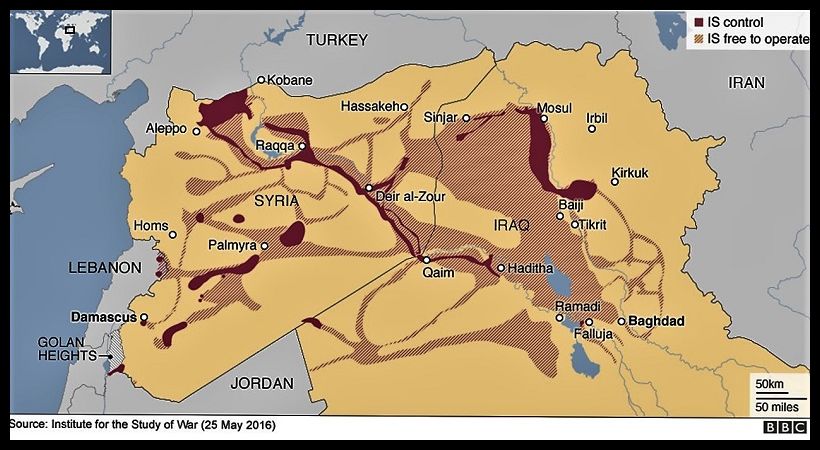
In Iraq, the effective territorial prominence of the Islamic State started in early 2014, when during its western Iraq offensive, a.k.a. as the Anbar offensive, the Islamic State was able to push Iraq’s government forces out of key Iraqi cities. After that offensive, on June 10, 2014, the group captured Mosul, a city home to 2.5 million people and a relevant center for crude oil production located in northern Iraq. In Syria, during the Syrian Civil War, in 2013, the city of Al Raqqah was captured by the Islamic State, which in 2014 made this city its headquarters in Syria. Raqqah is the de facto capital of the territory under Islamic State’s control in Iraq and Syria. In brief, the Islamic State currently controls a vast area straddling between eastern Syria and western Iraq. In specific, the Islamic State controls vast areas of the following governorates:

  • in Syria: Aleppo, Al Raqqah, Deir ez-Zour, Homs, and Rif Dimashq

  • in Iraq: Al Anbar, Saladin, Kirkuk and Nineveh

BACCI-The-IS-Oil-Industry-Is-a-Pipe-Dream-July-2016(1)

Theoretically, approximately 10 million people should live in the Islamic State-controlled territory in Iraq and Syria — exactly twice as much the population of the Kurdistan Regional Government (the K.R.G.), which according to K.R.G. cabinet sources stands at 10.2 million people. It’s important to understand that both in Iraq and Syria there are large swaths of territory where, although it does not have direct control, the Islamic State is completely free to operate. According to U.N. reports, 4.8 million Syrians have been forced to flee abroad, primarily to Turkey (2.7 million) and Lebanon (registered 1 million but the refugees are probably 1.5 million exerting a huge impact on the already not brilliant Lebanese economy). In Iraq, still according to U.N. data, there should be more than 3 million people who are now internally displaced.

Since its apogee in the summer of 2014, the Islamic State has lost around 40 percent of its territory in Iraq and 10 to 20 percent of its territory in Syria. According to the latest U.S. intelligence estimates, the present number of Islamic State recruits is put at 25,000; indeed, there has been a consistent decline in the number of recruits over the previous months, although in light of the contingent situation in both Iraq and Syria, these statistics are not a 100 percent reliable. A total of 25,000 Islamic State fighters have been killed by the U.S.-led airstrikes in the region. But, unless Western countries decide to scale up their intervention, with all the unknown possible outcomes that may derive from a Western presence on the ground, reconquering the lost cities in Iraq is a very lengthy process. For instance, Ramadi, in Iraq, was reconquered by Iraq’s government forces only after an offensive that lasted several months. In Syria, where getting some sense of the civil war, an ongoing multi-sided armed conflict with international interventions, is even more complicated, trying to stabilize the country is right now almost an impossible task.

Is the Islamic State Rich? It Depends From What It Means to Be Rich  

It goes by itself that the Islamic State needs money in order to:

  • fight in Iraq and Syria

  • manage the territory it controls in Iraq and Syria

  • conduct terrorist attacks in other countries

The difference between the Islamic State and some other terrorist groups is that it controls a vast territory. And from this territory, it derives several revenue channels. It is on a grand scale a replica of what happens in some cities across the globe (for instance, Caracas, San Pedro Sula, San Salvador) where the police do not dare to enter some neighborhoods because it would be outgunned — in other words in these cities as well as in the Islamic State-controlled territory the official rule of law is not applied. Having a precise estimate of the Islamic State’s revenues is not easy because these local revenue channels may vary consistently from month to month. At the time of this writing, three are the most important sources of revenue: taxes and property confiscation (together around 50 percent), and the sale of crude oil (43 percent). The latter was initially the most important of the Islamic State’s revenues. Other sources of financing are the sale of antiquities, drug smuggling, banks reserves, ransom for hostages, and donations. When the Islamic State conquered Mosul, it found something like half billion dollars in the Mosul branch of Iraq’s Central Bank, but of course this was a one-time revenue source.

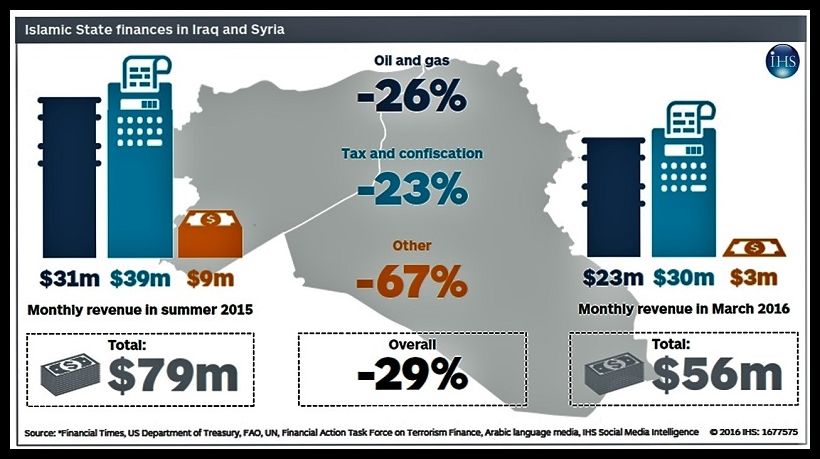
According to the Rand Corporation, a U.S. policy think tank, in late 2008 and early 2009, the Islamic State earned around $1 million per day, while in 2014 it was able to collect an amount ranging from $1 million to $3 million per day. So, assuming that the Islamic State is able to collect $3 million per day, this is equivalent to $90 million per month (best case scenario for the terrorist group). But, these estimates are too optimistic. In fact, I.H.S., a consultancy, reported that as of March 2016, the Islamic State’s revenue per month experienced a 30 percent decrease to $56 million from a value of $80 million per month in mid-2015.

BACCI-The-IS-Oil-Industry-Is-a-Pipe-Dream-July-2016(2)


These numbers tell us one main thing: $56 million per month, but it would be the same if the Islamic State still collected $90 million, is a high amount of money in order to carry out terrorist operations around the world, but it is absolutely insufficient in order to run a territory that the Islamic State would like to transform into a fully fledged country. Managing a territory is a much more complex and expensive task. For instance, the K.R.G.’s population is practically half the Islamic State’s population. And, the Kurdish government estimates that to manage the K.R.G., an autonomous province within Iraq, it needs $850 million to $1 billion per month, which should be equivalent to the 17 percent of the federal budget. The Iraqi Constitution assigns 17 percent of the federal budget to the K.R.G. Today, between Erbil and Baghdad there is again a strong confrontation as for the distribution of the revenue obtained from selling the K.R.G.’s and Iraq proper’s oil via the Kurdish pipeline — in March 2016, Iraq’s central government decided to stop its oil exports via the Kurdish pipeline system (more details below) because of disagreements with the K.R.G. on oil revenues. In both the K.R.G. and Iraq proper, under the current strained circumstances (a war against the Islamic State, low oil prices, and 3 million of internally displaced people), it’s quite improbable that the budget may permit Baghdad to transfer $1 billion a month to Erbil, but at least it gives us an idea of the financial burden required to run a country of 5.2 million people in that area of the Middle East — although it’s true that geography of the K.R.G and that of the Islamic State territory is quite different (mountain vs. desert plain). The fact that, in 2015, the Islamic State approved a budget of $2 billion confirms that its revenues are not comparable to the revenues of a standard country.

So the real question is whether the Islamic State has abundant economic resources to at least barely run a territory spanning between Iraq and Syria. And the answer is no. The economic means that it has right now at its disposal are absolutely not sufficient. Resorting to terrorism — although a constant in Iraq’s life after the fall of Saddam Hussein — is a manifestation of a weak position versus adversaries more powerful; adversaries who cannot be won in an open political confrontation or in a fight according to international humanitarian law (I.H.L.), a.k.a., jus in bello.        

In addition to these economic considerations, after the immediate fall of Saddam Hussein and during the years of Nouri Al Maliki’s government (2006-14), the Islamic State partially found fertile ground in Iraq thanks to the disenfranchisement of the Iraqi Sunni population, around 35 percent of Iraq’s population — an important caveat: some Sunni groups helped the invasion of Iraq by the Western powers, but later they were never rewarded for their help by the new Iraqi administration. Instead, during Saddam Hussein’s period, Sunnis were the majority of the Ba’athist government and enjoyed a special treatment. In brief, today the economic conditions of most Sunnis in Iraq are at the root of their support for the Islamic State. In fact, apart from some areas in Baghdad and the city of Mosul, most of Iraq’s Sunnis are farmers, who have been hit hard by the poor harvests and food shortages of the last years — in Iraq, after 2003, agricultural productivity declined by 90 percent. In other words, poverty and political marginalization pushed many Sunnis toward the Islamic State. In the Middle East, the identitarian affiliation has always been a very powerful political tool. Especially when life is harsh and the future is bleak, the normal behavior is to more tightly embrace one’s identitarian affiliation, no matter whether the basic ideology is not supported a 100 percent. This is exactly what happened between the disenfranchised Sunnis and the Islamic State ideology.

The Islamic State and the Sale of Crude Oil

As mentioned above, the Islamic State obtains half of its revenues from taxation and confiscation in the territory it controls. It’s evident that the wider territory it controls and the more people live in that territory, the higher are the rents for the Islamic State. Over the last year the Islamic State has lost ground in both Iraq and Syria, so it has now a reduced taxable base. Despite the importance of taxation and confiscation, I would like to develop some considerations on the relation between the Islamic State and the sale of crude oil. The reason behind this choice is that last fall during my conversation with the film director a lot of attention was given to the flow of revenues the Islamic State obtains from crude oil sales — in addition to this, I am a petroleum consultant (legal and fiscal issues), while I do not know much about selling antiquities, smuggling drugs and so on.

A petro-state is a country that depends on petroleum for:

  • 50 percent or more of export revenues

  • 25 percent or more of G.D.P.

  • 25 percent or more of government revenues

Under this definition, the Islamic State may well be defined as a petro-state. Putting aside considerations about whether it’s good for a country to be a petro-state (also the well managed Norway is a petro-state), the real issue is that the Islamic State is a “very poor” petro-state. In other words, its petroleum revenue is insufficient to administer the territory it controls. Revenues are insufficient today, when the Islamic State approximately produces 21,000 bbl/d, and were insufficient in 2014 and 2015 when its production was higher — in August 2014, before the beginning of the U.S. airstrikes production hovered around 70,000 bbl/d.

For the petroleum industry, the advance of the Islamic State has created a lot of economic damage, especially in Iraq — Syria is today a minor oil producer at the world level. Luckily the Islamic State has completely been unable to reach two out three of Iraq’s main oil-producing areas, i.e., southern Iraq and the K.R.G. The third area, Kirkuk Province, sees the presence of both Kurdish forces and Islamic State forces, but the most important oil fields, technically still under federal jurisdiction, are under Kurdish control. As a result of the presence of the Islamic State in central and western Iraq, the Kirkuk-Ceyhan pipeline has in operation only the section related to the Turkish part from Fishkhabur (Iraq-Turkey border) to the port city of Ceyhan in Turkey. The Iraqi section of the Kirkuk-Ceyhan pipeline (from Kirkuk to Fishkhabur) has been out of service since March 2014 as a consequence of repeated militant attacks. In fact, this pipeline runs through Islamic State-controlled territory. So, since May 2014, the K.R.G. has been exporting its crude oil to Turkey via its new Kurdish pipeline system, which is connected to the Turkish section of the Kirkuk-Ceyhan pipeline. This new Kurdish pipeline system was then expanded from Khurmala to the Avana dome in the Kirkuk area with the express goal of facilitating export from the Makhmour, Avana and Kirkuk area fields. In fact, these fields had been unable to export since March 2014 because the standard Kirkuk-Ceyhan pipeline had been damaged by the Islamic State.

BACCI-The-IS-Oil-Industry-Is-a-Pipe-Dream-July-2016(3)


In the territory the Islamic State has conquered in both Iraq and Syria, it has the control of practically all the oil fields and the related infrastructure, but it may use them only in a very limited way. In fact, since August 2014, the U.S.-led airstrikes have consistently reduced oil extraction inflicting a lot of damages to the oil industry. In specific, Operation Tidal Wave II, a U.S.-led military operation that started at the end of October 2015, targeted oil transport, refining and distribution facilities and infrastructure under the Islamic State control. According to the U.S. forces, in just two months, Operation Tidal Way II destroyed 90 percent of the Islamic State’s oil production. In addition to this, the Islamic State has also to face the difficulty of substituting aging as well as broken infrastructure. Similarly, it is not easy to find engineers and technicians able to operate the oil fields — the call for recruiting these types of professionals started immediately during the advance of the spring/summer of 2014. The way the group managed the Baiji refinery, which is 130 miles north of Baghdad, well testifies to these difficulties. The refinery had a capacity of 170,000 bbl/d and supplied petroleum products for northern Iraq. After the Islamic State captured the refinery in June 2014, the refinery started to produce only a fraction of its rated capacity because of lack of personnel and oil supply — Iraqi forces retook the refinery five months later.

BACCI-The-IS-Oil-Industry-Is-a-Pipe-Dream-July-2016(4)


As mentioned above, the Islamic State is experiencing a reduction in its overall oil production. It’s currently producing around 21,000 bbl/d. It’s quite evident that in order to move this oil the Islamic State has to use exclusively trucks. But shipping oil by truck is an expensive means, especially when oil prices are low. Tank trucks are described by their size or volume capacity. Large trucks typically have a capacity ranging from 20,800 liters to 43,900 liters. The present capacity of the Islamic State could be moved with as many as 76 43,900-liter tank trucks.

Furthermore, in light of its illegality, this oil has necessarily to sell at a discount. As a means of comparison, last year when prices averaged $52 a barrel, the K.R.G. was able to cash in $36 a barrel, while in February 2016, when Brent was $32 a barrel, the K.R.G. cashed in $20 a barrel. Of course, although in Baghdad someone might dissent on this point, for a potential buyer one thing is to buy from the K.R.G. and one completely different thing is to buy from a terrorist organization. In other words, the oil of the Islamic State should be consistently sold at an important discount in comparison to Brent. Reliable data are not available, but it has been reported that the Islamic State’s oil from Syria sold at as little as $18 per barrel when Brent sold at $107 per barrel.

In brief, part of the Islamic State’s oil is sold on the black market along the very much permeable borders between the Islamic State and the neighboring countries. The Islamic State primarily refines oil in small rudimentary mobile refineries having a capacity of 300 to 500 barrels per day. Also this refined oil is shipped to Turkey via truck, although some of this oil has been sold to the Syrian regime — pecunia non olet. Refining has always been a problem for the Islamic State because by October 2014, 50 percent of its refining capacity had been destroyed by the U.S.-led airstrikes. Moreover, in both Iraq and Syria, the Islamic State gets profits as well from selling oil to its captive markets at a price higher than the one obtained when exporting oil abroad. And in Iraq and Syria, people desperately need oil for their daily activities; in many areas diesel generators are essential because otherwise there would be no electricity. 

BACCI-The-IS-Oil-Industry-Is-a-Pipe-Dream-July-2016(5)


Conclusion

When assessing the Islamic State, the most important first step is to decide whether to consider it a state or a terrorist organization. If the Islamic State is state, it is indeed a poor and dysfunctional state. It may control a territory straddling between eastern Syria and western Iraq, but it will always be difficult for this hybrid state to consolidate its position. A state in order to thrive needs a functioning economy, which is something that the Islamic State completely lacks. Instead, its economy is a looting economy, i.e., an economy based on the indiscriminate taking of goods by force as part of its military victories. Continuing with looting activities (the present futile taxations based on the Islamic State-imposed new norms are nothing more than disguised looting) after several months is a clear sign that the Islamic State will never succeed in establishing a normal state. Instead, if the Islamic State is a terrorist organization, it is indeed a very rich organization in relation to its terrorist activities. Indeed, it’s an organization that has the economic capabilities of committing atrocities in several countries. Especially now, in light of the recent difficulties in the Iraqi theater, it is highly probable that Islamic State terrorists will continue to export to other countries the present Iraqi-Syrian mess. The oil business is a very complex and complicated business, so, since the beginning of its territorial expansion, it was out of question that the Islamic State, a terrorist organization, could have continued developing Iraq’s and Syria’s petroleum sector — this idea was already even more clear after the beginning of the U.S.-led airstrikes. In other words, from an economic point of view, the Islamic State may implement only one technique: pillaging.