Monday, September 14, 2009

Arabic Language in Damascus: A Natural Blend


September 14, 2009
DAMASCUS, Syria During the last few years, Syria has increasingly emerged as the most important cultural center for teaching Arabic. As a matter of fact, every Arab country uses two different languages: Modern Standard Arabic (M.S.A.) and colloquial Arabic. This phenomenon is called "diglossia" and consists of utilizing two forms, which sometimes are very different, of the same language according to context.

M.S.A. is used in journalism, in modern literature, on radio, on television and in formal occasions like conferences and official speeches. M.S.A. is based on Classical Arabic, which is also known to be the language used in the Koran as well as in many numerous literature texts of the Omayyad and Abbasid eras (between the 7th and 9th centuries A.D.). On the one side, differently from Classical Arabic, which today is a static language, M.S.A. is a living language and continuously evolves. Moreover, between Classical Arabic and M.S.A. there are lexical and stylistic differences. And differences exist regarding some language innovations on which the classic authorities have not ruled upon. On the other side, M.S.A. is identical from Morocco to Oman and therefore it allows a perfect understanding among people from different countries. If the native dialects of two educated Arabic speakers from two different countries are incomprehensible (for example: Moroccan colloquial and Levantine colloquial), the two speakers will revert to M.S.A. and they will perfectly understand each other. M.S.A. is also one of the six official languages of the United Nations (U.N.).

However, there is no colloquial Arabic language that works well from Casablanca, Morocco to Muscat, Oman. Indeed, we found a number of local dialects. Among these one of the closest dialects to M.S.A. is the Levantine dialect (Lebanon and Syria). It should be noted that there are many sub-dialects across the Levant (in Syria they are three) but the Levantine dialect permits an almost perfect understanding among people from Syria, Lebanon, Jordan and Palestine and even a good understanding with people from Egypt. Small problems begin to arise with the dialects of the Persian Gulf. But, also in this case, if a Levantine speaker may have some little understanding problems when dealing with the Persian Gulf dialects he may need just some time to be accustomed to different sounds — Gulf Arabs will immediately understand him. So, the Syrian-Lebanese colloquial Arabic is really a kind of passe-partout  valid for almost the entire Arab world, except for Morocco. Indeed between Syrian-Lebanese colloquial Arabic and M.S.A., there are differences especially in the usage of verbs (it’s very interesting the usage of the so called "helping verbs" in colloquial Levantine), but at the same time there are many vocabulary similarities allowing a student of Arabic to improve fast both M.S.A. and Levantine during a Damascene stay.

With reference to this point I want to debunk, once and for all, the bias that who wants to speak Arabic needs to decide whether learning M.S.A. or instead a dialect. In reality, it’s necessary to continue exercising both languages at the same time. Keeping going an everyday conversation in M.S.A. sounds really hilarious and deeply embarrasses the ears of native Arabs. Many of them might not even answer you. In addition to this, not being able to speak an Arabic dialect means losing everyday color and humor, which are present in songs, jokes, stories, films and in all the other aspects of popular culture.

My choice to come to Damascus prevailed over the option of going to Lebanon. In Beirut the Arabic dialect is very close to the dialect of Damascus, but in addition to Arabic a good part of Lebanese people speak English or French, if not both languages. Very often when a foreigner has some difficulties with Arabic, Lebanese people will immediately switch to English or French according to what their second language is. Syria has understood very well its language privilege and in the city of Damascus, many schools and centers that teach Arabic have sprung up in the last years. The main teaching centers are the University of Damascus (one-month courses), the Arabic Teaching Institute for Non-Arabic Speakers (three-month courses) and the French Cultural Center (much more expensive courses). These schools are perhaps a bit “messy”, because in the same classes there are students with very different Arabic skills, but in the end they really let you have a daily commitment of at least three hours, pushing the student to work with a language that especially in the beginning is very complex and has nothing in common with neo-Latin languages. Plus, a lot of Syrians offer to tutor students with face-to-face sessions for very reasonable prices. Some tutors are just offhanded professors who require cheap money, but that in the end do not teach well, while others are extremely well organized and allow students to get positive results in a short timeframe.

The motivations pushing students to enroll with the mentioned schools or private tutors are quite different as I have noticed myself. There are people who want to know Arabic for reading Quran and get closer to Islam, people who have to work with Arabic and, last but not least, (and this is not a small category) half-Syrian people (in general the father or the husband is Syrian) who want to learn Arabic because they do not want to lose their Arabic cultural heritage or because their family recently moved back to Syria.

The most difficult moment when studying Arabic when a lot of people quit studying is exactly at the beginning when students have to memorize a different alphabet, fresh sounds, unknown words and unheard grammatical constructions. But in the end, it’s living in Damascus that allows breaking the initial barrier, which is always present when the studied language does not have any overlapping points with students’ mother tongue. The key ingredient to speak Arabic after few months is mixing lectures in school, sessions with private tutors, radio, television and street chats. And in the end, as people say in Middle East, Inshallah (God willing) students will speak Arabic. 

Lingua Araba a Damasco: un connubio pressoché naturale


14 settembre 2009

DAMASCO, Siria Negli ultimi anni la Siria sta emergendo sempre di più come il centro culturale per eccellenza per l’insegnamento della lingua araba. In ogni paese arabo si utilizzano due lingue a seconda del contesto in cui si opera: l’arabo standard e l’arabo colloquiale. Questo fenomeno si chiama diglossia e consiste nell’uso di due distinte varietà anche molto differenti  dello stesso linguaggio generalmente in due diversi contesti.
 
L’arabo standard (Modern Standard Arabic, M.S.A.) è quello che viene utilizzato nella stampa, nella letteratura moderna, alla radio, alla televisione e in occasioni formali come discorsi ufficiali e conferenze. Esso si basa sull’arabo classico chiamato anche arabo Coranico che è quel linguaggio utilizzato dal Corano come anche in numerosi testi letterari del periodo Umayyade e Abbaside (dal settimo al nono secolo D.C.). Però a differenza dell’arabo classico, oramai una lingua statica, l’M.S.A. è una lingua viva e dunque in continua evoluzione. Inoltre, fra arabo classico e M.S.A. vi sono differenze di carattere lessicale, stilistico e in riferimento ad alcune innovazioni non regolate dalle autorità classiche. L’M.S.A. è identico dal Marocco all’Oman e quindi permette una perfetta comprensione fra persone provenienti da paesi diversi. Nell’eventualità di una conversazione fra due persone arabe di buon livello culturale e di differenti nazionalità nel caso in cui i dialetti rispettivi risultino incomprensibili (per esempio arabo colloquiale marocchino con arabo colloquiale siriano-libanese) queste due persone saranno in grado di passare all’M.S.A. e di comprendersi perfettamente. L’M.S.A. è inoltre una delle sei lingue ufficiali delle Nazioni Unite.
 
Invece non esiste una lingua colloquiale araba che vada bene da Casablanca(Marocco) a Muscat (Oman). Infatti si riscontrano tutta una serie di dialetti locali di cui quello più simile all’arabo standard o M.S.A. è quello definito grosso modo come siriano-libanese. Questo dialetto (va detto però che già all’interno della Siria vi sono almeno tre sottodialetti) permette inoltre una pressoché perfetta comprensione fra persone provenienti da Siria, Libano, Giordania e Palestina e un’ottima comprensione con persone provenienti dall’Egitto. Dei problemi iniziano a sorgere con i dialetti del Golfo Arabo. Però anche in questo caso bisogna notare che se da un lato un interlocutore che parli il dialetto siriano-libanese avrà qualche difficoltà iniziale a comprendere i dialetti del Golfo e necessiterà di un pò di tempo per adattarsi, dell’altro lato egli verrà quasi interamente compreso sin dall’inizio da un abitante del Golfo. L’arabo colloquiale siriano-libanese, dunque, è una sorta di passpartout valevole per quasi tutto il mondo arabo, Maghreb escluso.
 
Infatti fra arabo colloquiale siriano-libanese e M.S.A. vi sono delle differenze nell’utilizzo dei verbi (interessante l’utilizzo dei cosiddetti “helping verbs” nel colloquiale) però vi sono anche moltissime analogie a livello di vocabolario che permettono di portare avanti nello stesso tempo ambedue le varietà di lingua araba durante un soggiorno damasceno. A questo riguardo bisognerebbe sfatare una volta per tutte il preconcetto che chi vuole parlare arabo debba decidere se imparare l’M.S.A. oppure il dialetto. In realtà, è necessario ed è altamente consigliabile di portarli avanti ambedue nello stesso tempo. Pensare di sostenere una conversazione inerente la vita di tutti i giorni in M.S.A. apparirà come una cosa ilare e fortemente impacciata alle orecchie di tutti i nativi arabi e molti di loro non risponderanno neppure. Inoltre, non parlare un dialetto significa invariabilmente perdere il colore, lo humor del linguaggio della vita di tutti i giorni presente in canzoni, barzellette, storie, film e tutti gli altri aspetti della cultura popolare.
 
Nel mio caso la scelta di venire a Damasco ha prevalso sulla possibilità di andare in Libano A Beirut  dove il dialetto locale è pressoché lo stesso di Damasco  buona parte della popolazione parla in aggiunta all’arabo inglese oppure francese se non un po’ di tutti e due. Spesso e volentieri quando uno straniero avrà delle difficoltà a parlare arabo l’interlocutore locale cambierà immediatamente lingua passando all’inglese oppure al francese a seconda del caso.
 
La Siria ha compreso molto bene questo suo privilegio di carattere linguistico e nella città di Damasco sono sorti molti centri dove è possibile effettuare dei corsi di arabo. E similmente moltissimi siriani si offrono come tutori linguistici face-to-face per cifre molto basse. Le principali scuole sono l’Università di Damasco (corsi di un mese), lo Arabic Teaching Institute for Non-Arabic Speakers (corsi di tre mesi) e il Centro Culturale Francese (quest’ultimo molto più caro). Queste scuole forse  anche in base alla mia personale esperienza  sono un po’caotiche però permettono veramente di avere un impegno quotidiano di almeno tre ore che spinge lo studente a lavorare in una lingua che specialmente all’inizio è molto complessa senza punti di contatto con le lingue neo-latine. Ugualmente con i tutori privati va posta un po’ di attenzione nella scelta. Alcuni sono professori improvvisati che prendono poco ma rendono anche poco, altri invece sono estremamente organizzati e permettono di ottenere ottimi risultati in poco tempo.
 
Le motivazioni che spingono gli studenti a registrarsi presso le scuole o con dei tutori privati sono le più varie come ho potuto constatare io stesso. Si passa da persone che vogliono studiare l’arabo per poter leggere il Corano e che vogliono avvicinarsi sempre di più alla religione musulmana, a persone che invece in futuro dovranno lavorare con la lingua araba, a persone – e questa categoria non e’ piccola - che hanno un componente della famiglia siriano (primariamente il padre oppure il marito) e che vogliono imparare l’arabo per non dissipare un patrimonio culturale presente in famiglia oppure perché si sono trasferiti da poco in Siria.
 
Con l’arabo il momento più difficile, quando molte persone si “arrendono”, è proprio all’inizio, quando uno studente si trova a confrontarsi con un alfabeto differente, con suoni differenti, con parole differenti e con costruzioni grammaticali differenti. In ogni modo è il vivere a Damasco che permette di rompere quella barriera iniziale che esiste sempre quando vi sono scarsi punti di contatto fra una lingua di partenza ed un’altra. E’ il mix di lezioni scolastiche, tutori privati, radio, televisione e chiacchiere di strada che rende possibile dopo qualche mese fare un certo salto di qualità ed iniziare a parlare arabo. E poi, come si dice da queste parti, “se Dio vorrà”alla fine lo studente parlerà arabo.


Wednesday, March 18, 2009

Europe and the Recession


Will the recession do more to divide or unite Europe?
 
March 18, 2009


FLORENCE, Italy  It seems very plausible that during 2009 Europe will face a huge economic downturn with G.D.P. tumbling by 3.6 percent (according to Goldman Sachs, an international bank), while the German economy by far the most important economy at the E.U. level could plummet by 5.2 percent. In addition to these general very dark forecasts, until now it is not entirely understandable how to solve two disruptive issues that Europe has to confront right now: growing trade imbalances within the Eurozone and possible sovereign state defaults in Eastern and Central Europe.   

First, the growing trade imbalances within the Eurozone where the economically most vulnerable countries the so-called PIIGS (Ireland, Italy, Spain, Portugal and Greece) are considered to be more prone to undergoing an economic stagnation as a consequence of the current recession. These economic imbalances have already started to be evident since the middle of 2008 because of the spreads between the yields of German bunds and the yields paid by bonds emitted by PIIGS countries. The worst case scenario is to have one of the PIIGS countries forced to abandon the euro with all the consequences that such a move could mean for the future of the common European currency.
 
The second issue to be solved is linked to what is happening in Eastern and Central Europe where some sovereign states, like Hungary, Bulgaria, Romania and Latvia, really risk defaulting in the next months and where also other countries like the Czech Republic and Slovakia — which are in better economic conditions will be strongly touched upon by both the general economic recession and the dramatic situations of the surrounding countries. If one of these countries defaults also the eurozone could be brought down. At the moment it is understandable that the E.U. and the International Monetary Fund (I.M.F.) will provide financial help, but given the fact that serious risks of huge household defaults exist in Eastern and Central Europe, will both the E.U. and the I.M.F. be capable of injecting the required resources in order to avoid the default of sovereign states? There is no clear answer.

In other words, the situation is critical and it is quite interesting to try to investigate whether the recession could boost Europe’s unity or could rather be an instrument of division among the European countries such an instrument would indeed create fissures to the EU building. This recession could already have been for the E.U. a great opportunity probably for Europe in general to become a more integrated area. Last October, after the failures and the bailing-outs of many an international bank on both sides of the Atlantic Ocean it seemed that also in Europe there was a clear understanding among Europe's political key players (N. Sarkozy, G. Brown, A. Merkel) of the fact that global problems require collective solutions. Instead, after initial proposals regarding an extension of the field of action of the E.U. economic policy, Germany strongly rejected this possibility. Since then, all the attention has been given more to domestic interventions rather than to the implementation of collective E.U. actions. All this means that the indicators are not positive and that at the moment it is possible to have started a process that will continue to divide Europe rather than unify it. The economic crisis is a reality that cannot be avoided, but good E.U. economic politics could be the best tool to tackle it at three different levels: eurozone (16 countries), E.U. (27 countries), and European countries not included in the E.U. But could this be implemented in the next weeks? The answer is no.

In fact, Europe misses a class of national leaders seriously oriented towards the European idea. None of the political leaders of the E.U. most important countries, i.e., France, Germany, Italy and U.K., is entirely committed to the advancement of the E.U. In particular, there is not anymore a credible Franco-German axis, like the one that around 20 years ago at the time of Mitterand and Kohl was the real cornerstone of the European building. What is striking today is the position of the German Chancellor Angela Merkel, who does not understand that carving out just national solutions is not the right answer for Berlin. In fact, economic growth in Germany has become in the last years more reliant on exports than for the rest of the currency union. At the same time, Germany has continued to have a constant weakness in relation to its domestic demand. In other words, this means that the German economy is not well balanced and that its future possibilities are not extremely positive in reason of the current global recession that is investing also the Eurozone where are located the most important buyers of German products. The reasons for this position is probably linked to the fact that German politicians (like all politicians) have to respond to their constituencies. And these groups do not have a clear picture of the basic imbalances that have generated the current global economic turmoil, while they merely understand how to retrench their national economies domestically. This brings to another aspect, which is the widening gap between the E.U. institutions and the people of the countries members of the E.U. This trend had already emerged during the previous years and the vicissitudes of the Lisbon Treaty well exemplified it. What is happening now is only the following step.

The absence of politicians committed toward the European building is the real and most difficult hurdle to overcome in order to use this current global recession to unify in a better way Europe. On the one hand, it's true that  prospects are really grim. In Eastern Europe (Hungary, Czech Republic and Slovakia) it is already growing support for nationalistic movements some of them inspired by the Nazi-Fascist ideology — and, given the fact that for the whole 2009 the economic situation will continue to worsen, the outlook is depressing. On the other hand, there is a possibility that the economic recession could be used to unite Europe. In fact, if  the global recession really risked destroying the E.U., probably, such a scenario would force the E.U. technocrats, as well as the politicians of the member countries, first to understand that only a common action could save the European dream, and second to find a way to implement a reliable solution.


Sunday, March 1, 2009

The Integrated Framework: Institutional Conflict Over Mandate, Role and Responsibility


March 1, 2009

The-Integrated-Framework-Institutional-Conflict-Over-Mandate-Role-and-Responsibility-March-2009


BACCI, A., The Integrated Framework: Institutional Conflict over Mandate, Role and Responsibility in SANER, R. & MICHELUN, V., Negotiations between State Actors and Non-State Actors: Case Analyses from Different Parts of the World, 6 International Negotiation Series, Republic of Letters Publishing, Dordrecht, March 2009.


Monday, September 8, 2008

Possible Advantages & Disadvantages of G-8 Expansion


September 9, 2008

ABSTRACT
In the international relations arena there is an increasing debate about the possible advantages and disadvantages of expanding the Group of Eight (G-8). The aim of this article is after a brief historical introduction with reference to the G-8 and its role to try to understand the pros and cons of G-8 expansion in the light of the recent public debate.

Introduction
The group of the world's eight most industrialized countries includes Canada, France, Germany, Italy, Japan, Russia (only since 2006), the UK and the USA. Previously, Russia was admitted to the meetings of the then G-7 countries only as an observer. This forum was created in the 1970s and initially it brought together the governments of France, West Germany, Italy, Japan the U.S and the U.K. At that time, the world was partly trying to recover from the oil shock of 1973 and the following economic recession spurred by the huge increase in the price of oil. The idea of creating a group including the most industrialized countries was linked to the fact that it could be very helpful to cyclically have a forum where to discuss at the highest level about the international economic situation. It is important to understand that also today the G-8 is not an organization but a forum. The participation of Italy to the group was partially opposed in the 1970s by some other countries that were casting doubts about the stability and the results of the Italian economy.
   
The problem that has arisen since the last years is that the membership of the G-8 is not completely matching anymore all the real powerhouses of the world economy. This means that G-8 countries are without any doubt important economic players, but that in order to have a sound and complete discussion about the international economic trends new members should probably be added to the forum. Among them it goes by itself to mention China, India and Brazil, but others countries like Turkey, Indonesia, Mexico and South Africa could also be considered. In Paragraph 1 it will be discussed the advantages of extending the G-8 membership, while in Paragraph 2 it will be done an evaluation of the disadvantages of such an extension.


Paragraph 1  Advantages
As well as for some other international organizations (but I repeat the G-8 is not an international organization) the actual real risk for the G-8 is to lose legitimization if it does not increase its membership. Obviously, if G-8 meetings continue in the future to have a membership only partially covering the most important economic players the risk of losing legitimization will become a reality. The world economy is not anymore only driven by the U.S., Europe and Japan. Asia is economically speaking rising powerfully and the balance of power is moving from the Atlantic Ocean to the Pacific Ocean and the Indian Ocean. The advantages of an extended G-8 membership could well comply with the reason and the aim of this kind of forum. Similarly to the G-8, the I.M.F. (the International Monetary Fund) risks losing importance as well, if it does not restructure its voting structure. Given the fact that an increased membership is necessary for the G-8, the real issue is to understand how to reform it, i.e., to understand which country should be admitted.

This is the core of the problem. According to some analysts the G-8 should be transformed into a G-20 adding at least 12 more countries. But others speak of  a G-22 adding 14 new members. Probably, the right way to solve the problem could be to have a first extension of the membership adding those countries, like China and India, that already represent a big chunk of the world economy. Then, after this first extension, others could follow suit in the future when their economies will have increased their role with reference to the world economic trends. 
     
Paragraph 2  Disadvantages
The clear and obvious disadvantage of an increased membership is the possible slow motion of the decision-making procedures during the meetings of the new G-10 (G-20?, G-22?). Increasing the number of actors could block the discussions or bring about additional frictional topics among member states. For example, the admittance of Russia in the forum in 2006 created a shift of the discussed topics from mainly economics themes to geopolitical considerations given the new assertiveness of Russian internal and external politics (this shift happened well before the Russian intervention in Georgia). Another good example of the difficulties created by a broad membership, although in a different context, is the W.T.O., where since the inception of the Doha Round in 2001 the process has been blocked by the different positions expressed by the member states.

Another disadvantage for a G-8 expansion could be that an enlarged membership would probably require the transformation of this sort of forum, which is the actual G-8, into a real organization capable of coordinating meetings with more delegations, topics and possible political frictions among the involved member states. The forum would have to be transformed into a real organization with additional costs, which not all the countries want to sustain.  
 
Conclusion
All this said, according to the expounded analysis, the advantages of G-8 expansion well outweighs the disadvantages. Maintaining an economic forum that is not able anymore to represent the world economy is definitely useless. Similarly, other international organizations will necessarily change their membership and one of these is the I.M.F. In other words, with reference to the group of the most industrialized countries it is worth having a new forum with more actors where the decision-making process could be slow, but where, at least, the forum is a living body well representing today’s world.         


Saturday, May 31, 2008

Is the E.U. Energy Policy Reliable Facing the European Dependence on Russian Gas? — PowerPoint

BACCI-Is-the-E.U.-Energy-Policy-Reliable-Facing-the-European-Dependence-on-Russian-Gas-pptx-Cover-May-2008


May 2008

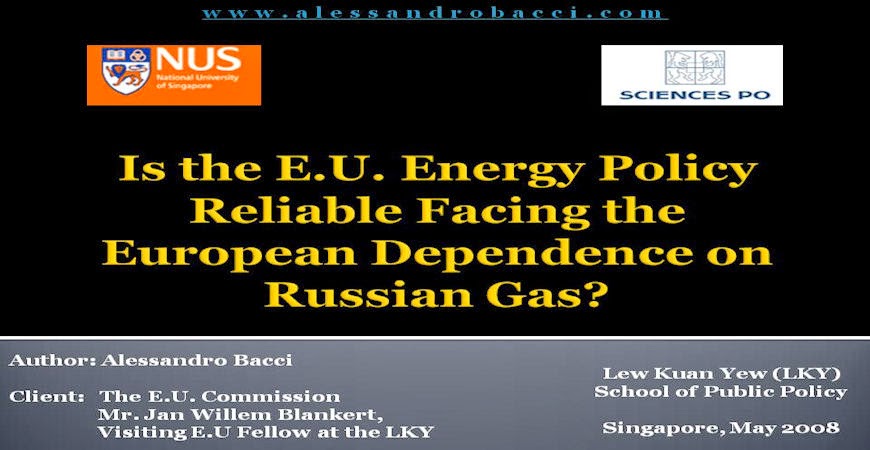
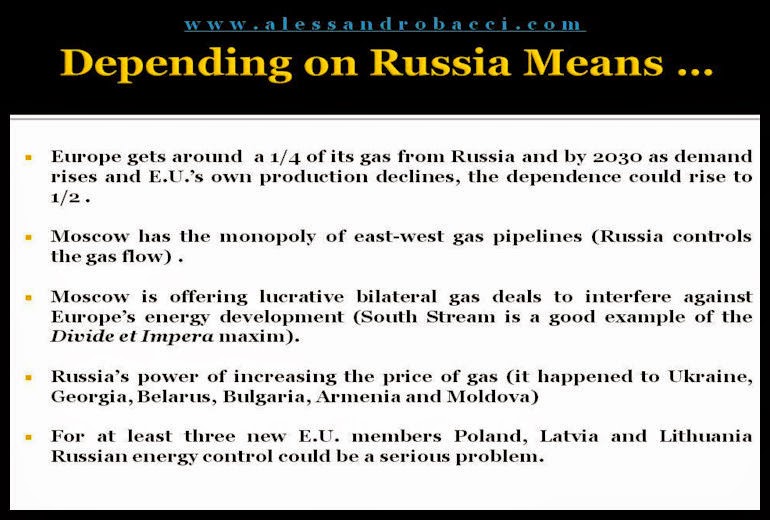
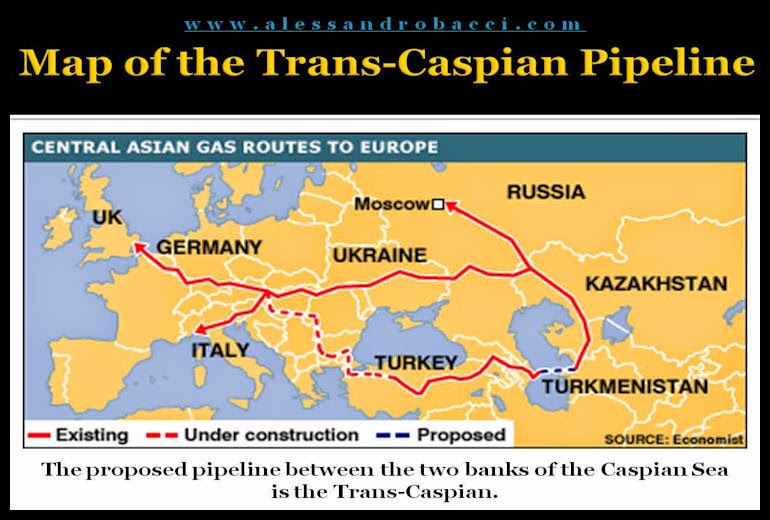
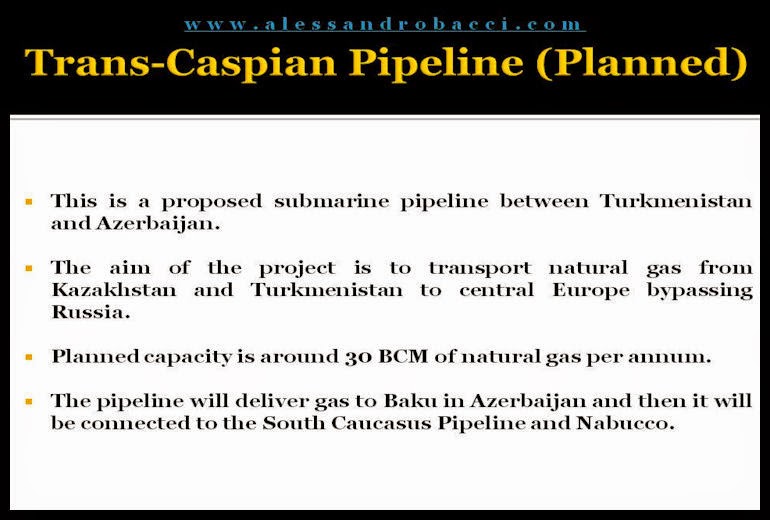
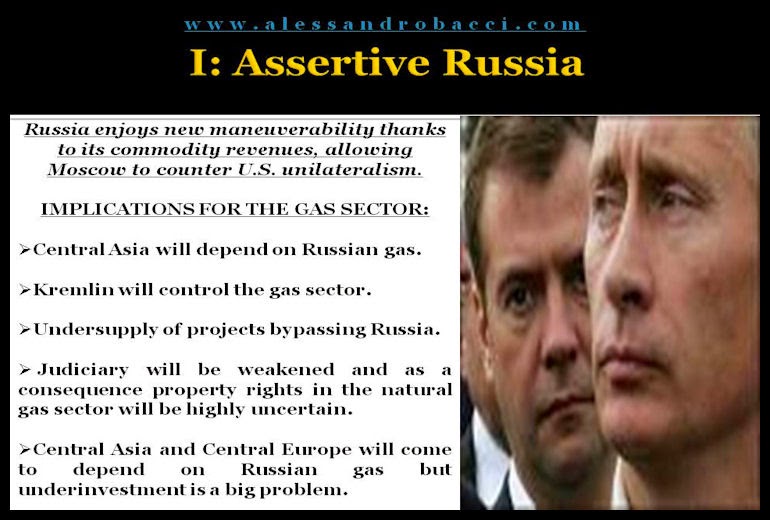
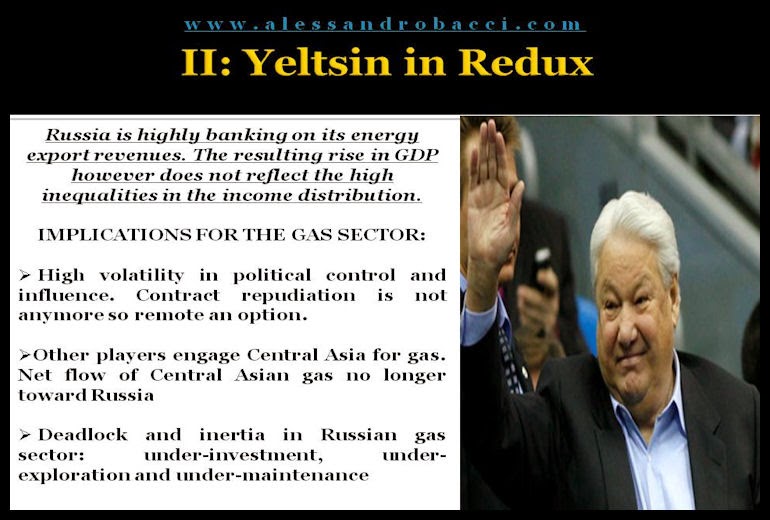
SINGAPORE — This PowerPoint analyzes the energy relations between the European Union (E.U.) and Russia. In specific, it aims to understand what policy the E.U. Commission could implement in order to deal with the E.U. dependence on Russian natural gas.

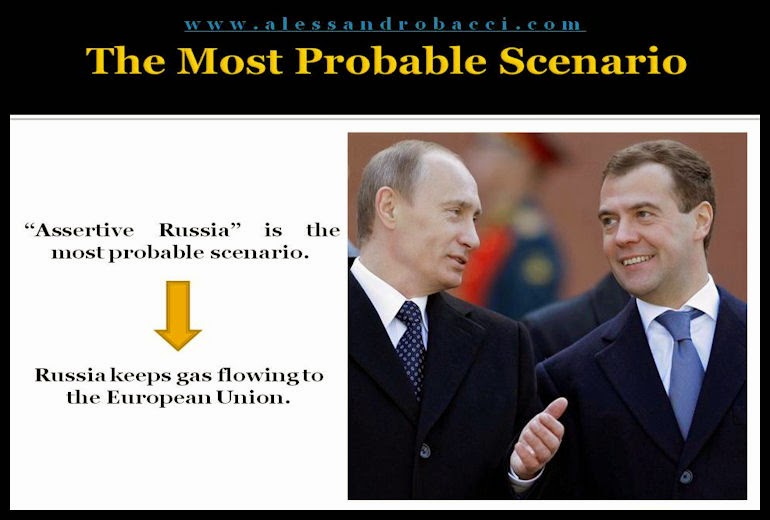
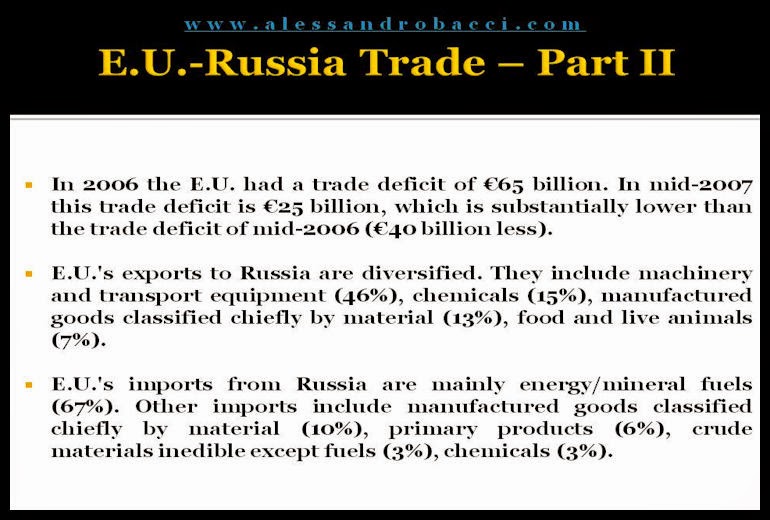
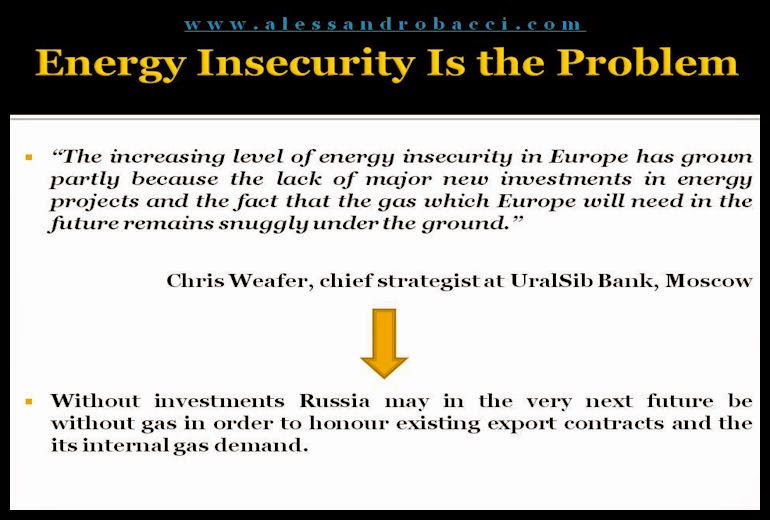
According to the latest figures the E.U. depends for around 25 percent of its gas requirements on Russia. And if the E.U. does not try to change this trend, in the following years it will really risk depending even more on Russia for its gas necessities. On the one hand, it is true that Europe has depended on Russian gas for at least the last four decades and that this relationship was never interrupted also during the worst frictions of the Cold War era. In other words, although some fears and panic subsequent to some specific events — like the Russia-Ukraine dispute between year-end 2005 and  beginning 2006 — the Soviet Union first, or Russia after 1991, has always been a reliable partner for the European gas necessities. But, in the future this policy may indeed result in at least important high costs while, in the eventuality of Russian failure to honoring its gas commitments towards the E.U., it could engender a real slowdown of the E.U. economic growth. On the other hand, it is also true that the economic exchange between Russian gas and European assets is billions of euro's worth and this economic relation is positive for both the E.U. and Russia.

In light of this condition, the policy recommendations of this document all point toward the E.U. goal of minimizing risks in relations to Russian gas imports.

This PowerPoint is the additional document to the final thesis I wrote and discussed at the Lee Kuan Yew School of Public Policy of the National University of Singapore where I completed a master's degree in public policy (M.P.P.) in 2008. The title of the thesis was: "Is the E.U. Energy Policy Reliable Facing the European Dependence on Russian Gas?"


BACCI-Is-the-E.U.-Energy-Policy-Reliable-Facing-the-European-Dependence-on-Russian-Gas-pptx-1-May-2008


BACCI-Is-the-E.U.-Energy-Policy-Reliable-Facing-the-European-Dependence-on-Russian-Gas-pptx-2-May-2008


BACCI-Is-the-E.U.-Energy-Policy-Reliable-Facing-the-European-Dependence-on-Russian-Gas-pptx-3-May-2008


BACCI-Is-the-E.U.-Energy-Policy-Reliable-Facing-the-European-Dependence-on-Russian-Gas-pptx-4-May-2008


BACCI-Is-the-E.U.-Energy-Policy-Reliable-Facing-the-European-Dependence-on-Russian-Gas-pptx-5-May-2008


BACCI-Is-the-E.U.-Energy-Policy-Reliable-Facing-the-European-Dependence-on-Russian-Gas-pptx-6-May-2008


BACCI-Is-the-E.U.-Energy-Policy-Reliable-Facing-the-European-Dependence-on-Russian-Gas-pptx-7-May-2008


BACCI-Is-the-E.U.-Energy-Policy-Reliable-Facing-the-European-Dependence-on-Russian-Gas-pptx-8-May-2008


BACCI-Is-the-E.U.-Energy-Policy-Reliable-Facing-the-European-Dependence-on-Russian-Gas-pptx-9-May-2008


BACCI-Is-the-E.U.-Energy-Policy-Reliable-Facing-the-European-Dependence-on-Russian-Gas-pptx-10-May-2008


BACCI-Is-the-E.U.-Energy-Policy-Reliable-Facing-the-European-Dependence-on-Russian-Gas-pptx-11-May-2008


BACCI-Is-the-E.U.-Energy-Policy-Reliable-Facing-the-European-Dependence-on-Russian-Gas-pptx-12-May-2008


BACCI-Is-the-E.U.-Energy-Policy-Reliable-Facing-the-European-Dependence-on-Russian-Gas-pptx-13-May-2008


BACCI-Is-the-E.U.-Energy-Policy-Reliable-Facing-the-European-Dependence-on-Russian-Gas-pptx-14-May-2008


BACCI-Is-the-E.U.-Energy-Policy-Reliable-Facing-the-European-Dependence-on-Russian-Gas-pptx-15-May-2008


BACCI-Is-the-E.U.-Energy-Policy-Reliable-Facing-the-European-Dependence-on-Russian-Gas-pptx-16-May-2008


BACCI-Is-the-E.U.-Energy-Policy-Reliable-Facing-the-European-Dependence-on-Russian-Gas-pptx-17-May-2008


BACCI-Is-the-E.U.-Energy-Policy-Reliable-Facing-the-European-Dependence-on-Russian-Gas-pptx-18-May-2008


BACCI-Is-the-E.U.-Energy-Policy-Reliable-Facing-the-European-Dependence-on-Russian-Gas-pptx-19-May-2008


BACCI-Is-the-E.U.-Energy-Policy-Reliable-Facing-the-European-Dependence-on-Russian-Gas-pptx-20-May-2008


BACCI-Is-the-E.U.-Energy-Policy-Reliable-Facing-the-European-Dependence-on-Russian-Gas-pptx-21-May-2008


BACCI-Is-the-E.U.-Energy-Policy-Reliable-Facing-the-European-Dependence-on-Russian-Gas-pptx-22-May-2008


BACCI-Is-the-E.U.-Energy-Policy-Reliable-Facing-the-European-Dependence-on-Russian-Gas-pptx-23-May-2008


BACCI-Is-the-E.U.-Energy-Policy-Reliable-Facing-the-European-Dependence-on-Russian-Gas-pptx-24-May-2008


BACCI-Is-the-E.U.-Energy-Policy-Reliable-Facing-the-European-Dependence-on-Russian-Gas-pptx-25-May-2008


BACCI-Is-the-E.U.-Energy-Policy-Reliable-Facing-the-European-Dependence-on-Russian-Gas-pptx-26-May-2008


BACCI-Is-the-E.U.-Energy-Policy-Reliable-Facing-the-European-Dependence-on-Russian-Gas-pptx-27-May-2008


BACCI-Is-the-E.U.-Energy-Policy-Reliable-Facing-the-European-Dependence-on-Russian-Gas-pptx-28-May-2008


BACCI-Is-the-E.U.-Energy-Policy-Reliable-Facing-the-European-Dependence-on-Russian-Gas-pptx-29-May-2008


BACCI-Is-the-E.U.-Energy-Policy-Reliable-Facing-the-European-Dependence-on-Russian-Gas-pptx-30-May-2008


BACCI-Is-the-E.U.-Energy-Policy-Reliable-Facing-the-European-Dependence-on-Russian-Gas-pptx-31-May-2008


BACCI-Is-the-E.U.-Energy-Policy-Reliable-Facing-the-European-Dependence-on-Russian-Gas-pptx-32-May-2008


BACCI-Is-the-E.U.-Energy-Policy-Reliable-Facing-the-European-Dependence-on-Russian-Gas-pptx-33-May-2008
 

BACCI-Is-the-E.U.-Energy-Policy-Reliable-Facing-the-European-Dependence-on-Russian-Gas-pptx-34-May-2008


BACCI-Is-the-E.U.-Energy-Policy-Reliable-Facing-the-European-Dependence-on-Russian-Gas-pptx-35-May-2008